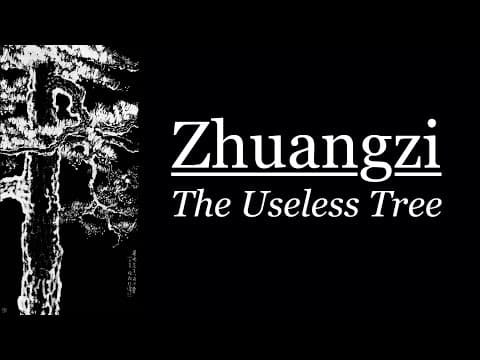
Zhuangzi's parable of the Useless Tree explores the theme of relativism in value judgments, contrasting the perceived worth of utility against the benefits of uselessness. Through the encounter between Craftsman She and the tree, the story reveals how societal standards of usefulness can lead to exploitation, while embracing uselessness can foster true flourishing and longevity.
Within the classical Chinese text, the Zhuangzi, there exists a motif of a large but seemingly useless tree. This tree introduces us to several profound ideas, the most notable being a perspective-driven relativism that challenges conventional value standards by asserting the great use of uselessness. This paradoxical idea holds modern significance, as explored in this analysis of the tree's encounter with Craftsman She.
The story begins with Craftsman She traveling to Chi. Upon arriving at a shrine, he notices an enormous oak tree, large enough to shade thousands of oxen and tall enough to overlook mountains. Despite its impressive size, Craftsman She continues on his journey without a second glance, much to the surprise of his apprentice, who is captivated by the tree's beauty.
The apprentice, having followed Craftsman She with an axe in hand, expresses his astonishment at the tree's potential for timber. He questions why Craftsman She, a skilled woodworker, would ignore such a magnificent specimen. Craftsman She responds with a harsh critique, declaring the tree to be useless. He explains that any product made from its wood—be it a ship, coffin, instrument, or door—would ultimately fail. The tree's lack of utility, he argues, is precisely why it has survived so long.
Later, Craftsman She dreams of the tree, which questions his judgment. The tree contrasts itself with adorned trees that bear fruit, suggesting that their utility leads to their exploitation and premature demise. In its quest for uselessness, the tree has achieved a long life, free from the abuses that befall more useful trees.
The tree articulates a critical insight: being useful often entails being abused. The adorned trees, while valuable for their fruit or timber, suffer from the very qualities that make them desirable. They are cut down, stripped of their branches, and ultimately destroyed by the very conventions that society praises. In contrast, the tree's uselessness allows it to flourish, untouched by the hands of those who seek to exploit it.
Craftsman She’s perspective is rooted in conventional standards of worth, where utility equates to value. This perspective is not uncommon in modern society, where business decisions prioritize profit and efficiency. Educational programs in the humanities often face cuts due to perceived lack of utility, reinforcing the notion that only what is useful is worthy of support.
The tree's words challenge the authority of utility as a measure of worth. It highlights the relativism inherent in value judgments, suggesting that what is deemed useful or worthless can shift dramatically based on perspective. The tree's scattered form, which renders it useless in the eyes of the woodworker, is precisely what allows it to thrive.
The relevance of this parable extends beyond the natural world. In contemporary society, individuals often find themselves valued solely for their utility, leading to feelings of worthlessness when they cannot produce. The relentless pursuit of productivity can result in exhaustion and exploitation, mirroring the fate of the adorned trees.
The parable prompts us to reconsider how we assess worth in ourselves and others. The authority of utility can lead to harmful judgments, reducing individuals to mere resources. The tree's perspective encourages a reevaluation of what it means to be valuable, suggesting that embracing one's inherent qualities, rather than conforming to societal expectations, can lead to genuine flourishing.
In conclusion, Zhuangzi's parable of the Useless Tree serves as a profound commentary on the nature of value and the dangers of utility. By presenting a tree that thrives in its uselessness, the story invites us to reflect on our own lives and the societal pressures that dictate our worth. It challenges us to recognize that true value may lie not in what we can produce, but in simply being ourselves, free from the constraints of conventional judgments. The tree's wisdom reminds us that sometimes, being good for nothing can be the greatest gift of all.