Thomas Hobbes' social contract theory posits that moral and legal rules arise from a collective agreement to escape the chaotic state of nature, characterized by fear and violence. Morality is framed as self-interest in maintaining society. The theory faces criticisms regarding its reduction of morality to self-interest, its portrayal of human nature, and its applicability to all individuals, yet remains a powerful framework for understanding the origins of moral rules.
This article explores the social contract theory of Thomas Hobbes, a foundational concept in ethics and political philosophy. Hobbes' theory provides a compelling explanation for the origin of moral and legal rules, grounded in the human desire to escape the chaotic and dangerous "state of nature."
In his 1651 work Leviathan, Hobbes asks us to imagine a state of nature where no legal or moral rules exist. In this state, every individual has the ability to kill others and competes for limited resources such as food and shelter. This leads to a constant state of war, where fear, violence, and distrust dominate.
Hobbes vividly describes this state as one where:
He famously characterizes life in this state as "solitary, poor, nasty, brutish, and short."
To escape this grim state, Hobbes argues that humans must come together to create moral and legal rules through a social contract. This contract involves individuals agreeing to give up certain liberties, such as the liberty to kill others, in exchange for the benefits of civilization and social living.
The social contract establishes:
This framework suggests that rational, self-interested individuals (ethical egoists) should follow these rules because it is in their self-interest to do so.
Hobbes' revolutionary idea is that morality is not divine or heavenly but is instead a set of rules created to maximize self-interest. The general flourishing of society leads to individual flourishing—a rising tide lifts all ships.
Morality, therefore, is both invented and discovered. Cultures create various rules, but only those that promote human flourishing endure. This dual nature is analogous to inventing different types of wheels and discovering that the circular wheel works best.
Social contract theory provides tools to evaluate moral practices across cultures. For example, James Rachels uses it to justify civil disobedience, such as Martin Luther King Jr.'s nonviolent protests. According to the theory, individuals are obligated to obey laws only when they receive societal benefits in return. When groups are denied these benefits, they are released from the contract and justified in protesting.
Rachels states that civil disobedience is a natural and reasonable means of protest for disadvantaged groups denied the benefits of social living.
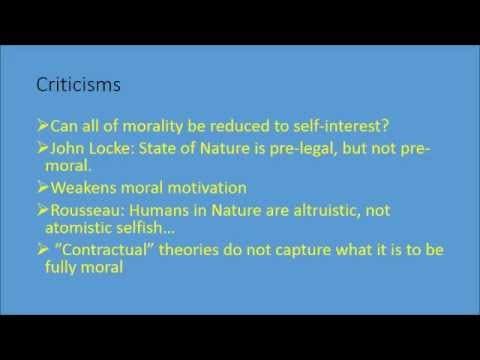
Despite its strengths, social contract theory faces several criticisms:
The theory reduces morality to self-interest, but some moral acts, such as saving others at personal risk, seem to transcend self-interest. Hobbes might respond that altruistic behaviors develop only after living in society, arising from self-interest in social living.
John Locke argued that the state of nature is pre-legal but not premoral. People have natural moral rights before governments exist, based on natural laws and divine authority. Governments exist to protect these rights, not create them. This view influenced the United States Declaration of Independence.
Social contract theory may allow individuals to justify immoral acts if they believe such acts do not threaten society. For example, cheating might be rationalized if it does not lead to societal collapse, which challenges the theory's ability to fully motivate moral behavior.
Hobbes portrays humans as isolated and selfish in the state of nature. Critics like Rousseau argue that humans are naturally altruistic and live harmoniously in small communities with abundant resources. The formation of property and contracts may corrupt this natural morality.
Feminist critiques, such as those by Carol Gilligan, argue that the contract model focuses on rights and obligations but neglects the relational and caring aspects of morality. A fully moral person recognizes dependence on others and acts altruistically beyond self-interest.
The social contract assumes rational individuals consent to rules, but groups like infants, animals, or mentally impaired individuals cannot consent. This raises questions about their moral inclusion and the theory's comprehensiveness.
Consent to the social contract is complex. Does continuing to live in a country imply consent to its laws? This remains a topic of philosophical debate.
Some argue that because there is no actual physical contract, social contract theory is false. However, the theory is better understood as an implicit agreement explaining the origin and purpose of moral and legal rules.
Thomas Hobbes' social contract theory offers a powerful framework for understanding why morality and legal rules exist: to escape the dangerous state of nature and promote human flourishing through self-interest. While it has notable weaknesses and faces significant criticisms, it remains a foundational theory in ethics and political philosophy.
Reflecting on these questions can deepen your understanding of social contract theory and its implications for morality and society.