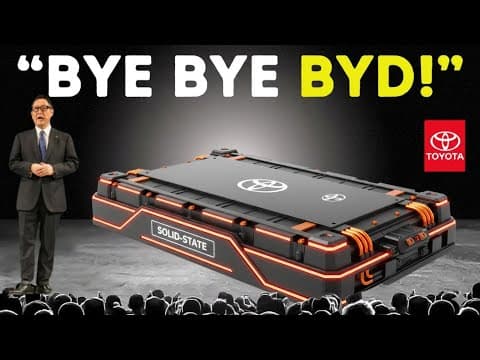
Toyota's upcoming solid-state battery promises over 1,000 kilometers on a single charge, potentially reshaping the EV landscape and challenging Tesla's dominance. With rapid charging and enhanced safety, this technology could redefine consumer expectations and accelerate the shift to electric vehicles.
Imagine a battery that can run for more than 1,000 kilometers on a single charge, unaffected by extreme temperatures or rough terrains. This is not a fantasy; it is the reality that Toyota claims its upcoming solid-state battery will achieve, sending shockwaves through the electric vehicle (EV) industry. As Tesla promotes its 4680 cells, emphasizing performance and power, Toyota has been quietly refining its technology, improving materials, and testing prototypes, now stepping toward what many thought was years away.
Could this be the end of Tesla's dominance in battery technology? Or is Toyota simply setting the stage for a new era of EVs where reliability, range, and safety all rise together? Toyota is no longer just the company that popularized hybrids; it is now investing tens of billions of dollars in EV platforms and battery research and development (R&D). The company is building EV factories in Japan, the US, and Europe, with a goal to sell over 1.5 million fully electric vehicles annually by 2026. Central to this plan is solid-state battery technology.
Solid-state batteries use solid electrolytes instead of liquid ones, which has massive implications for safety and performance. Without liquid to leak, the risks of overheating or fire are significantly reduced, and the solid materials can maintain stability under extreme conditions. Research from Toyota suggests that these batteries may offer a driving range of up to 900 miles in some versions, with other estimates indicating even higher figures. Additionally, they can recharge from 10% to 80% in about 10 minutes, providing rapid power comparable to refueling a petrol car.
Toyota aims for mass production of solid-state batteries by 2027 to 2028. These projections are based on credible sources, including Toyota's public announcements and independent reporting from battery and EV specialists. However, challenges remain, including cost, durability, and large-scale manufacturing.
In a significant announcement, Toyota revealed it will begin producing the first US-made battery electric vehicles starting in 2025, specifically a three-row SUV. Currently, all battery electric vehicles are manufactured in Asia. This move aligns with trends showing that more consumers are switching to electric cars and seeking larger cabin spaces.
Tesla's 4680 cells have been crucial in the EV market, offering high energy storage and faster power delivery. However, they still rely on liquid electrolytes, which pose risks of fire and performance degradation in extreme weather. Solid-state batteries promise to address these issues, with lower range loss under extreme conditions and potentially higher cycle longevity.
Toyota's roadmap indicates incremental improvements in battery types before fully adopting solid-state technology. New lithium-ion packs with bipolar structures, high nickel cathodes, and enhanced fast charging capabilities are currently in development. These advancements are part of Toyota's strategy to transition to solid-state technology.
One of the main technical difficulties with solid-state batteries is ensuring that the solid electrolyte materials maintain long-term stability. Solid materials can crack under repeated cycles, exhibit brittleness, or face issues with ion transport. Toyota is collaborating with partners to solve these challenges. Key factors include manufacturing scale, material costs, and the supply chain of essential minerals. However, there is strong belief that breakthroughs will come, with hints from Toyota's engineers that new composite electrolytes and improved anode designs could be the missing link.
If Toyota succeeds, the implications for the EV market could be vast. EV owners may no longer experience range anxiety, making long trips practical without frequent charging stops. The demand for charging infrastructure may ease, as fewer but more powerful stations could suffice. Safety concerns that have hindered adoption in some markets may diminish significantly, leading to a shift in insurance, regulatory, and consumer confidence in EVs.
The automotive market could undergo a major transformation if these advancements take hold. Traditional automakers may need to rethink their strategies, while new players could enter the scene, driving competition and innovation. Consumers may begin to expect longer ranges and faster charging as standard, accelerating the global shift to electric vehicles.
Research collaborations are underway to make materials more affordable, enhance cycle life under real-world conditions, and scale up manufacturing. Major firms like Idamitsu are building solid electrolyte plants, indicating a move from prototype to industrial scale. Analysts believe that the involvement of traditional suppliers means Toyota's timeline is serious and not speculative.
The psychology of the EV market is also set to change. Consumers who once hesitated due to slow charging or limited range will find renewed confidence. Governments may update incentives to encourage wider adoption, transforming entire supply chains from lithium and nickel mining to charging network construction. The ripple effect could touch every layer of the energy economy, benefiting industries such as airlines, shipping, and even military applications.
Despite the excitement, some critics caution against overpromising. They point out that real-world range often falls short of laboratory claims, and manufacturing defects can emerge when scaling up. Additionally, costs may remain prohibitively high for ordinary consumers. Tesla's current technology still leads in many EV markets, and it has a head start in deploying infrastructure, charging networks, and mass delivery.
Toyota's slower approach in the past has sometimes frustrated EV enthusiasts who favor bold, fast innovation. Nevertheless, the momentum appears to favor Toyota. If solid-state batteries meet expectations for safety, charging speed, durability, and cost, Toyota may become the new benchmark in EV battery performance. This could mark a pivotal moment when EV buyers begin to expect more than just range; they will demand reliability and safety across extreme conditions.
This shift could trigger a new wave of competition globally, with automakers such as Hyundai, BMW, and Volkswagen racing to develop their own solid-state systems to remain competitive. We are standing at the precipice of a profound transformation in the automotive world. The initial tentative steps of the electric vehicle era are giving way to a confident stride, revealing a future that was once the stuff of science fiction.
In just a few short years, the average driver's experience is poised for a radical shift, moving beyond early adopters' compromises into a new age of seamless performance. The next generation of EVs, leveraging ultra-advanced charging systems and innovative battery chemistry, promises to deliver a comparable experience to traditional refueling. This evolution signals a critical maturation of the entire EV race, focusing not just on speed or power but on enduring performance and safety. As this torrent of technological advancement converges with fierce global competition, the next decade will be decisive in shaping the future of electric vehicles and energy consumption.