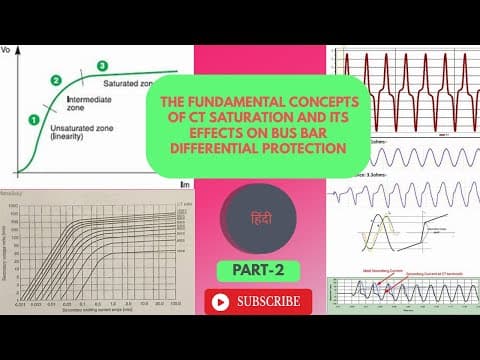
This blog post explores the fundamental concepts of Current Transformer (CT) saturation and its effects on bus bar protection systems. It discusses the basic structure of CTs, the principles of electromagnetic induction, and the implications of CT saturation on electrical systems, emphasizing the importance of maintaining proper connections to prevent dangerous conditions.
In this post, we will delve into the fundamental concepts of Current Transformer (CT) saturation and its effects on bus bar protection systems. This discussion builds upon previous sessions where we explored the basic principles of bus bar protection and the role of CTs in electrical systems.
CT saturation occurs when the magnetic core of a current transformer becomes fully magnetized and can no longer accurately transform the primary current into a proportional secondary current. This phenomenon can lead to significant issues in electrical protection systems, particularly in bus bar applications.
A typical current transformer consists of a primary winding connected to the line conductor and a secondary winding that produces a scaled-down current proportional to the primary current. The core of the CT is made from magnetic material, which plays a crucial role in the operation of the transformer through electromagnetic induction.
When alternating current flows through the primary winding, it generates a magnetic field in the core. This magnetic field induces a current in the secondary winding. The relationship between the primary and secondary currents is defined by the turns ratio of the transformer. However, if the primary current exceeds the CT's rated capacity, saturation occurs, leading to inaccurate current readings.
CT saturation can have several detrimental effects on bus bar protection systems:
To mitigate the risks associated with CT saturation, it is crucial to ensure that the secondary winding is never left open while the primary is energized. This practice helps maintain the integrity of the magnetic field and prevents dangerous voltage levels from developing.
Understanding CT saturation and its implications is vital for maintaining the safety and reliability of electrical systems, particularly in bus bar protection. Proper installation and maintenance practices can help prevent saturation and ensure that protection systems function as intended. In our next session, we will explore the effects of differential protection and how CT saturation influences these systems.
If you found this discussion helpful, please share it with others who may benefit from this knowledge. Feel free to leave comments or questions for further clarification on any points discussed.