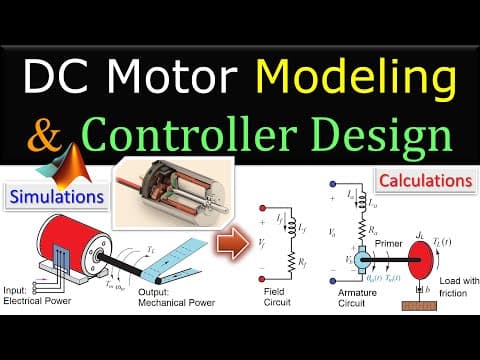
This blog post provides an in-depth exploration of DC motor modeling and controller design, covering the fundamentals of electromechanical systems, equivalent circuits, control mechanisms for position and velocity, and MATLAB simulations to analyze performance.
In this article, we will delve into the modeling of DC motors and the design of controllers for both position and velocity control systems. We will explore the fundamental concepts, including the interaction between electrical and mechanical systems, the equivalent circuit of a DC motor, and the electromagnetic phenomena that govern motor operation. Additionally, we will discuss controller design and present simulation results using MATLAB.
A DC motor is an electromechanical system that involves the interaction between electrical and mechanical domains, coupled through a magnetic field. In motor operation, there are two primary modes:
Two key electromagnetic phenomena are crucial for understanding DC motors:
The equivalent circuit of a separately excited DC motor consists of:
The relationship between the applied voltage, field current, and armature current can be expressed mathematically, leading to the development of torque and angular displacement equations.
The developed torque in a DC motor can be expressed as:
Where K1 is a constant. This relationship highlights the non-linear nature of the torque, as both field and armature currents influence the output.
Position control involves setting a desired angular position and using feedback to minimize the error. The basic configuration includes:
Using Mason's gain rule, we can derive the closed-loop transfer function for the position control system, which typically results in a second-order system.
Velocity control is similar to position control but focuses on maintaining a desired speed. The configuration includes:
The closed-loop transfer function for velocity control is often a first-order system, reflecting the dynamics of the motor's response to speed changes.
To analyze the performance of the DC motor models, we can use MATLAB simulations. The simulations allow us to visualize the step response and assess the effectiveness of the control strategies:
By running the simulations, we can observe the system's response to various inputs and adjust parameters to optimize performance.
In summary, understanding DC motor modeling and controller design is essential for developing effective control systems. By exploring the interactions between electrical and mechanical domains, we can design controllers that achieve desired performance metrics. MATLAB simulations provide valuable insights into system behavior, allowing for fine-tuning of control strategies. If you have any questions or comments, feel free to reach out for further discussion.