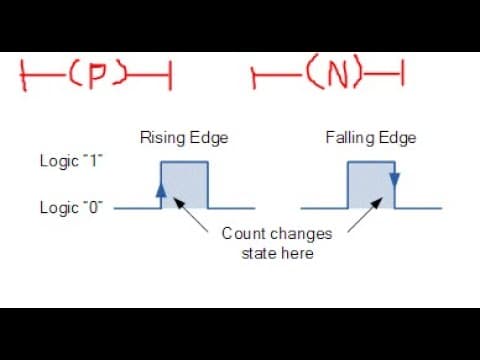
This blog post explores the concepts of positive and negative edge detection in Programmable Logic Controllers (PLCs), detailing how rising and falling edges are utilized in automation processes.
Edge detection is a fundamental concept in the realm of Programmable Logic Controllers (PLCs), particularly when it comes to managing inputs and outputs in automation systems. This blog post delves into the intricacies of positive and negative edge detection, focusing on how these operations are implemented in PLC programming.
Edge detection refers to the identification of changes in the state of a signal. In PLCs, this is crucial for responding to events that occur at specific moments, such as the transition of a signal from low to high (rising edge) or from high to low (falling edge). Understanding these transitions allows for precise control in automated processes.
Positive edge detection occurs when a signal transitions from a low state (0) to a high state (1). This type of detection is essential for triggering actions that should only occur once when an event starts. For example, if a button is pressed, the PLC can be programmed to recognize this rising edge and execute a specific function, such as starting a motor or initiating a sequence.
Conversely, negative edge detection identifies when a signal transitions from a high state (1) to a low state (0). This detection is useful for actions that should occur when an event ends. For example, releasing a button can be detected as a falling edge, prompting the PLC to stop a motor or conclude a process.
In practical applications, both rising and falling edge detections are often used in tandem to create a robust control system. For instance, a PLC might be programmed to start a conveyor belt when a product is detected (rising edge) and stop it when the product leaves the detection zone (falling edge). This dual-edge detection ensures that processes are tightly controlled and responsive to real-time changes in the environment.
Edge detection operations, both positive and negative, are vital components of PLC programming. By understanding how to implement rising and falling edge detection, engineers and technicians can create more efficient and responsive automation systems. Mastery of these concepts not only enhances operational efficiency but also contributes to the safety and reliability of automated processes in various industries.