GPS technology, rooted in ancient triangulation methods, utilizes satellites to determine precise locations on Earth through time-based signal measurements. This blog post explores the principles of GPS, including the importance of accuracy and the role of atomic clocks in achieving precise geolocation.
Global Positioning System (GPS) technology has revolutionized how we navigate and locate ourselves on Earth. But how does it actually work? The principles behind GPS can be traced back to ancient Greece, where the concept of triangulation was first utilized. This blog post will delve into the mechanics of GPS, explaining how it determines locations and the significance of accuracy in measurements.
To understand GPS, we can liken it to a treasure hunt. Imagine you have a clue that a treasure is located 205 kilometers away from Notre-Dame de Paris. This information allows you to draw a circle with a radius of 205 kilometers centered on Notre-Dame. However, this circle encompasses many possibilities, including cities like Bourges, Lille, Chimay in Belgium, and Caen in Normandy.
Next, suppose you receive another clue stating that the treasure is also 243 kilometers away from London. You can now draw a second circle centered on London with a radius of 243 kilometers. The intersection of these two circles narrows down the possibilities to two locations: Lille and a beach near Caen.
To further refine the search, you receive a third clue indicating that the treasure is 93 kilometers from Brussels. Drawing this third circle will lead to a single intersection point: Lille. However, to pinpoint the treasure's exact location in Lille, you would need even more precise measurements.
When attempting to locate the treasure with high precision, you might measure distances within one meter. However, upon drawing the corresponding circles, you may find that they do not intersect at a single point. This discrepancy raises the question: is one of the measurements incorrect? The answer lies in the concept of measurement accuracy, or the uncertainty of measurement.
For instance, if you measure a distance with a meter rule, the accuracy is limited to about 0.5 millimeters due to the spacing of the markings. In our treasure hunt scenario, if the accuracy of the distance measurements is around 50 meters, the circles will thicken, leading to a common area where the treasure is likely located, perhaps near Lille's Main Square.
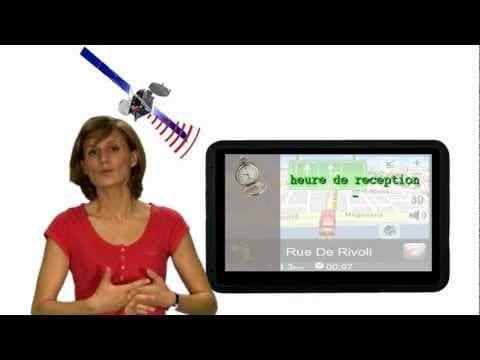
The GPS operates on a similar principle. Since 1978, the American military has maintained a fleet of satellites that continuously send radio signals containing two crucial pieces of information: the satellite's position and the time the signal was sent.
GPS devices, such as those found in cars and smartphones, act as receivers that capture these signals. When a GPS receiver gets a signal, it records the time of reception and deciphers the time the signal was sent. By calculating the time it took for the signal to travel from the satellite to the receiver, the distance can be determined, as radio waves travel at the speed of light.
For example, if a signal reaches the GPS receiver in 70 milliseconds, it has traveled approximately 20,985 kilometers. With the satellite's position known, a sphere can be drawn around the satellite with a radius of 20,985 kilometers. This process continues with additional satellites, allowing for a three-dimensional location fix.
The accuracy of GPS measurements heavily relies on the precision of the time measurements. A timing error of just one millionth of a second can result in a positional error of about 300 meters. To combat this, GPS satellites are equipped with highly accurate atomic clocks, which can measure time to within a tenth of a millionth of a second, achieving a positional accuracy of about 30 meters.
Looking ahead, the European Galileo system, which became operational in 2014, promises even greater accuracy, with the potential to geolocate within just one meter.
GPS technology is a remarkable application of ancient principles of triangulation, enhanced by modern advancements in satellite technology and precision timing. Understanding how GPS works not only highlights the complexity behind seemingly simple navigation but also emphasizes the importance of accuracy in our increasingly connected world. As technology continues to evolve, the potential for even more precise location tracking will undoubtedly enhance our daily lives and the way we interact with our environment.