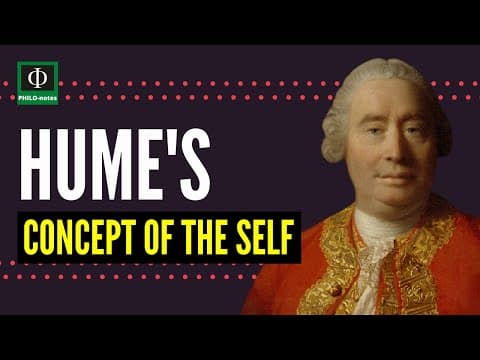
David Hume's concept of the self challenges traditional philosophical views by asserting that the self is an illusion, arguing that we cannot find a concrete impression of the self and that our understanding of identity is merely a collection of impressions linked by associations.
David Hume's philosophy presents a radical departure from the views of earlier philosophers such as Descartes, Plato, and Aristotle regarding the concept of the self. While these thinkers posited the existence of a stable, unchanging essence—often referred to as the soul or mind—Hume argues that the self is nothing more than an illusion.
For philosophers like Plato, Aristotle, and Descartes, the terms "soul" and "mind" denote a substance that remains constant over time. This substance is seen as the foundation of all mental states, including thinking, analyzing, and imagining. Consequently, they believed that although individuals may undergo physical or emotional changes, the core self remains unchanged throughout one's life.
Hume challenges this notion by asserting that if a self exists as a substance, we should have a concrete impression of it. However, he argues that we do not possess such an impression. For Hume, terms like "soul," "mind," or "self" are essentially meaningless because they refer to something that cannot be concretely experienced. He suggests that philosophers have been engaged in a debate about words rather than a substantive discussion about the nature of the self.
To understand Hume's perspective on the self, we must delve into his theory of ideas. Hume builds on John Locke's assertion that ideas originate from sensation and reflection, which he refers to as impressions. In Hume's framework, an idea is valid only if it corresponds to a concrete experience. Thus, abstract ideas—those that do not represent something real—are deemed meaningless. For example, the idea of a unicorn is abstract because unicorns do not exist in reality.
Hume identifies three laws of association that connect our ideas:
Among these, Hume emphasizes the law of cause and effect, which is crucial for understanding human perception and reasoning.
Hume distinguishes between two faculties of human understanding: perception and reason. Perception involves impressions or ideas, while reason deals with propositions. Propositions can be categorized into two types:
Hume's focus on empirical evidence leads him to conclude that our understanding of reality is grounded in experience. He questions how we can ascertain the existence of facts beyond our immediate perception and memory.
Hume argues that our knowledge of cause and effect does not stem from a priori reasoning, as rationalists claim, but from experience. He posits that the mind forms connections between events based on habit and custom rather than inherent necessity. For example, while rationalists might argue that rain necessarily leads to wet roads, Hume contends that this connection is a product of our habitual observations rather than a logical deduction.
Returning to Hume's concept of the self, he asserts that introspection reveals no concrete impression of a self as a substance. Instead, he argues that we are merely a collection of impressions. The idea of the self, much like the notion of an ultimate cause, is a natural inclination of our minds, but it lacks a solid foundation in reality. Hume famously states that we are simply a bundle of impressions, and the idea of a stable self is an illusion.
In summary, Hume's philosophy presents a compelling argument against the traditional conception of the self as a constant, unchanging entity. By emphasizing the role of experience and the limitations of our understanding, Hume invites us to reconsider our assumptions about identity. The self, as he posits, is not a singular substance but rather a complex interplay of impressions shaped by our experiences and associations. This perspective challenges us to reflect on the nature of our existence and the very essence of what it means to be a self.