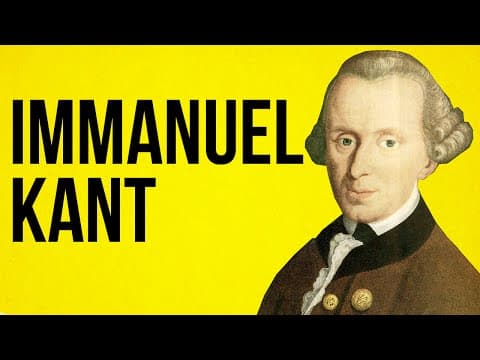
Immanuel Kant, an influential philosopher of the Enlightenment, sought to establish a moral framework based on reason rather than religion. His key concepts, including the Categorical Imperative, emphasize ethical behavior and the importance of treating individuals as ends in themselves. Kant's ideas extend to politics, art, and the struggle between our better selves and our passions, aiming to foster a more rational and ethical society.
Immanuel Kant is a pivotal figure in philosophy, known for his efforts to explore how human beings can embody goodness and kindness outside the confines of traditional religions. Born in 1724 in Königsberg, a city that was part of Prussia and is now known as Kaliningrad, Russia, Kant's modest upbringing shaped his worldview. His father was a saddle maker, and Kant lived a frugal life, only achieving financial stability in his fifties when he became a fully salaried professor.
Kant's family was deeply religious and strict, which influenced his early life significantly. Despite his later rejection of conventional religious beliefs, he recognized the role that religion played in helping his parents cope with life's hardships. He understood the importance of religion in fostering social cohesion and community, even as he moved towards a more secular understanding of morality.
Physically frail and not conventionally attractive, Kant was nonetheless sociable. His colleagues often criticized him for attending too many social gatherings. When he eventually hosted dinner parties, he established rules for conversation, encouraging guests to share recent stories, engage in reflective discourse on important topics, and conclude with light-heartedness to ensure everyone left in good spirits.
Kant's philosophical work emerged during the Enlightenment, a period characterized by a growing secularism. In his 1784 essay "What is Enlightenment?", he identified this secular trend as a defining feature of his time. While he welcomed the decline of Christian belief, he was also concerned about the implications of this shift. Kant viewed human nature as inherently prone to corruption, which led him to seek a replacement for religious authority with the authority of reason.
One of Kant's most significant contributions to philosophy is the concept of the Categorical Imperative, introduced in his work "Groundwork of the Metaphysics of Morals". This principle serves as a method for evaluating the morality of actions by considering whether they could be universally applied. For instance, while it may seem harmless to take a few pads of paper from work, if everyone did this, it would lead to a breakdown of trust and order in society.
Kant's Categorical Imperative encourages individuals to view their actions from a broader perspective, recognizing the potential consequences of their behavior on others. He articulated this idea as a replacement for the Christian command to "love one's neighbor," emphasizing the importance of treating individuals as ends in themselves, deserving of justice and fair treatment.
Kant extended his philosophical inquiries into the realm of politics, asserting that the primary duty of government is to ensure liberty. However, he critiqued the common understanding of freedom as mere absence of restraint. Instead, he argued that true freedom involves acting in accordance with our rational nature. According to Kant, a free society is one that promotes reason and helps individuals align with their best selves, rather than indulging their passions.
In 1793, Kant published "The Critique of Judgment," a significant work on beauty and art that may seem tangential to his primary concerns with ethics and politics. However, Kant believed that art and beauty play a crucial role in his philosophical framework. He posited that beauty serves as a reminder of our better selves, providing a disinterested pleasure that elevates us beyond our selfish concerns.
Kant appreciated the beauty of nature, such as roses and birds, as universal experiences that resonate with all people, regardless of their status. He argued that art embodies essential ethical ideas and should be present in our lives to inspire good behavior and keep our baser instincts in check.
Kant's writings, though dense and abstract, outline a vital project that remains relevant today: understanding how to strengthen the rational aspects of our nature to overcome our inherent weaknesses and selfishness. He aimed to create a secular, rational framework for morality that could guide individuals towards goodness, much like religion has attempted to do throughout history. Through his exploration of reason, ethics, and the role of art, Kant's philosophy continues to challenge and inspire us to strive for a more ethical and rational society.