This blog post explores Karl Marx's theory of religion, detailing his philosophical evolution from conventional Christianity to a critical stance on religion as a reflection of societal struggles and oppression. It discusses the implications of his views on religion's role in society, critiques of his theory, and the limitations of his understanding of diverse religious contexts.
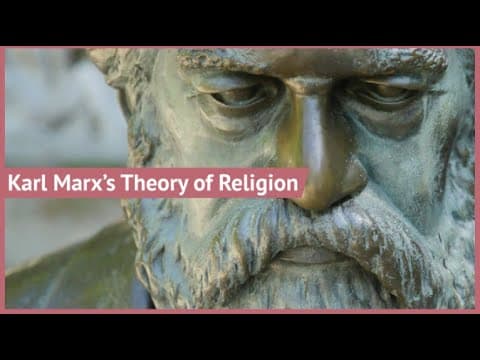
Karl Marx, a German philosopher and the father of Marxist theory, is widely recognized for his critique of capitalism and his assertion that the history of society is characterized by class struggles between the oppressed and the oppressor. While much has been discussed regarding his views on economics and politics, Marx also offered significant insights into the role and function of religion in society. This blog post delves into Marx's theory of religion, tracing his philosophical journey and examining the implications of his ideas.
Initially, Marx accepted conventional Christian beliefs during his youth, including notions about Jesus, God, and sin. His early academic work included a paper on Christian theology. However, as he attended the University of Berlin, Marx's philosophical outlook began to shift. He became involved with a group known as the Young Hegelians, where he was introduced to the ideas of George Hegel and engaged in discussions that promoted skepticism towards religious beliefs.
Among the prominent figures in this group were Bruno Bauer, a theology lecturer, and Ludwig Feuerbach, a philosopher who argued that the divine was merely a projection of ideal human traits. This skepticism influenced Marx's early critiques of religion, leading him to assert that religion was not essential for the survival of the state, as evidenced by the Prussian state's independence from Christianity.
Marx's critique of religion evolved significantly after 1843, as he increasingly appreciated the philosophical arguments against Christianity put forth by thinkers like David Strauss and Feuerbach. He argued that Christianity could not be reconciled with reason and that religious beliefs should be subject to criticism. Marx famously stated that religion is the "opium of the people," suggesting that it provides an illusory happiness that distracts individuals from the harsh realities of their lives.
Marx viewed religion as a form of false consciousness, a comforting illusion that allows people to escape from their real-world struggles. He described religion as a "reflex of the real world," indicating that it arises from tangible human experiences, particularly those related to exploitation and oppression. For Marx, the existence of religion is rooted in societal inequities, such as low wages, alienation from labor, and the struggles faced by the working class under capitalism.
He argued that religion serves as a coping mechanism for the oppressed, providing solace in the face of suffering. Furthermore, Marx noted that the ruling class often encourages religious beliefs, particularly Christianity, which promotes submission and acceptance of one's circumstances. The state, in turn, protects religion through force and censorship, reinforcing its role in society.
Marx also critiqued religion for its alienating nature, as it places human destiny in the hands of non-human forces. He believed that religion's focus on the spiritual realm detracted from the material world, rendering it incompatible with revolutionary movements aimed at social change. According to Marx, true revolution requires a focus on tangible, material conditions rather than spiritual concerns.
Despite the depth of Marx's analysis, several criticisms of his theory of religion warrant consideration:
Limited Understanding of Religion: Critics argue that Marx's knowledge of religion was primarily limited to Christianity and Judaism, raising questions about the validity of his sweeping claims regarding all religions. His theories may not adequately explain the complexities of religious beliefs in diverse cultural contexts.
Contextual Applicability: Marx's assertion that religion emerges from suffering and oppression may not apply universally. For instance, the religiosity of Taoists, Confucians, or Buddhists may not align with Marx's framework, suggesting that his theory is contextually bound to the specific socio-economic conditions of 19th-century Germany.
Focus on the Transcendent: Marx's claim that religion prioritizes the transcendent over the material world is debatable. Many religious traditions, including Christianity and Confucianism, emphasize ethical living and social responsibility, challenging the notion that religion is solely concerned with the afterlife.
Marx's theory of religion provides a critical lens through which to examine the interplay between faith and societal structures. While his insights into the role of religion as a reflection of human suffering and a tool of oppression are compelling, the limitations of his understanding of diverse religious contexts necessitate a cautious approach to his conclusions. As we engage with Marx's ideas, it is essential to consider the broader spectrum of religious experiences and the complexities that shape belief systems across different cultures and historical periods.