This article explores the fundamental concepts of latches and flip-flops, two essential memory elements in sequential circuits. It details their functionalities, differences, and applications, providing a comprehensive understanding of how they operate in digital electronics.
In the realm of digital electronics, memory elements play a crucial role in the design of sequential circuits. This article delves into two primary types of memory elements: latches and flip-flops. Both are capable of storing one bit of information, making them essential components in various electronic applications.
Latches are asynchronous memory elements that respond immediately to changes in input levels. For instance, if a latch's input is initially set to 1, it will store this value. However, if the input changes to 0, the latch will instantly reflect this change in its output. This immediate response characterizes latches as level-sensitive devices.
Transparent Latch: This type of latch is always responsive to input changes. It continuously reflects the input state as long as the enable signal is active.
Gated Latch: Unlike the transparent latch, the gated latch requires a control input (enable signal) to determine its responsiveness. When the enable input is high, the latch behaves transparently, mirroring the input. Conversely, when the enable input is low, the latch retains its previous state, regardless of any changes in the input.
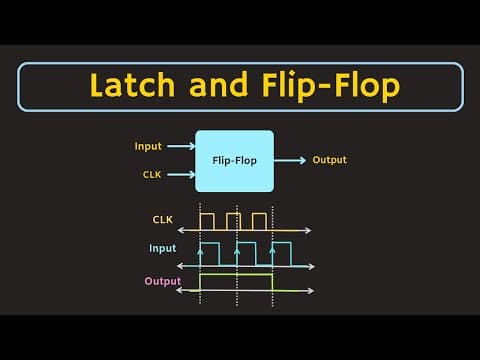
To illustrate the operation of a gated latch, consider a timing diagram where a clock signal serves as the enable input. When the clock signal is high, the output of the latch follows the input signal. However, when the clock signal goes low, the latch maintains its last output state, demonstrating its level-sensitive nature.
In contrast to latches, flip-flops are edge-triggered memory elements. They respond to input changes only at specific transitions of the clock signal, either at the rising edge or the falling edge. This characteristic makes flip-flops essential for synchronous circuits.
Positive Edge Triggered Flip-Flop: This flip-flop responds to input changes at the rising edge of the clock signal. If the input is high at the clock transition, the output will also be high, and it will retain this state until the next rising edge.
Negative Edge Triggered Flip-Flop: Conversely, this flip-flop reacts to input changes at the falling edge of the clock signal. The output will change based on the input state at the moment of the falling edge, maintaining its state until the next falling edge.
Using a timing diagram, we can observe how a positive edge triggered flip-flop behaves. At the first rising edge of the clock, if the input is high, the output becomes high and remains so until the next rising edge, regardless of any input changes in between. Similarly, for a negative edge triggered flip-flop, the output remains unchanged until the next falling edge, demonstrating its edge-sensitive nature.
The primary distinction between latches and flip-flops lies in their sensitivity to input changes:
In synchronous circuits, flip-flops are typically preferred as memory elements due to their predictable behavior during clock transitions. However, with modifications, gated latches can also function as flip-flops by incorporating clock transition circuits.
Understanding the differences between latches and flip-flops is fundamental for anyone working with digital electronics. Both memory elements serve distinct purposes and are implemented using logic gates. In future discussions, we will explore how to design transparent latches and gated latches using logic gates. If you have any questions or suggestions, feel free to leave a comment below. Don't forget to like and subscribe for more informative content on electronics!