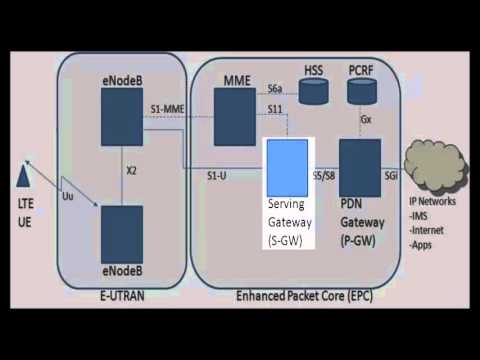
This blog post provides a comprehensive overview of LTE architecture, detailing the various nodes involved, their interfaces, and the specific functionalities of each node within the LTE network, including the Evolved Packet Core (EPC) and Evolved Universal Terrestrial Radio Access Network (E-UTRAN).
In this blog post, we will delve into the intricacies of LTE architecture, focusing on the various nodes that comprise the network and the interfaces that connect them. We will also explore the specific functionalities of each node, providing a clear understanding of how LTE operates.
The LTE network can be divided into two primary components:
The E-UTRAN consists of two main nodes:
One of the notable features of the E-UTRAN is its flat architecture, which differs significantly from the 3G architecture that included Radio Network Controllers (RNCs). In LTE, there is no centralized node; the eNodeB is capable of handling all processing related to air interface protocols independently.
The eNodeB connects to multiple other eNodeBs through the X4 interface and to the core network via the S1 interface. The S1 interface can be further divided into two parts:
The eNodeB connects to the Mobility Management Entity (MME) through the S1-MME interface and to the Serving Gateway (SGW) through the S1-U interface. The MME is responsible for control plane signaling, while the SGW handles user plane data.
The MME is connected to a database known as the Home Subscriber Server (HSS). The HSS is a central repository that contains information about all subscribers of the network operator, including:
The SGW connects to the PDN Gateway (PGW), which serves as the interface between the mobile network and external networks, including the Internet.
The eNodeB performs several critical functions:
The MME has several key responsibilities:
The Serving Gateway (SGW) acts as a mobility anchor for data bearers and manages downlink data when the UE is in idle mode. The PDN Gateway (PGW) has two main tasks:
The PCRF plays a crucial role in managing policies and charging rules for subscribers. It enables service providers to charge users based on their data usage, manage bandwidth during peak times, and enforce limits on heavy bandwidth applications.
In summary, we have explored the key nodes within the LTE architecture and their respective functionalities:
This overview provides a foundational understanding of LTE architecture. For a deeper dive into specific protocols and data flow, further exploration of technical specifications is recommended. Stay tuned for future discussions on related topics.