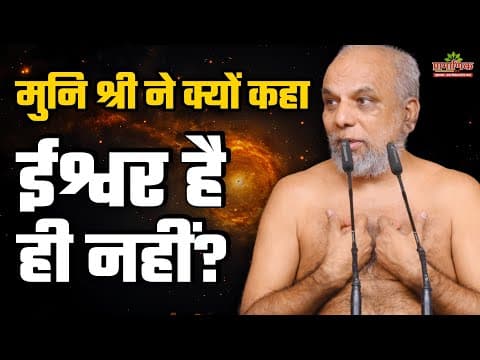
Muni Shri emphasizes that instead of seeking an external God, individuals should recognize their own divine nature as taught in Jain philosophy. He argues that the quest for God should shift from external worship to self-realization and inner transformation.
In a recent discussion, Muni Shri addressed a pressing question among today's youth regarding the existence of God. Many young individuals, both studying locally and abroad, express skepticism about the divine, often seeking proof of God's existence. This skepticism is not uncommon, especially in a world where diverse beliefs and philosophies coexist.
Muni Shri noted that some young people have even researched this topic online, discovering that belief in God is often viewed as a cultural phenomenon, primarily associated with Indian religions. This raises a significant challenge: how can one convince the youth to believe in God when they are adamant about needing proof?
Instead of attempting to convince them of God's existence, Muni Shri proposed a radical approach: stop trying to explain God to them. He suggested that individuals should focus on recognizing their own existence and divinity. According to Jain philosophy, each person is inherently divine. Muni Shri stated, "You are your own God."
Jain teachings emphasize that the divine is not an external entity but resides within each individual. Muni Shri explained that the concept of God in Jainism does not revolve around an omnipotent being who rewards or punishes. Instead, it focuses on the idea that the true essence of God is within oneself. The teachings encourage individuals to recognize their own divine nature and to understand that they are not separate from the divine.
Muni Shri elaborated on the journey of self-realization, stating that individuals often stray from their true nature due to flaws, weaknesses, and negative traits. He emphasized that suffering arises from these imperfections. The path to becoming one with the divine involves overcoming these shortcomings.
Just as gold is refined through a process of purification, individuals must undergo their own transformation. Muni Shri likened this to the process of refining gold, where impurities are removed through intense heat. He encouraged the youth to focus on their inner self, to meditate on their own divine essence, and to work towards eliminating their flaws.
Muni Shri questioned the need for external worship of a deity when the divine is already within. He explained that the images and idols of God serve as reminders of the divine presence within oneself. The practice of worship should not be about seeking an external savior but about recognizing that the same divine essence exists within each person.
In conclusion, Muni Shri's teachings challenge the conventional understanding of God. Instead of looking outward for divine validation, he encourages individuals to turn inward, to recognize their own divinity, and to embark on a journey of self-discovery and transformation. By doing so, one can transcend their limitations and realize their true potential as a manifestation of the divine.