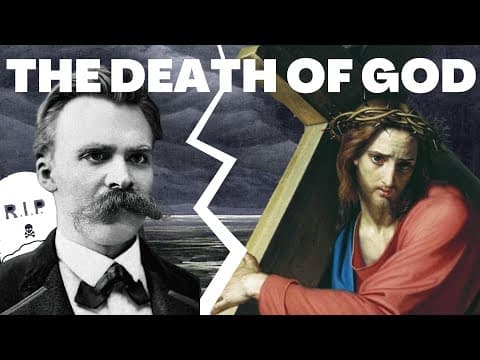
Nietzsche's proclamation that 'God is dead' reflects a significant cultural shift in Western society, marking the decline of Christianity's influence and the rise of individualism and self-creation. This blog explores the meaning of this statement, its historical context, and its implications for modern life, emphasizing the need for individuals to create their own values and meaning in a world where traditional beliefs have diminished.
Since the 19th century, Western culture has undergone a major transformation. Christianity, which once occupied a central role in people's lives as a moral framework and guide, has gradually become less important, transitioning from a prominent position to residing in the shadows of thought. Friedrich Nietzsche's famous statement, "God is dead," perfectly captures this societal shift and predicts its long-lasting consequences. This declaration is one of the best-known statements in philosophy, often referenced even by those who have never read Nietzsche's works. It is mentioned several times in his writings, particularly in The Gay Science and Thus Spoke Zarathustra, and is considered a core idea in 19th and 20th-century philosophical thought.
Nietzsche's proclamation still resonates today, seen as an accurate prediction of the cultural transformation over the past two centuries. However, it is often misunderstood or twisted. So, what does it mean, and why does this century-old declaration make even more sense today? What are its consequences on our daily lives?
Nietzsche states, "God is dead. God remains dead, and we have killed him. How shall we comfort ourselves, the murderers of all murderers?" This provocative statement challenges the prevailing Christian morality of his time. Nietzsche argued that Christian values fostered complacency and conformity, eroding individuality and promoting a herd mentality. He believed that adherence to established moral frameworks stifled critical thinking and encouraged blind acceptance, which clashes with his philosophy centered on self-affirmation and authenticity.
While many interpret this statement as a critique of Christianity, it goes deeper. Nietzsche's declaration can also be seen as an atheistic position; however, it is distinct from traditional atheism. The concept of atheism suggests that God does not exist, while Nietzsche's idea of the death of God implies that God once existed but has now ceased to exist. This distinction shows that Nietzsche's statement is not merely about the existence or non-existence of God but rather about how God's place has evolved throughout history.
Most scholars view Nietzsche's statement as a sociological observation rather than a theological proclamation. It reflects the impact of belief in God on societal behavior rather than asserting God's inherent existence.
To better understand Nietzsche's statement, we must examine the social context of his time. Nietzsche wrote during the aftermath of the Enlightenment period, also known as the Age of Reason, marked by significant scientific, intellectual, and philosophical advancements. This movement, which took place in Western Europe during the 17th and 18th centuries, displaced Christianity as the dominant authority on truth. Discoveries in philosophy, science, and mathematics rendered the Christian narrative obsolete, prompting people to adopt new ways of living.
A pivotal element of this movement was the advocacy for the separation of church and state. Philosophers like John Locke, Voltaire, and Montesquieu opposed the excessive influence of religious institutions in politics, promoting governance grounded in reason, law, and the protection of individual liberties. This separation played a vital role in the gradual decline of Christianity in political, social, and personal realms.
In contrast, the significance of God in our lives has considerably diminished in the 21st century. While God may still hold a place in some people's lives, it has become limited. Nowadays, many associate God only with praying, reading scriptures, or visiting places of worship. The notion of God exists primarily in private or religious spheres, rather than in public or political ones. This shift led Nietzsche to proclaim that God is dead, indicating a fundamental change in the role of God in our lives.
The idea of God's death holds significant importance as it has profound consequences for our lives. In the past, belief in God provided meaning and direction. People's lives were often mapped out, with answers to life-related questions readily available in religious scriptures. This framework offered emotional stability, reducing anxiety about making wrong decisions and providing a clear moral compass.
However, the absence of God can lead to a significant life shift, leaving individuals feeling lost and disconnected. Without a guiding belief system, people may struggle with questions about their meaning and purpose on Earth. Nietzsche feared that this situation could lead to pessimism or a "will to nothingness," the opposite of his life-affirming philosophy. Without direction, individuals may lose hope and fall into depression, exacerbated by the lack of answers regarding existence.
The absence of God creates an existential vacuum, as described by psychologist Viktor Frankl. Born without intrinsic meaning or clear direction, individuals can easily spiral into negativity without any truth to anchor them. Nietzsche articulated this fear of nihilism in his book The Will to Power, predicting a cultural catastrophe stemming from the death of God.
This situation presents a crucial decision: we must either find a new mechanism for the reevaluation of values or surrender to a world filled with absurdity and meaninglessness. This choice lies between the path of selfhood or despair, or in Nietzsche's terms, between the Übermensch (Overman) and the last man.
When approached correctly, this existential vacuum can be viewed positively, presenting opportunities for new and exciting possibilities in life. Nietzsche considered it an excellent opportunity for growth and self-creation. He expressed gratitude and anticipation at the news of God's death, suggesting that it opens new horizons for individuals.
In today's information-saturated world, the significance of God has diminished, leading us to seek meaning in philosophy, science, technology, art, and other areas. However, this change necessitates the responsibility of crafting a cohesive strategy and vision for our lives. The freedom of self-creation echoes the main argument of existentialism, a school of thought that emerged in the 20th century following Nietzsche's declaration.
Nietzsche's statement was a precursor to the ideas championed by philosophers like Jean-Paul Sartre and Albert Camus, who acknowledged the freedom and responsibility that come with the existential void. They asserted that the only meaning life will ever have is the meaning we assign to it. Nietzsche suggested that we must stop relying on divine entities for guidance, consolation, or morality, as this breeds complacency and passivity. Instead, individuals should take full responsibility and face life with courage, enthusiasm, and a spirit of creation.
The objective is not to radically reject religious values but to pursue an individual path and become one's guide. This requires the courage to analyze, criticize, dismantle, create, and adopt new values. Now that God is dead, we must become the Übermensch and create new meaning on Earth, promoting personal growth and the pursuit of an authentic life.
Nietzsche is not merely an atheist; he is an anti-theist, believing that the belief in God hinders personal growth and development. Therefore, he advocated for abandoning this idea in favor of creating our values and striving for personal excellence. However, this matter is complex and nuanced. We must first understand our connection with God, questioning whether it is genuine or merely convenient, influenced by societal norms.
In conclusion, Nietzsche's philosophy challenges us to critically examine our beliefs and their impact on our lives. As we navigate a world where traditional beliefs have diminished, we are called to embrace the responsibility of creating our own meaning and values, ultimately leading to a more authentic existence. Stay tuned for the next exploration of Nietzsche's solution to the death of God and the distinction between the Übermensch and the last man.