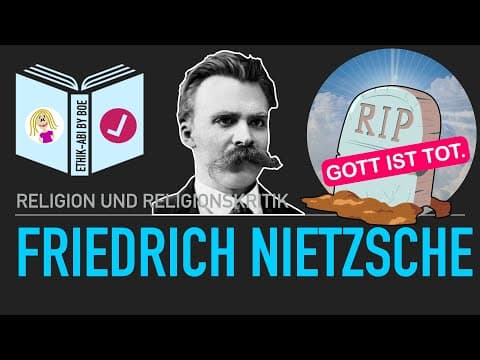
Friedrich Nietzsche's declaration that 'God is dead' signifies a profound shift in societal values and morality, challenging the foundations of Christian ethics and prompting a revaluation of values that could lead to both liberation and nihilism.
Friedrich Nietzsche, a prominent German philosopher, is often remembered for his provocative statement, "God is dead." This phrase encapsulates a complex critique of religion, particularly Christianity, and its implications for morality and society. In this blog post, we will explore the meaning of this statement, its historical context, and the consequences it holds for humanity.
Friedrich Nietzsche (1844-1900) was born in Prussia to a Protestant pastor and raised in a strict Lutheran environment. After the death of his father when he was just five years old, Nietzsche lived in an all-female household, which shaped his early life. He excelled academically and pursued studies in classical philology and Protestant theology at the University of Bonn, later transferring to the University of Leipzig.
Nietzsche became a professor of classical philology at the University of Basel at the young age of 24, despite not having a doctorate. His health deteriorated in 1879, forcing him to leave academia and travel extensively, seeking relief from his ailments. By 1889, he suffered severe mental health issues, leading to his care by family members until his death in 1900.
Nietzsche's philosophical work is characterized by a sharp critique of morality, religion, and societal norms. His criticism of Christianity is particularly pronounced in his works such as "Froehliche Wissenschaft" (The Gay Science), "Also Sprach Zarathustra" (Thus Spoke Zarathustra), and "Der Antichrist" (The Antichrist).
One of the most significant expressions of Nietzsche's thoughts on the death of God is found in aphorism 125 of "Froehliche Wissenschaft." In this parable, a madman proclaims:
"Have you not heard of that madman who lit a lantern in the middle of the morning, ran into the market and kept crying, 'I am looking for God! I seek God!'"
The madman faces ridicule from the crowd, who do not comprehend the gravity of his declaration. He asserts that humanity has killed God, questioning how they could have done so and what it means for their existence. This moment signifies a profound existential crisis, as the madman realizes that the moral and spiritual foundations of society have been irrevocably altered.
Nietzsche's proclamation that "God is dead" does not imply a literal death but rather reflects the decline of belief in a divine moral order. By the 19th century, many began to question the existence of God, influenced by advancements in natural sciences and historical inquiry. Nietzsche observed that the Christian values that once provided meaning and direction were losing their relevance.
The death of God presents a duality of consequences:
Freedom from Moral Burdens: With the absence of a divine moral authority, individuals are liberated from guilt and the constraints of traditional morality. This freedom allows for self-determination and the creation of personal values.
The Burden of Value Creation: However, this freedom also comes with the responsibility of establishing one's own values. Nietzsche argues that many people are unprepared for this task, as they still cling to remnants of Christian morality, which he describes as a "slave morality."
Nietzsche contrasts two moral frameworks:
Despite the potential for liberation, Nietzsche warns of the danger of nihilism—the belief that life is meaningless and devoid of value. Without a divine moral compass, individuals may struggle to find purpose, leading to disorientation and despair. Nietzsche feared that this void could result in people gravitating towards false idols or substitute religions, such as nationalism or socialism.
In response to the challenges posed by the death of God and the threat of nihilism, Nietzsche introduces the concept of the "superman" (Übermensch). The superman represents an individual who transcends traditional morality, creating their own values and embracing life fully. Nietzsche envisions the superman as a beacon of hope for humanity, capable of overcoming the limitations imposed by slave morality.
Friedrich Nietzsche's declaration that "God is dead" serves as a profound commentary on the state of modern society and its moral foundations. While it offers the promise of freedom and self-determination, it also poses significant challenges, including the risk of nihilism and the need for individuals to redefine their values. Nietzsche's critique of Christianity and his vision of the superman invite us to reflect on the implications of living in a world where traditional beliefs are no longer tenable. As we navigate this complex landscape, the question remains: how will we create meaning and value in a post-religious world?