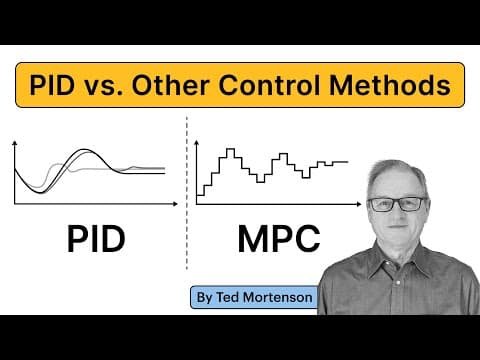
This article explores PID control, its components, and its significance in industrial applications, while also introducing advanced control methods like Fuzzy Logic Control and Model Predictive Control, highlighting their unique advantages and suitable applications.
In the realm of industrial automation, process control is a critical aspect that ensures systems operate efficiently and effectively. Among the various control methods available, PID control stands out as the gold standard. This article delves into PID control, its components, and its applications, while also introducing advanced techniques such as Fuzzy Logic Control (FLC) and Model Predictive Control (MPC).
Before diving into PID control, it's essential to understand a basic control technique known as ON/OFF or Bang-Bang Control. This method is commonly used in applications like home heating systems, where a furnace operates in a binary manner—either ON or OFF. While this approach may suffice for residential heating, it leads to continuous temperature fluctuations around the desired setpoint, which is unacceptable in industrial processes or motion control.
PID control, which stands for Proportional, Integral, and Derivative control, is a feedback control algorithm widely used in industrial applications. It is designed to maintain the process variable as close as possible to the setpoint, despite disturbances or changes in the setpoint itself. For instance, in a tank level control system, PID control can produce an acceptable quarter-wave response to a 1% setpoint change.
Proportional Component: This component applies an effort proportional to the distance of the process variable from the setpoint. While it brings the process close to the setpoint, it may not achieve it completely.
Integral Component: This component addresses the residual error after the proportional control has acted. The longer the error persists, the larger the integral output becomes, helping to eliminate steady-state error.
Derivative Component: This component anticipates future errors by assessing the rate at which the process variable is changing. It adjusts the controller output to mitigate overshoot and improve system stability.
Each of these components contributes a unique signal that combines to form the overall controller output signal.
PID control has been a staple in engineering education and practice for decades. Its simplicity, versatility, and reliability make it a preferred choice for many applications. Additionally, most Programmable Logic Controllers (PLCs) and Distributed Control Systems (DCSs) come equipped with built-in PID functionality, often featuring auto-tuning capabilities.
While PID control is effective for many applications, there are scenarios where more advanced control techniques may be better suited. Two notable alternatives are Fuzzy Logic Control and Model Predictive Control.
Fuzzy Logic Control expands on traditional binary logic by introducing the concept of degrees of truth. Instead of limiting outcomes to true or false, FLC allows for partial truths, enabling a more nuanced approach to control.
Some modern controllers combine PID and Fuzzy Logic, enhancing their performance in various applications.
Model Predictive Control is another advanced technique that utilizes a mathematical model to predict the behavior of a process variable. Unlike PID controllers, which react to current input data, MPC anticipates future behavior and optimizes control actions accordingly.
MPC is particularly effective in systems with multiple interacting variables, making it suitable for complex industrial processes, robotics, and autonomous vehicles.
In summary, while PID control remains a foundational technique in process control, advanced methods like Fuzzy Logic Control and Model Predictive Control offer unique advantages for specific applications. PID control is ideal for straightforward processes, whereas FLC excels in scenarios involving human input and linguistic variables, and MPC is best suited for complex systems with multiple variables. Understanding these control methods allows engineers and technicians to select the most appropriate strategy for their specific needs, ensuring optimal performance in industrial automation.