This article explores the functionalities and characteristics of various power devices including SCR, Triac, GTO, and BJT, detailing their operation, advantages, and applications in power electronics.
Power devices play a crucial role in modern electronics, particularly in power control and conversion applications. This article delves into four significant types of power devices: Silicon Controlled Rectifier (SCR), Triac, Gate Turn-Off Thyristor (GTO), and Bipolar Junction Transistor (BJT). We will explore their functionalities, operational principles, and applications.
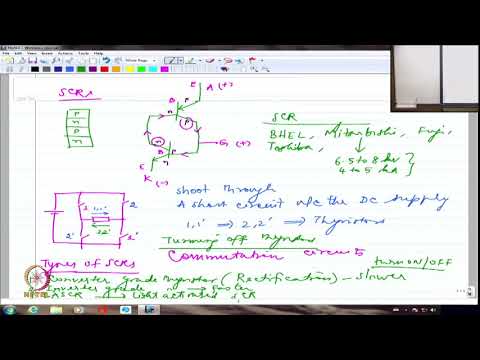
SCR is a four-layer semiconductor device that operates as a switch. Initially, when no voltage is applied, the SCR remains in a reverse-biased state. When a positive voltage is applied to the gate relative to the cathode, it allows a large current to flow through the collector, effectively turning the device on. Once triggered, the SCR remains in the conducting state even if the gate pulse is removed, making it a latching device.
Turning off an SCR is not straightforward. If used in an inverter circuit, for instance, turning on multiple SCRs simultaneously can lead to a short circuit. Therefore, careful control of the gate pulses is essential to manage the operation and prevent faults. The commutation process involves transferring current from one SCR to another, which can be achieved through various methods depending on the desired frequency of operation.
SCRs are available in various ratings, with manufacturers like Mitsubishi and Infineon producing high-rated devices capable of handling significant power levels. They are commonly used in applications requiring high power control, such as inverters and converters.
A Triac is essentially a bidirectional version of an SCR, allowing it to conduct current in both directions. It consists of three terminals: MT1, MT2, and the gate. The Triac can be triggered into conduction by applying a positive voltage to the gate, similar to an SCR, but it can also turn off when the current through it drops below a certain threshold.
Triacs are widely used in AC power control applications, such as light dimmers and motor speed controls, due to their ability to handle alternating current.
The GTO is a type of thyristor that can be turned off by applying a negative gate current. This feature allows for more flexible control compared to traditional SCRs, which require the current to drop to zero to turn off.
GTOs can operate at higher frequencies than SCRs, making them suitable for applications requiring rapid switching. They are often used in high-power applications, such as inverters and converters, where efficient control of power is essential.
BJTs are current-controlled devices that consist of three layers of semiconductor material, forming two pn junctions. They operate by allowing a small base current to control a larger collector current, making them effective amplifiers and switches.
Power BJTs are designed to handle higher currents and voltages. They are typically used in applications where high power amplification is required. The operational characteristics of BJTs include their transfer characteristics, which define how the output current relates to the input current.
When designing circuits with BJTs, it is crucial to ensure that the device operates within its safe operating area to prevent damage due to excessive heat or current.
Understanding the characteristics and operational principles of SCRs, Triacs, GTOs, and BJTs is essential for anyone working in power electronics. Each device has its unique advantages and applications, making them suitable for various power control and conversion tasks. As technology advances, these devices continue to evolve, offering improved performance and efficiency in electrical systems.