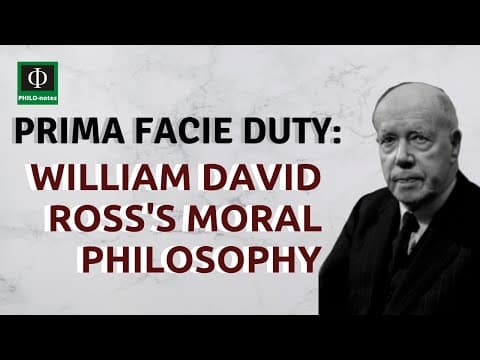
William David Ross's moral philosophy emphasizes the existence of objective moral truths, distinguishing between rightness and goodness, and introducing the concepts of prima facie duties and actual duties to navigate moral dilemmas.
William David Ross, a prominent moral philosopher, presents a compelling framework for understanding ethics through his concept of prima facie duties. This blog post delves into Ross's moral realism, the distinction between rightness and goodness, and how his philosophy guides moral decision-making.
Ross argues that objective moral truths exist in reality. He posits that something is considered good only if it is genuinely good. In his view, rightness and goodness are the two fundamental moral properties, yet they are indefinable and irreducible qualities. This means that while we can recognize instances of rightness and goodness, we cannot fully define them in isolation.
To illustrate his point, Ross uses the example of a satisfying dinner. We understand the term "good" in relation to its physical manifestation, such as the dinner being enjoyable. However, Ross contends that absolute goodness does not exist; rather, goodness is context-dependent. For instance, while some may view divorce as good, others may see it as bad, highlighting the subjective nature of moral judgments.
Ross makes a crucial distinction between rightness and goodness. He asserts that rightness pertains to actions, while goodness relates to motives. This means that the rightness of an act is not solely defined by the act itself, just as goodness is not solely defined by the motive behind it.
To assess the rightness of an act and the goodness of its motive, one must consider the non-moral properties or circumstances surrounding the act. For example, when a physician administers medicine to a patient, understanding the type of medicine and the physician's intent is essential to evaluate whether the act is right and the motive is good.
Ross introduces the concepts of prima facie duties and actual duties to navigate moral conflicts.
Prima facie duties are conditional obligations that guide individuals in determining what they ought to do in a given situation. In contrast, actual duties are unconditional and represent one's moral obligations. According to Ross, actual duties are the most stringent and must be prioritized when conflicts arise.
When faced with conflicting duties, Ross suggests that one should act according to the prima facie duty that has a greater balance of rightness over wrongness. For instance, consider Gloria, who has promised her son to be home early for dinner but must also take her boss to the hospital after a heart attack. Here, Gloria faces two prima facie duties:
In this scenario, the actual duty is to bring her boss to the hospital, as it carries a greater moral weight.
Ross is often regarded as an intuitionist because he believes that individuals can intuitively discern which prima facie duty is more pressing. He argues that the actual duty is self-evident, similar to mathematical truths. When making moral decisions involving multiple prima facie duties, one should thoroughly analyze the situation until arriving at a sound judgment about which duty is more significant.
In his seminal work, "The Right and the Good," Ross outlines seven basic types of prima facie duties that serve as moral guidelines:
Ross emphasizes that these duties are not ranked; instead, they must be evaluated independently in moral decision-making.
William David Ross's moral philosophy provides a nuanced approach to ethics, emphasizing the importance of understanding the context of moral actions and the interplay between rightness and goodness. By distinguishing between prima facie duties and actual duties, Ross offers a framework for resolving moral dilemmas that remains relevant in contemporary ethical discussions. Through careful consideration and intuition, individuals can navigate the complexities of moral obligations and make informed decisions that reflect their values and responsibilities.