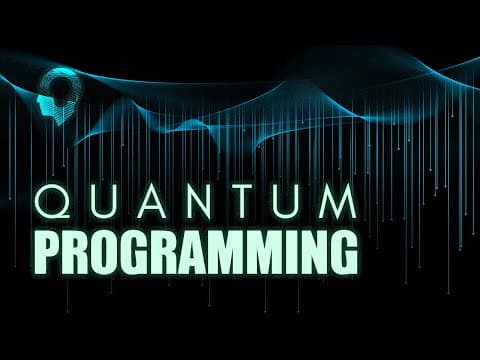
This blog post explores the foundational concepts of quantum programming, including the differences between classical and quantum computing, the role of algorithms, and the unique properties of qubits and quantum gates that enable quantum computers to solve complex problems more efficiently than traditional computers.
Quantum programming represents a revolutionary shift in the field of computing, leveraging the principles of quantum mechanics to solve problems that are intractable for classical computers. This post delves into the fundamental concepts of quantum computing, including algorithms, qubits, and quantum gates, providing a comprehensive overview of how quantum computers operate.
At the heart of computing lies the algorithm, defined as a finite sequence of instructions structured to solve a problem. In classical digital computers, these instructions manipulate information represented by binary states (0s and 1s). The manipulation occurs through logic gates, which produce defined outputs based on binary inputs. By combining these gates into complex networks, we create deterministic processing machines, such as CPUs.
Algorithms can be classified based on their efficiency and resource usage:
Intractable problems, which are theoretically solvable but impractical due to excessive time or memory requirements, pose significant challenges for classical computing. A prime example is the RSA encryption algorithm, which relies on the difficulty of factorizing large numbers. Current technology would take trillions of years to factorize sufficiently large numbers, making these problems suitable for quantum computing.
In the early 20th century, physicists began exploring quantum mechanics, leading to the proposal of quantum computing by Paul Benioff and Richard Feynman. They suggested that quantum computers could simulate processes that classical computers could not handle efficiently. Quantum computers utilize qubits, which differ fundamentally from classical bits.
A qubit can exist in a state of superposition, meaning it can represent both 0 and 1 simultaneously, unlike classical bits that are strictly either 0 or 1. This probabilistic nature allows quantum computers to process vast amounts of information simultaneously. Qubits are represented by quantum phenomena, such as the spin of an electron or the polarization of a photon.
Quantum gates manipulate qubits in a way that is fundamentally different from classical logic gates. They modify the probability and phase of qubit states rather than direct values. Key types of quantum gates include:
Entanglement is a unique property of quantum mechanics where two qubits become interdependent, meaning the state of one qubit directly affects the state of another, regardless of distance. This property enhances the computational power of quantum computers, enabling them to perform complex calculations at unprecedented speeds.
Quantum programming is a complex yet fascinating field that promises to revolutionize computing. By understanding the foundational concepts of algorithms, qubits, and quantum gates, we can appreciate the potential of quantum computers to solve problems that are currently beyond the reach of classical computing. In the next part of this series, we will explore the design of quantum algorithms, their applications, and the challenges faced in the development of quantum computing technology.