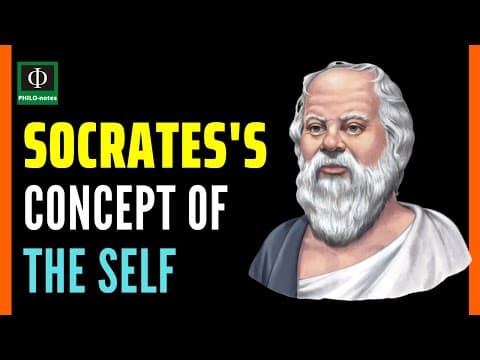
Socrates, an ancient Greek philosopher, emphasized the importance of self-knowledge and the soul as the essence of human identity. He believed that true wisdom and virtue are attained through introspection, leading to a good life defined by knowledge and moral integrity. Socrates argued that one's true self is not defined by material possessions or social status, but by the state of the soul, which is responsible for ethical decision-making.
Socrates was an ancient Greek philosopher considered to be the forerunner of Western philosophy. He was a scholar, teacher, and philosopher who influenced countless thinkers throughout generations. His method of questioning, famously known as the Socratic method, laid the groundwork for Western systems of logic and philosophy. Plato, considered to be Socrates's greatest student, systematically articulated Socrates's philosophy through his famous dialogues, which also chronicled Socrates's life.
Socrates was eventually accused of corrupting the youth of Athens and sentenced to death by drinking hemlock. He could have opted for exile but chose death instead. This decision can be interpreted as Socrates using his death as a final lesson for his students, encouraging them to face the adversities of life calmly and squarely rather than fleeing from challenges. Socrates believed that philosophy must yield practical results for the greater well-being of society, and the first step towards this goal is the acquisition of wisdom through self-knowledge.
Socrates famously stated that ultimate wisdom comes from knowing oneself. To understand Socrates's concept of the self, one must consider his views on the soul. It is crucial to note that Socrates's concept of the soul should not be viewed through the lens of Christianity, as the ancient Greeks lived long before its existence. For them, the soul did not carry the same religious connotations.
Most scholars, including Frederick Copleston, agree that when Socrates speaks of the soul, he refers to a thinking and willing subject. Thus, the soul represents the intellectual and moral personality of humans. When Socrates claimed that the soul is the essence of the human person, he meant that it is inherent to humans to think and will. Therefore, the soul, or the self, is the responsible agent in knowing and acting rightly or wrongly.
According to Socrates, the soul is the seat of knowledge and ignorance, goodness and badness. He urged individuals to take care of their souls to attain the good life, which is the ultimate goal of his philosophy. For Socrates, the good life is synonymous with being wise and virtuous. This explains why he believed that the pursuit of knowledge, wisdom, and virtue is essential.
Socrates posited that knowledge of the good life cannot be acquired externally but must come from within. Therefore, it is vital to devote attention, energy, and resources to making our souls as good and beautiful as possible. This conviction is encapsulated in Socrates's famous statement: "The unexamined life is not worth living." This statement highlights the importance of self-examination in the pursuit of knowledge.
For Socrates, knowing oneself is crucial to attaining the good life. He believed that virtue, which he equated with knowledge, is intrinsic to the human person and can be accessed through self-examination. Once individuals discover the truth about themselves, they will naturally do what they believe is right. This leads to the Socratic dictum: "Knowing what is right is doing what is right."
However, this raises the question of evil. Socrates acknowledged the existence of evil in the world but believed that those who commit evil acts are simply ignorant of the truth. They lack an immediate realization of the good. Thus, self-examination becomes the most important task one can undertake, as it provides the knowledge necessary to determine how one ought to live.
Socrates argued that one's true self should not be identified with material possessions, social status, reputation, or even one's body. Instead, he maintained that the state of the soul is the true inner being that determines the quality of one's life. It is not money, fame, elegant clothes, or high-tech gadgets that make life meaningful, but rather knowledge, wisdom, and virtue.
In conclusion, the true self for Socrates is one that is lived in accordance with knowledge, wisdom, and virtue. The virtuous self is the essence of what it means to be human, and it is through the care of our souls that we can achieve a meaningful and fulfilling life.