This blog post explores the concept of system calls in operating systems, detailing their role as an interface between user applications and the operating system. It discusses how system calls are implemented, the importance of APIs, and the process of parameter passing during system calls.
Operating systems serve as a crucial interface between users and computer hardware, providing essential services that applications rely on. To access these services, applications utilize system calls, which act as an interface between the user and the operating system. This blog post delves into the definition, implementation, and parameter passing of system calls in operating systems.
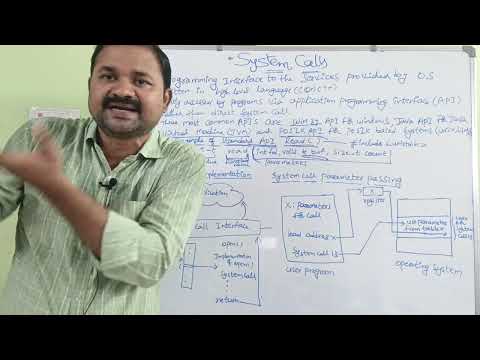
A system call is defined as a programming interface to the services provided by the operating system. When a user develops an application program, they will use system calls to access the operating system's services. System calls are typically written in high-level programming languages such as C and C++, which are also the languages used to develop most operating systems.
Most applications access system calls through an Application Programming Interface (API) rather than calling the system calls directly. An API is a collection of library functions that facilitate the execution of system calls. For instance, when a programmer uses a function like scanf in C, this function internally invokes the corresponding system call without the programmer needing to call it directly.
Different programming languages have their own APIs. For example:
To illustrate how system calls work, consider the task of copying data from one file to another. This process involves several system calls:
This sequence of operations demonstrates how multiple system calls work together to accomplish a task.
System calls are implemented in two modes: user mode and kernel mode. Initially, the CPU executes user programs in user mode. When a library function (API function) such as open is called, the CPU switches to kernel mode to execute the corresponding system call.
The kernel maintains a table of system call numbers. For example, if the open function corresponds to system call number I, the kernel will execute the implementation of the open function when called. This mapping from library function to system call is crucial for the operation of system calls.
When a system call requires parameters, these parameters are stored in registers. For instance, if a system call has a parameter X, the address of X is loaded into a register. When the CPU executes the system call, it retrieves the parameter from the register and uses it to execute the corresponding system call.
This process highlights the importance of both user mode and kernel mode in executing system calls, as the actual execution occurs in kernel mode.
In summary, system calls are a fundamental aspect of operating systems, providing a necessary interface for applications to access system services. Understanding how system calls are implemented and how parameters are passed is essential for developers working with operating systems. By utilizing APIs, programmers can efficiently interact with system calls without needing to manage the complexities of direct system call execution.