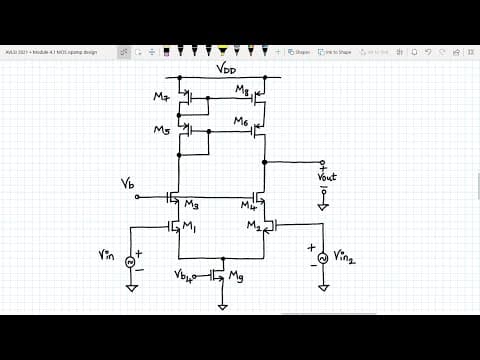
This blog post explores the intricacies of the telescopic cascode single stage operational amplifier (opamp) as discussed in Lecture 39.2 of the Analog VLSI Design series. It covers the operational principles, advantages, and applications of this amplifier design, providing a comprehensive understanding for students and professionals in the field.
In this lecture, we delve into the concept of the telescopic cascode single stage operational amplifier (opamp), a crucial component in analog VLSI design. This design is particularly significant due to its ability to achieve high gain and bandwidth while maintaining a compact layout.
The telescopic cascode opamp is a type of differential amplifier that utilizes a telescopic cascode configuration to enhance performance. This configuration allows for improved voltage gain and reduced output impedance, making it suitable for various applications in analog circuits.
The operation of the telescopic cascode opamp can be understood through its basic components and their interactions:
The telescopic cascode single stage opamp finds applications in various fields, including:
The telescopic cascode single stage opamp is a vital component in the realm of analog VLSI design. Its ability to provide high gain, compact design, and improved performance makes it a preferred choice for many applications. Understanding its operational principles and advantages is crucial for anyone looking to excel in the field of analog electronics.
In future discussions, we will continue to explore more advanced topics in analog VLSI design, including various amplifier configurations and their respective applications. Thank you for joining this lecture, and I look forward to our next session.