This blog post explores the addressing modes of the 8085 microprocessor, detailing their necessity and the five distinct types: immediate, register, absolute, register indirect, and implied addressing modes, along with examples for each.
In the realm of microprocessors, addressing modes play a crucial role in how data is accessed and manipulated. In this blog post, we will delve into the addressing modes of the 8085 microprocessor, exploring their necessity and the various types available.
Addressing modes refer to the different ways of accessing data within a microprocessor. To illustrate this concept, consider a group of people. If you want to specify a particular person, you can do so in several ways:
These examples highlight the various methods of identifying an individual, similar to how addressing modes allow a microprocessor to access data in different ways.
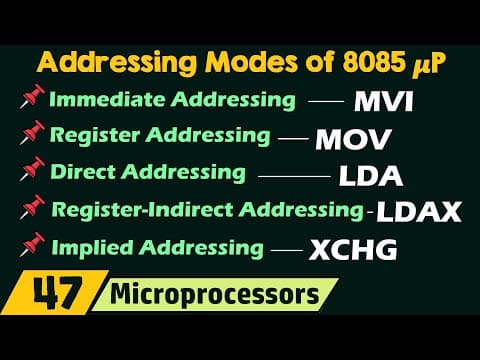
The 8085 microprocessor employs five distinct addressing modes, each serving a unique purpose. Let's explore these modes in detail:
In immediate addressing mode, the data is specified directly within the instruction itself. For example, the instruction MVI A, 12H moves the immediate data 12H into the accumulator register. This mode is straightforward as it provides the data directly in the instruction.
Register addressing mode involves specifying the registers that contain the data. For instance, the instruction MOV A, B indicates that the data in register B should be moved to the accumulator. Here, the microprocessor knows to access the data from the specified register.
In absolute addressing mode, the instruction specifies the exact memory address where the data resides. An example is LDA F820, which loads the data from memory location F820 into the accumulator. This mode is also known as direct addressing mode, as it directly points to the memory address.
Register indirect addressing mode allows the microprocessor to access data through a register pair that holds the address of the data. For example, in the instruction MOV A, M, the M refers to the memory location pointed to by the HL register pair. The microprocessor indirectly accesses the data without explicitly mentioning the register pair in the instruction.
In implied addressing mode, the instruction itself implies the operation without specifying the operands. For example, the instruction XCHG exchanges the contents of the DE and HL register pairs without explicitly mentioning them. The microprocessor understands the implied operation based on the instruction.
To summarize, the 8085 microprocessor features five addressing modes:
Understanding the addressing modes of the 8085 microprocessor is essential for effective programming and data manipulation. Each mode offers a unique way to access data, enhancing the flexibility and efficiency of operations. In future sessions, we will continue to explore different instruction types and their applications within the 8085 microprocessor framework.