Understanding the Curse of Dimensionality in Data Science
The curse of dimensionality refers to the challenges and complexities that arise when analyzing data in high-dimensional spaces. This blog post explores its implications in data science, particularly in machine learning, and offers insights into how to manage these challenges effectively.
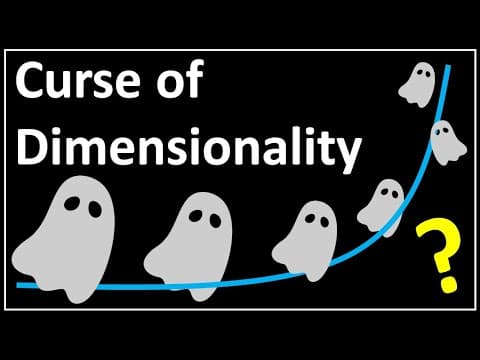
The curse of dimensionality is a critical concept in data science that describes the various phenomena that arise when analyzing and organizing data in high-dimensional spaces. As the number of dimensions increases, the volume of the space increases exponentially, leading to several challenges that can complicate data analysis and machine learning processes.
What is the Curse of Dimensionality?
The term "curse of dimensionality" was coined by Richard Bellman in the context of dynamic programming. It refers to the various issues that arise when working with high-dimensional data. In simpler terms, as the number of features (or dimensions) in a dataset increases, the amount of data needed to support the analysis grows exponentially. This can lead to several problems:
- Sparsity of Data: In high-dimensional spaces, data points become sparse. This sparsity makes it difficult to find patterns and relationships within the data, as the distance between points increases.
- Overfitting: With more dimensions, models can become overly complex, capturing noise rather than the underlying distribution of the data. This leads to poor generalization on unseen data.
- Increased Computational Cost: High-dimensional data requires more computational resources for processing and analysis, which can be a significant barrier in practical applications.
Implications in Machine Learning
In the realm of machine learning, the curse of dimensionality can severely impact the performance of algorithms. Here are some key implications:
- Distance Metrics: Many machine learning algorithms rely on distance metrics (like Euclidean distance) to determine the similarity between data points. In high dimensions, all points tend to become equidistant from each other, making it challenging to differentiate between them.
- Feature Selection: The presence of irrelevant or redundant features can exacerbate the curse of dimensionality. Effective feature selection techniques are essential to reduce the dimensionality of the dataset while retaining its informative aspects.
- Dimensionality Reduction Techniques: Techniques such as Principal Component Analysis (PCA), t-Distributed Stochastic Neighbor Embedding (t-SNE), and Autoencoders are commonly used to reduce the dimensionality of data. These methods help in preserving the essential structure of the data while mitigating the issues caused by high dimensions.
Strategies to Mitigate the Curse of Dimensionality
To effectively manage the challenges posed by the curse of dimensionality, data scientists can employ several strategies: