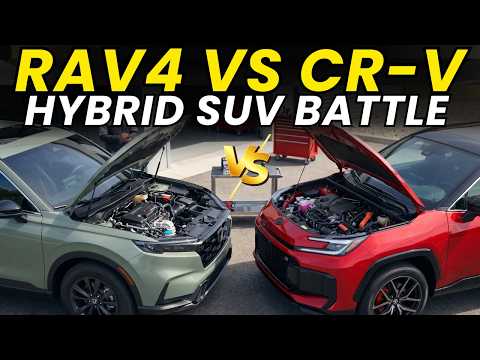
This article compares the Toyota RAV4 Hybrid and Honda CR-V Hybrid, detailing their hybrid systems, reliability, fuel economy, interior features, and ownership costs. Toyota's system is proven and reliable with a planetary gear set, while Honda's two-motor system offers a smoother city driving experience but has some injector issues. The choice depends on driving habits and priorities.
When shopping for a hybrid SUV, many buyers find themselves torn between the Toyota RAV4 Hybrid and the Honda CR-V Hybrid. On paper, these vehicles appear quite similar — they belong to the same segment, share comparable price ranges, and promise similar fuel economy. However, beneath the hood, these two vehicles operate with fundamentally different hybrid systems, and understanding these differences is crucial to making the right choice for your driving needs.
Many people walk into dealerships with preconceived notions based on reviews, videos, or word of mouth, only to regret their choice years later. The truth is neither the RAV4 Hybrid nor the CR-V Hybrid is universally better; they are designed for different types of drivers. Choosing the wrong one for your driving style can lead to dissatisfaction.
Toyota has been a pioneer in hybrid technology, and its system has become the industry benchmark. The 2026 RAV4 Hybrid uses an Electronically Controlled Continuously Variable Transmission (ECVT), which is not the traditional belt-driven CVT but is built around a planetary gear set. This mechanical arrangement of interlocking gears operates with minimal friction and wear, making it extremely durable.
The planetary gear set blends torque from the gasoline engine and electric motors seamlessly, with the computer making real-time decisions on power distribution. This system is known for its longevity, with many vehicles running smoothly beyond 300,000 miles.
Pros:
Cons:
The RAV4 Hybrid offers 37.5 cubic feet of cargo space behind the rear seats and about 69 cubic feet with seats folded. The rear seat comfortably fits two adults, with three manageable for short trips. Taller passengers might find headroom slightly tight.
The base RAV4 Hybrid XLE starts around $42,000, with higher trims approaching $50,000.
The 2026 Honda CR-V Hybrid employs a two-motor system that operates differently from Toyota's. Under typical city driving, the gasoline engine does not mechanically connect to the wheels but acts as a generator to power the electric motors. This design allows the CR-V Hybrid to feel like an electric vehicle in stop-and-go traffic, offering smooth, quiet, and responsive driving without engine noise or the rubber band effect.
At highway speeds, a mechanical lock-up clutch engages, allowing the engine to drive the wheels directly.
Pros:
Cons:
The CR-V Hybrid EX starts around $42,000, with the Touring trim nearing $51,000.
Both vehicles come with an 8-year, 100,000-mile warranty on their hybrid batteries.
Routine maintenance such as oil changes is similar for both, typically every 5,000 to 7,000 miles.
If your priority is a vehicle that is statistically less likely to give you trouble over 10 years and 200,000 miles, the Toyota RAV4 Hybrid is the safer bet. Its proven drivetrain, physical controls, and strong resale value make it ideal for buyers who want a "set it and forget it" vehicle.
If you spend most of your time in stop-and-go city traffic and value a smooth, electric vehicle-like driving experience with more interior space, the Honda CR-V Hybrid is compelling. Just be aware of the potential injector service and spare tire limitations.
The RAV4 Hybrid’s physical knobs and straightforward controls make it a better choice for older drivers or anyone who prefers simplicity and reliability without surprises.
The impact of extreme climates on hybrid systems is still being studied. Cold weather may affect the CR-V Hybrid’s lithium-ion battery, while desert heat could challenge the RAV4 Hybrid’s thermal management. Real-world owner feedback from various climates is invaluable for understanding these effects.
Both the Toyota RAV4 Hybrid and Honda CR-V Hybrid offer unique advantages tailored to different driving styles and priorities. Understanding their hybrid systems, reliability records, and practical features will help you make an informed decision that suits your lifestyle and driving habits.
If you own either vehicle or have experience with them in different climates and conditions, sharing your insights can help others make better choices.