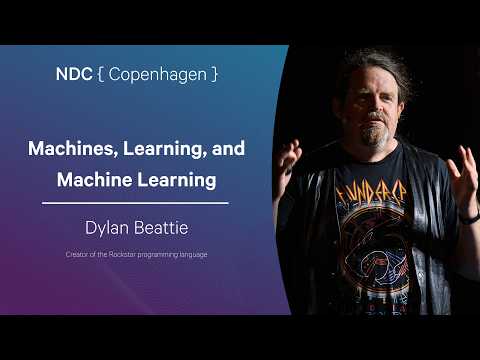
This article explores the evolving relationship between humans and technology, focusing on machine learning and AI's impact on software engineering, society, and the economy. It discusses the challenges of non-deterministic AI systems, the importance of human judgment, the hype versus reality of AI, and the future skills engineers should develop to navigate this changing landscape.
At the NDC Copenhagen conference, a discussion unfolded about machines, learning, and machine learning, highlighting the profound changes AI is bringing to software engineering and society. This article delves into the nuances of AI technology, its promises, pitfalls, and the human factors intertwined with its development and deployment.
A personal anecdote illustrates how technology can appear smarter than it is. The Omron X4 smart automatic upper arm blood pressure monitor, which provides health readings, initially seemed to offer a clear path to perfect health. However, it became evident that the device was not as intelligent as presumed—it was essentially a calendar with limited functionality.
This example underscores a human tendency to project intelligence and personality onto machines, a phenomenon linked to evolutionary survival instincts. Humans are wired to recognize patterns and intelligence quickly, which can lead to overestimating the capabilities of technology.
Historically, humans spent the majority of their time securing basic needs like food. Today, thanks to technological advancements such as industrialized farming and labor-saving devices, people have more freedom to pursue diverse activities—from arts to technology development.
Technology's importance lies in its ability to free up time and provide choices about how we spend our lives. For instance, ordering a pizza via an app is now mundane but represents a significant convenience compared to the past.
Determinism—the idea that the same inputs produce the same outputs—is foundational to fairness and reliability in society and technology. Software engineering strives to create deterministic systems, isolating variables to ensure predictable outcomes.
However, real life is inherently non-deterministic and chaotic. Technologies like the internet use protocols (e.g., TCP/IP) to impose deterministic layers over unreliable networks, ensuring reliable communication despite underlying randomness.
Recent developments in AI, particularly language models like ChatGPT, have dramatically altered software development. These AI systems can generate code and assist in various tasks but operate on probabilistic models rather than deterministic logic.
This shift introduces challenges:
"Vibe coding" refers to the practice of using AI to generate code rapidly, often pushing it directly to production with minimal human intervention. While AI can produce functional code snippets quickly, understanding, debugging, and maintaining this code remains challenging.
Experiments with AI-assisted coding reveal that while initial outputs may work, subsequent modifications can introduce errors, highlighting the need for human expertise.
The concept of operant conditioning, demonstrated by B.F. Skinner's experiments with rats, explains how variable rewards can lead to compulsive behavior. This principle is evident in how humans interact with technology, such as checking phones for notifications due to the unpredictable nature of rewards.
AI tools can induce similar behaviors, leading to fatigue and burnout among developers who constantly engage with non-deterministic systems.
AI systems sometimes refuse to assist with tasks deemed unethical or illegal, reflecting the influence of their controlling entities. This raises concerns about:
Despite AI's capabilities, it is unlikely to replace software engineers entirely in the near future. Instead, AI will transform how software is developed, emphasizing the importance of:
The current AI landscape is marked by significant investment and hype, with companies like Nvidia profiting from hardware sales. However, many AI products are heavily subsidized, and their long-term economic viability remains uncertain.
Moreover, the societal impact includes:
The evolution of AI reflects cycles of optimism and disappointment, reminiscent of past AI winters. Language models have advanced due to the vast amount of data available online but face limitations in achieving true human-like intelligence.
Douglas Adams' work, particularly "The Hitchhiker's Guide to the Galaxy," exemplifies creativity and intelligence beyond mere data replication, highlighting the unique human element in innovation.
AI and machine learning represent powerful tools that can augment human capabilities but come with inherent uncertainties and challenges. The key takeaways include:
As we face an uncertain future shaped by AI, the advice from Douglas Adams resonates: "Don't panic." Embracing change with informed caution and human values will guide us through this transformative period.
This comprehensive exploration underscores the complex interplay between technology, human behavior, and society, offering insights for engineers, users, and policymakers alike.