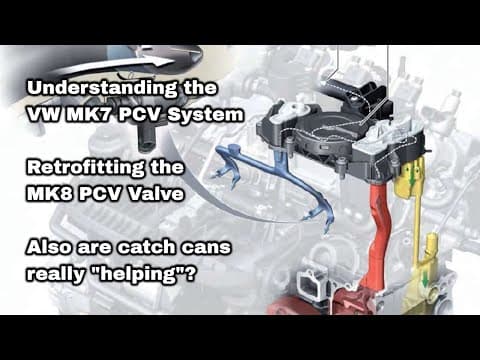
This blog post explores the workings of the MK7 Volkswagen PCV system, its shortcomings, and the advantages of retrofitting the MK8 PCV valve. It covers the mechanics of both systems, the impact of throttle transitions, the role of catch cans, and real-world testing results, providing a comprehensive guide for enthusiasts looking to enhance their vehicle's performance.
This article delves into the Mark 7 Volkswagen PCV (Positive Crankcase Ventilation) system, aiming to clarify its functionality and the rationale behind retrofitting it with the Mark 8 PCV valve. The discussion is informed by the experiences of Tony, a seasoned Master Tech and contributor to the Golf Mark 7 forum, who has conducted extensive testing and analysis on this topic.
To understand the benefits of retrofitting, it is essential to first grasp how the stock MK7 PCV system operates. At idle or low load, the intake manifold creates a vacuum that draws air through the PCV valve, venting blow-by gases from the crankcase. However, at higher RPMs and under boost, the dynamics change significantly. The check valve within the PCV assembly prevents excessive pressurization of the crankcase, but this can lead to issues during throttle transitions.
The MK7 PCV valve has been noted to struggle under specific conditions, particularly during hard braking and sharp turns, which can lead to oil flooding the air-oil separator. This flooding can result in significant knock correction, as evidenced by data collected during autocross events, where knock corrections exceeded 10 degrees.
One of the key differences between the MK7 and MK8 PCV systems is the design of the air-oil separator. The MK8 features a larger outlet, which allows for quicker drainage and reduces the likelihood of being overwhelmed by oil. This design change is crucial for maintaining optimal performance during high-load situations.
When comparing the flow characteristics of both valves, the MK8 shows improved performance at both idle and wide-open throttle. The MK8's design allows for better management of crankcase pressures, particularly during throttle transitions, which can mitigate the risk of oil ingestion into the intake system.
While many enthusiasts install inline catch cans to prevent oil from entering the intake, this can inadvertently create additional problems. The added volume and length of hoses can delay the vacuum draw from the turbo inlet pipe, leading to increased crankcase pressure and potential oil flooding. This can result in the catch can filling up quickly, which may mislead users into thinking they are effectively managing oil ingestion.
Tony's testing of the MK8 PCV valve during autocross events yielded promising results. The data indicated a significant reduction in knock correction, with only minor fluctuations observed during throttle transitions. This suggests that the MK8 PCV valve effectively addresses some of the shortcomings of the MK7 system.
To retrofit the MK8 PCV valve to a MK7, several components are necessary:
The installation process involves capping off certain hoses and ensuring that the new setup allows for optimal vacuum draw from the turbo inlet pipe. This adjustment is crucial for enhancing the performance of the crankcase ventilation system.
The retrofitting of the MK8 PCV valve to the MK7 Volkswagen offers a viable solution to the inherent issues of the stock PCV system. While it may not resolve all problems, initial testing indicates a marked improvement in performance, particularly in reducing knock and managing crankcase pressures. As enthusiasts continue to explore this modification, further testing and feedback will be invaluable in refining the approach and understanding the full implications of this upgrade.
Tony plans to continue testing and will provide updates based on future experiences, particularly during track events. Enthusiasts are encouraged to share their experiences with the retrofit to contribute to the collective knowledge on this topic.