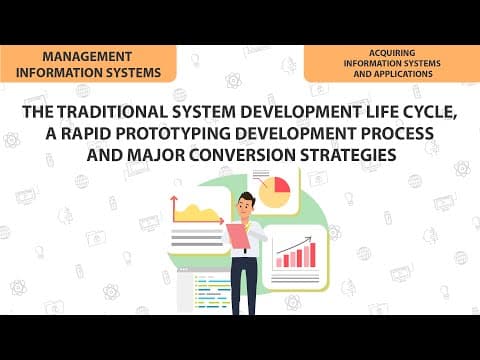
This blog post explores the System Development Life Cycle (SDLC), detailing its phases, the rapid prototyping development process, and major conversion strategies for implementing new systems. It provides insights into how organizations can effectively develop and maintain information systems to meet modern business needs.
In the realm of information systems, the System Development Life Cycle (SDLC) is a crucial methodology that guides the development and maintenance of software systems. This blog post will delve into the various phases of the SDLC, the rapid prototyping development process, and the major conversion strategies that organizations can employ when implementing new systems.
The SDLC is a structured approach that consists of several phases, each playing a vital role in ensuring the successful development and maintenance of information systems. The key phases include:
In this initial phase, organizations conduct a thorough study to identify the problems with the current software system and gather requirements for the new system. This often involves interviewing users and conducting surveys to understand the strengths and weaknesses of the existing system.
During the analysis phase, the gathered information is scrutinized to determine both functional and non-functional requirements for the new software system. Tools such as use case diagrams and flowcharts are created to describe the system's behavior and its interactions with users and other systems.
The design phase involves creating a detailed blueprint of the new software system based on the requirements identified in the previous phase. This includes high-level and low-level designs, covering aspects such as architecture, interface design, data design, and security design.
In this phase, the actual software development takes place. The development team creates the software according to the design specifications and conducts various testing methods, including unit testing, integration testing, and system testing, to ensure the software meets the required standards and is free of defects.
Once the software has been developed and tested, it is deployed in the production environment. This phase includes user training and user acceptance testing to confirm that the system works as intended and meets user requirements.
The final phase involves the ongoing operation and maintenance of the software system. This includes monitoring system performance, addressing any issues that arise, and performing regular maintenance to ensure the system continues to meet business needs.
By following the traditional SDLC approach, organizations can successfully develop software systems that are user-friendly, secure, and capable of meeting modern business requirements.
In addition to the traditional SDLC, many organizations utilize the rapid prototyping development process to quickly develop and test new software applications. This approach consists of several stages:
The development team collaborates with stakeholders to identify key features and requirements for the application. This may include functionalities such as product categories, search capabilities, and shopping cart features.
The team creates wireframes and mockups of the application screens to visualize the layout and user interface. Stakeholder feedback is crucial at this stage to ensure the design aligns with user needs.
A working prototype of the application is developed, often starting with a minimum viable product (MVP) that includes only essential features. This allows for rapid development and testing.
The application undergoes rigorous testing to identify and fix any bugs or glitches. User testing is also conducted to gather feedback on the design and usability of the application.
Based on user feedback, the team iterates on the design and functionality of the application, refining the prototype until it meets user expectations.
The team conducts JAD sessions with stakeholders to gather input and ensure the application meets all requirements. Feedback from these sessions is used to revisit and adjust development requirements as necessary.
The team continues to refine and improve the application until it is ready for launch. The rapid prototyping process allows organizations to create functional applications quickly, ensuring they meet customer needs within tight deadlines.
When implementing a new system or upgrading an existing one, organizations must choose an appropriate conversion strategy. The main strategies include:
This strategy involves switching to the new system all at once. While it is quick and requires minimal resources, it carries a high risk of system failure and downtime.
In this approach, the new system is implemented in a small, controlled environment before a full rollout. This allows for testing and refinement, reducing the risk of failure.
Phase conversion involves rolling out the new system in stages, with each stage replacing a specific function of the old system. This gradual transition minimizes disruption and risk.
This strategy entails running both the old and new systems simultaneously. While it allows for a controlled transition, it can be costly and complex to maintain two systems at once.
After careful evaluation, organizations can select the most suitable conversion strategy based on their size, scope, and budget. For instance, a large multinational company may opt for phase conversion to ensure a smooth transition without disrupting ongoing operations.
In summary, understanding the System Development Life Cycle, the rapid prototyping development process, and major conversion strategies is essential for organizations looking to acquire and implement information systems effectively. By following these methodologies, businesses can ensure that their software systems are reliable, efficient, and capable of meeting the demands of modern operations.