This article explores the engineering and purpose of hybrid cars, focusing on the 2021 Toyota Sienna minivan. It explains how hybrid drivetrains improve fuel efficiency primarily through the use of a modified Atkinson cycle engine and electric motors that assist during acceleration. The article also clarifies common misconceptions about hybrid systems, comparing parallel and series hybrids, and highlights Toyota's innovative hybrid synergy drive system.
The 2021 Toyota Sienna is a remarkable example of modern hybrid technology applied to a minivan, a vehicle type traditionally not associated with fuel efficiency. Toyota made a bold move by replacing the conventional V6 engine with a hybrid electric drivetrain across all models for this year. This change allows the Sienna to achieve over 50% better fuel economy than its competitors, consistently delivering around 34 miles per gallon in both city and highway driving.
Most people understand that hybrid cars use a battery pack and electric motors to assist the gasoline engine, improving fuel economy. However, what is less understood is that in conventional hybrids like the Toyota Sienna, all the energy ultimately comes from gasoline. Unlike plug-in hybrids, these vehicles cannot charge their batteries from an external source; the batteries are charged through driving and regenerative braking.
The electric motors and batteries in these hybrids primarily exist to improve the driving experience. Without them, the engine alone would be inefficient and unpleasant to drive.
Internal combustion engines (ICE) are inherently inefficient, typically converting only about 25% of the chemical energy in gasoline into mechanical energy. The rest is lost as heat, which is why engines require large cooling systems.
Engines produce varying power depending on their speed (RPM). To deliver usable power across different driving conditions, cars use transmissions to adjust the ratio between engine speed and wheel speed. However, engines are generally more fuel-efficient at lower speeds, creating a compromise between power and efficiency.
The Toyota Sienna uses a modified Atkinson cycle engine, which improves thermal efficiency to around 40%. This engine design allows the combustion gases to expand more fully, extracting more energy before exhaust. It achieves this by keeping the intake valves open longer during the compression stroke, effectively reducing the compression ratio while maintaining a longer expansion stroke.
While this engine is more fuel-efficient, it produces less power and has a less responsive feel compared to traditional engines. This is where the hybrid system's electric motors come into play.
The electric motors provide additional power during acceleration, compensating for the Atkinson engine's lower power output. For example, the Sienna's 2.5L engine produces 186 horsepower, but the electric motors can add about 60 horsepower, bringing total output to 245 horsepower when needed.
During cruising, the engine operates efficiently at lower power levels, and the electric motors assist only when necessary. The battery pack stores energy recovered from regenerative braking and engine excess power, which can be used later to boost acceleration or power accessories.
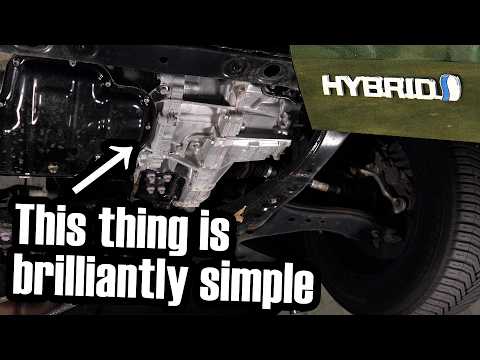
Many people mistakenly believe hybrid cars have two separate drivetrains (electric and gasoline) combined into a complex system. In reality, Toyota's hybrid system replaces the traditional transmission with a simpler device called the power split device, which is mechanically simpler than many conventional transmissions.
Another misconception is that hybrid cars operate like diesel-electric locomotives, converting mechanical energy to electricity and back, which is inefficient. However, Toyota's system cleverly combines mechanical and electrical power paths to minimize conversion losses.
Toyota's hybrid system uses two electric motor-generators (MG1 and MG2) and a planetary gear set (power split device) to manage power flow:
This setup allows the engine to operate at its most efficient speed while MG1 and MG2 adjust power delivery to the wheels. The system can seamlessly switch between engine power, electric power, or a combination of both.
When slowing down, the electric motors act as generators, converting kinetic energy into electrical energy to recharge the battery. This process recovers energy that would otherwise be lost as heat in traditional brakes.
The battery state of charge is carefully managed. The system avoids charging the battery with the engine unless the charge drops below a certain threshold, to minimize energy conversion losses.
Toyota's system is a parallel hybrid, meaning the engine can mechanically drive the wheels. This is more efficient than series hybrids, where the engine only generates electricity.
For example, the first-generation Chevy Volt operated mostly as a series hybrid after its battery was depleted, resulting in lower fuel efficiency due to multiple energy conversions.
The Sienna's all-wheel-drive system uses a third electric motor on the rear axle, providing additional traction without a significant fuel economy penalty. This is possible because the motor only activates when needed, and the vehicle normally operates efficiently with front-wheel drive.
Plug-in hybrids are essentially standard hybrids with larger battery packs that can be charged from external sources. They allow for all-electric driving over short distances but carry a fuel economy penalty when running on gasoline due to the added weight.
Plug-in hybrids are most beneficial for drivers who can regularly charge their vehicles at home or work with inexpensive electricity.
Hybrid cars like the 2021 Toyota Sienna achieve impressive fuel economy not just through electric motors and batteries but primarily through the use of a highly efficient modified Atkinson cycle engine. The electric components serve to augment the engine's power and maintain it within its optimal efficiency range.
Toyota's hybrid synergy drive is a mechanically simple yet sophisticated system that balances power and efficiency, debunking many common misconceptions about hybrid technology. While plug-in hybrids have their place, conventional hybrids remain a smart choice for many drivers seeking to reduce fuel consumption without sacrificing performance.
As the automotive industry transitions toward electrification, understanding the engineering behind hybrid vehicles helps appreciate their role in improving fuel efficiency and driving experience today.