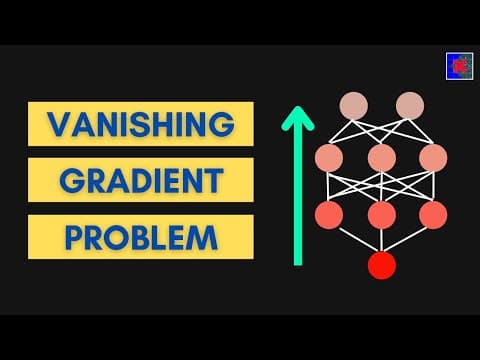
The vanishing gradient problem is a significant issue in training deep neural networks, where gradients become too small for effective learning. This blog post explains the problem, its causes, and potential solutions, including reducing model complexity and using different activation functions.
In the realm of deep learning, the vanishing gradient problem is a critical issue that can hinder the training of artificial neural networks (ANNs). This problem often arises during the training phase when using gradient-based learning methods, particularly in deep networks with many layers. In this blog post, we will explore what the vanishing gradient problem is, why it occurs, and how to address it effectively.
The vanishing gradient problem occurs when the gradients of the loss function become exceedingly small as they are propagated back through the layers of the network during training. This leads to minimal updates to the weights of the network, effectively stalling the training process. As a result, the network fails to learn and improve its performance.
Mathematical Basis: The problem stems from the mathematical operations involved in backpropagation. When gradients are multiplied through multiple layers, if the values are less than one, the product becomes smaller with each multiplication. This is akin to multiplying several fractions together, which results in a number that approaches zero.
Deep Networks: The vanishing gradient problem is particularly prevalent in deep neural networks, where there are many layers (often more than ten). The deeper the network, the more pronounced the issue becomes, as gradients diminish exponentially.
Activation Functions: The choice of activation function also plays a significant role. Functions like sigmoid and tanh can squash the output into a small range, leading to small gradients during backpropagation.
To detect the vanishing gradient problem, one can monitor the loss function during training. If the loss does not change significantly over time, it may indicate that the gradients are too small to effectuate meaningful updates. Additionally, plotting the gradients can provide insights into their behavior throughout the training process.
One straightforward approach to mitigate the vanishing gradient problem is to reduce the complexity of the model. This can involve decreasing the number of layers or using simpler architectures. While this may not always be feasible, it can help in scenarios where the data does not require a deep network.
Switching to activation functions that do not suffer from the vanishing gradient problem can be beneficial. For instance, the ReLU (Rectified Linear Unit) activation function allows for gradients to remain significant, as it outputs zero for negative inputs and retains positive values. This characteristic helps maintain larger gradients during backpropagation.
Batch normalization is a technique that normalizes the inputs to each layer, which can help stabilize the learning process and mitigate the vanishing gradient problem. By ensuring that the inputs to each layer maintain a consistent distribution, the gradients can be kept at a more manageable scale.
Residual networks (ResNets) introduce skip connections that allow gradients to flow more freely through the network. This architecture helps in preserving the gradient information, making it easier for the network to learn effectively even with many layers.
Gradient clipping is a technique used to prevent gradients from becoming too large or too small. By setting a threshold for the gradients, one can ensure that they remain within a reasonable range, thus avoiding the extremes of both vanishing and exploding gradients.
The vanishing gradient problem is a significant challenge in training deep neural networks, but understanding its causes and implementing effective solutions can help overcome it. By reducing model complexity, choosing appropriate activation functions, and utilizing techniques like batch normalization and residual networks, practitioners can enhance the training process and improve the performance of their neural networks. As deep learning continues to evolve, addressing such fundamental issues will be crucial for developing more robust and efficient models.