This blog post provides a comprehensive overview of Transformer Neural Networks, detailing their architecture, key components like self-attention and positional encoding, and their applications in natural language processing and beyond. It explains how Transformers improve upon traditional models by enabling parallel computation and handling long-range dependencies effectively.
In this blog post, we will explore Transformer Neural Networks, a revolutionary type of machine learning model designed for processing sequences. Introduced in the seminal paper "Attention is All You Need" in 2017, Transformers have gained widespread use, particularly in natural language processing (NLP). Prominent examples include BERT and GPT-3, but their applications extend to other data types, such as images, with models like DALL-E synthesizing images from text descriptions.
Transformers were developed to address several limitations of previous models, particularly in handling long-range dependencies in sequences. Traditional recurrent neural networks (RNNs) process sequences sequentially, leading to path lengths that grow linearly with the distance between two positions of interest. This can hinder the model's ability to summarize long documents effectively.
In contrast, Transformers maintain constant path lengths, allowing for more efficient learning of long-range dependencies. Additionally, they enable parallel computation within training examples, which is desirable for speeding up the training process. While convolutional sequence models can alleviate some issues, they still face challenges with distance-dependent path lengths. Transformers leverage self-attention mechanisms to compute updated representations for each sequence element in parallel, enhancing both speed and efficiency.
The architecture of a Transformer can appear complex at first glance, but it consists of familiar components such as feed-forward networks, along with novel elements like positional encoding and multi-head attention. Let's break down the architecture into its core components.
The Transformer architecture is composed of an encoder and a decoder, each containing multiple layers. The encoder processes the input sequence, while the decoder generates the output sequence. Both components share similar structures but have distinct roles.
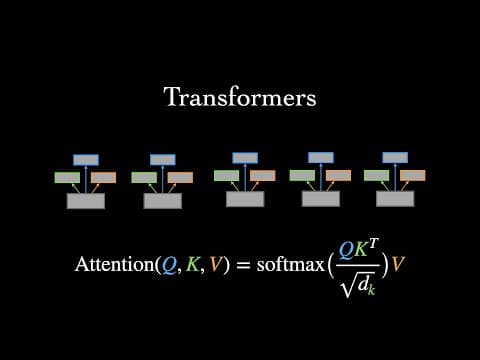
The process begins with raw input sentences, which are mapped to unique integer tokens. These tokens are then passed through an embedding layer, creating continuous vector representations. The attention mechanism consists of three key components: queries, keys, and values. Each query vector is compared to a set of key vectors to determine compatibility, influencing the output based on the corresponding value vectors.
Multi-head attention is a crucial feature of Transformers. It allows the model to learn different representations simultaneously by using multiple attention heads. Each head computes its own set of queries, keys, and values, enabling the model to capture various aspects of the input data. The outputs from all heads are concatenated and projected back to the original embedding dimensionality.
Since Transformers do not process input sequentially, they require a mechanism to account for the order of words in a sequence. Positional encodings are added to the input embeddings to provide information about the position of each token. These encodings can be learned or generated using a fixed scheme based on sinusoidal functions, allowing the model to understand both absolute and relative positions.
An encoder layer consists of two main sub-layers: multi-head attention and a position-wise feed-forward network. After each sub-layer, a residual connection and layer normalization are applied to stabilize training. By stacking multiple encoder layers, the model generates a fixed-length vector representation for each word, considering the full context of the sequence.
The decoder layer also includes multi-head attention and a feed-forward network, but with modifications to respect the temporal dependencies of the output sequence. A masked multi-head attention block ensures that predictions at each position depend only on previously generated tokens. Additionally, cross-attention allows the decoder to attend to the encoder's output, ensuring that the generated sequence corresponds to the input sequence.
To train the Transformer model, a final linear layer maps each vector representation to a set of unnormalized logits over the output vocabulary, followed by a softmax function. The model is trained using a maximum likelihood objective, adjusting parameters to maximize the probability of predicting the next token in the sequence.
The complexity of Transformers compared to traditional RNNs is noteworthy. For self-attention, the complexity per layer is O(n² * d), where n is the sequence length and d is the representation dimensionality. In contrast, RNNs have a complexity of O(n * d²). While Transformers can be more expensive for longer sequences, they excel in scenarios with shorter inputs, making them versatile for various applications.
Transformers have transformed the landscape of machine learning, particularly in natural language processing. Their ability to handle long-range dependencies, enable parallel computation, and provide interpretable attention mechanisms has led to significant advancements in the field. As research continues, we can expect further innovations and applications of Transformer models across diverse domains.
For those interested in delving deeper into the intricacies of Transformers, numerous resources and studies are available that explore their efficiency, theoretical foundations, and exciting applications.