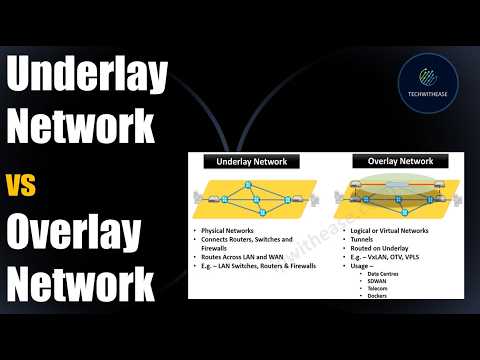
In the realm of networking, the terms underlay network and overlay network are frequently discussed. Understanding how these two types of networks relate to each other, their differences, and their similarities is crucial for network engineers and IT professionals. This article delves into the definitions, characteristics, and applications of both underlay and overlay networks.
What is an Underlay Network?
An underlay network refers to the physical infrastructure that provides connectivity between hosts or sources and their respective destinations. It encompasses the hardware components responsible for routing and switching data across both Local Area Networks (LAN) and Wide Area Networks (WAN).
Key Components of Underlay Networks
- Routers: Direct data packets between different networks.
- Switches: Connect devices within a LAN, facilitating communication.
- Firewalls: Provide security by controlling incoming and outgoing network traffic.
- Bridges and Hubs: Connect multiple network segments, allowing them to function as a single network.
Examples of underlay networks include Ethernet switches and routing on routers, which are essential for establishing connectivity.
What is an Overlay Network?
In contrast, an overlay network is a logical or virtual network that is built on top of an underlay network. It utilizes tunneling techniques to create virtual connections that operate independently of the underlying physical infrastructure.
Key Components of Overlay Networks
- Tunnels: Virtual pathways that encapsulate data packets for transmission over the underlay network.
- Protocols: Common overlay network protocols include VXLAN (Virtual Extensible LAN), OTV (Overlay Transport Virtualization), and VPLS (Virtual Private LAN Service).
Overlay networks are particularly useful in environments such as data centers, where VXLAN is employed to extend the number of segment domains.
Comparing Underlay and Overlay Networks
1. Philosophy
- Underlay Network: The physical infrastructure that supports the construction of overlay networks.
- Overlay Network: A virtual network built on top of the underlying infrastructure.
- Underlay Network: Involves protocols such as Ethernet switching, bridging, VLAN, routing, and firewalls.
- Overlay Network: Comprises tunnels and logical connectivity protocols like VXLAN, OTV, and VPLS.
3. Scalability
- Underlay Network: Generally less scalable due to technological limitations. For instance, VLANs can support only 4096 segments.
- Overlay Network: Highly scalable, capable of supporting up to 16 million segments with VXLAN.
4. Packet Control
- Underlay Network: Orchestrated and controlled via hardware components.
- Overlay Network: Governed by software, utilizing Software Defined Networking (SDN) for LAN and Software Defined WAN (SD-WAN) for WAN.
5. Packet Delivery
- Underlay Network: Responsible for the reliable delivery of packets, operating primarily at Layer 3 and Layer 4.
- Overlay Network: Offloads packet delivery responsibilities, requiring encapsulation and decapsulation of packets for transmission.
6. Managing Multi-Tenancy
- Underlay Network: Manages multi-tenancy through NAT (Network Address Translation) or VRF (Virtual Routing and Forwarding) based segregation.
- Overlay Network: Inherently designed to manage overlapping IP addresses and multi-tenancy efficiently.
7. Multipath Forwarding
- Underlay Network: Supports multipath forwarding but with scalability and complexity challenges.
- Overlay Network: Facilitates efficient multipath forwarding as a core feature of its design.
8. Deployment Time
- Underlay Network: Deployment is often time-consuming and less scalable.
- Overlay Network: Allows for rapid and incremental deployment of new functions through edge-centric innovations.
9. Traffic Flow
- Underlay Network: Transmits packets through physical network devices such as switches and routers.
- Overlay Network: Transmits packets along virtual links between overlay nodes.
Conclusion
Understanding the distinctions between underlay and overlay networks is essential for modern networking practices. While underlay networks provide the foundational physical infrastructure, overlay networks offer flexibility and scalability through virtualized connections. As networking technologies continue to evolve, the integration of both types of networks will play a critical role in enhancing connectivity and efficiency in various applications, particularly in data centers and telecom infrastructures.
This comprehensive overview of underlay and overlay networks highlights their unique characteristics and use cases, providing valuable insights for network engineers and IT professionals alike.