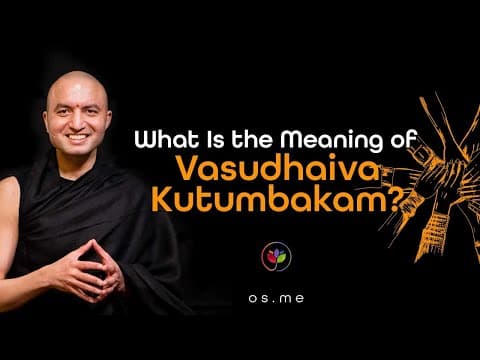
Vasudhaiva Kutumbakam, a concept from Indian philosophy, emphasizes the importance of prioritizing societal welfare over personal interests. Through examples from Hindu epics and Buddhist teachings, the article explores the balance between individual responsibilities and collective well-being, advocating for truthfulness and selflessness in our actions.
The phrase "Vasudhaiva Kutumbakam" is derived from ancient Indian texts, specifically the Upanishads and Puranas. It translates to "the world is one family," encapsulating a profound philosophy that prioritizes collective well-being over individual interests. This article delves into the meaning of this concept and its implications for personal and societal progress.
In our journey through life, we often prioritize our relationships in a hierarchical manner: first our family, then our relatives, and finally society at large. However, true progress requires a shift in this perspective. To set a commendable example for society, as exemplified by Lord Rama, one must sometimes place familial ties aside in favor of broader societal responsibilities.
Lord Rama, a revered figure in Hindu mythology, faced a critical decision when he was confronted with the words of a washerman questioning the integrity of his wife, Ma Sita. Instead of resorting to violence or personal vengeance, Rama chose to uphold his duty to society, demonstrating that leadership often requires sacrifices for the greater good. This act illustrates the essence of Vasudhaiva Kutumbakam, where the welfare of society takes precedence over personal relationships.
The teachings of Hindu epics suggest that different eras (Yugas) require different approaches to behavior. In the Treta Yuga, one must embody the virtues of Lord Rama, while in the Dvapara Yuga, the cunning and strategic nature of Lord Krishna is necessary. In the current Kaliyuga, individuals must adapt their behavior to the circumstances, sometimes embodying both Rama and Krishna. This adaptability distinguishes a sage from an ordinary person, who may cling to personal loyalties at the expense of others.
Lord Krishna's interactions with Duryodhana during the Mahabharata illustrate the importance of truth over power. Krishna offered his army to Duryodhana but chose to stand with the Pandavas, emphasizing that true allegiance lies with righteousness rather than material gain. This highlights the necessity of prioritizing truth and justice in our actions, aligning with the philosophy of Vasudhaiva Kutumbakam.
The story of Angulimala, a notorious figure who committed heinous crimes to support his family, further reinforces the message of collective responsibility. When confronted by Buddha, Angulimala learned that his family did not wish to share the consequences of his actions. This realization prompted a profound transformation, illustrating that true support for one's family comes from ethical actions rather than harmful deeds.
A poignant anecdote about a wealthy man and his sons reveals the futility of attachment to material wealth. As the man approached death, his sons debated the extravagance of his funeral. The father's decision to walk to the crematorium, rejecting the need for a lavish procession, underscores the idea that attachment blinds individuals to the reality of life and death. Ultimately, no one can accompany us after death, and the fruits of our actions remain ours alone.
The core message of Vasudhaiva Kutumbakam is to act truthfully and selflessly for the benefit of all. While it is essential to care for family and loved ones, one must also extend that care to society and the world. The Punjabi saying, "Hey Raba Sab Da Bhala Kari, Par Shuru Sadhe to Kari," translates to "Oh my God, do good to everyone but start with me," encapsulating the need for a balanced approach to altruism.
In conclusion, the philosophy of Vasudhaiva Kutumbakam encourages individuals to transcend personal attachments and prioritize the welfare of society. By embodying truthfulness and selflessness, we can contribute to a more harmonious world. As we lay our heads down at night, we should reflect on our actions and strive to ensure that we have acted in accordance with these principles, ultimately leading to true wealth and fulfillment in life.