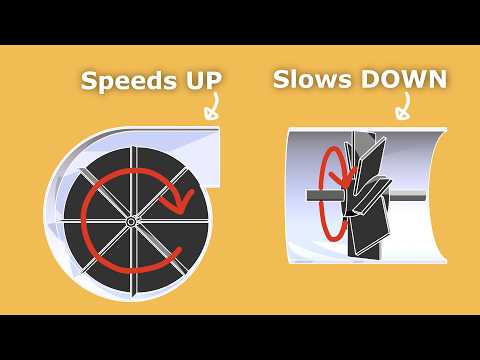
This article explores why centrifugal fans in vacuum cleaners speed up when their intake is blocked, unlike axial fans which typically slow down. It delves into the physics of fan operation, differences between axial and centrifugal fans, the role of centrifugal force, blade angles, and how these factors influence fan speed and efficiency under blocked conditions.
Vacuum cleaners often exhibit a curious behavior: when you block their intake, the centrifugal fan inside speeds up. This contrasts with regular axial fans, which tend to slow down under similar conditions. Understanding this phenomenon requires a deep dive into the physics of fans, the differences between axial and centrifugal fans, and how air moves through these devices.
There are two primary types of fans relevant to this discussion:
Axial Fans: These fans move air along the axis of rotation. The incoming air already has some axial speed as it is sucked in, and the fan blades increase this speed slightly. However, the rotation of the blades also imparts a swirl to the air, which is essentially wasted energy.
Centrifugal Fans: These fans draw air into the center and fling it outward radially due to rotation. The incoming air has no rotational speed and is accelerated by the fan blades to gain rotational speed, which pushes the air outwards through the fan's outlet.
Axial fans waste energy by imparting a swirl to the air, which does not contribute to forward movement. Centrifugal fans waste energy initially by the incoming air slamming into the back of the fan, but then efficiently use the rotational speed to push air outward.
Centrifugal force is an apparent force experienced in a rotating frame of reference. Although it is not a real force, it is useful for understanding how centrifugal fans operate. Air, having mass, is flung outward by the rotation of the fan blades, which creates pressure and moves the air through the fan.
When the intake of a centrifugal fan is blocked:
This behavior is different from axial fans, which usually slow down when blocked.
Axial fans typically slow down when the intake is blocked because:
However, this slowing down is not an inherent property of all axial fans. Some axial fans may speed up slightly when blocked, depending on their design.
Fan blades are designed with specific angles to optimize efficiency:
Curved blades and swept blades help improve airflow and reduce turbulence:
The reason vacuum cleaners with centrifugal fans speed up when their intake is blocked lies in the physics of rotation and airflow. Centrifugal fans reduce resistance when airflow stops, allowing them to spin faster. Axial fans, on the other hand, usually slow down due to increased drag and stalling effects. Understanding these differences helps in designing more efficient fans and troubleshooting fan-related issues.
Look around your home and identify the worst fan design you can find. Consider how the blade shape, angle, and fan type might affect its efficiency and behavior when blocked. Share your observations and reasoning with others interested in fan physics.
This exploration was inspired by discussions in the No Art community and supported by experts in centrifugal fan technology. Understanding the quirks of fan operation not only satisfies curiosity but also informs better design and usage of everyday appliances like vacuum cleaners.