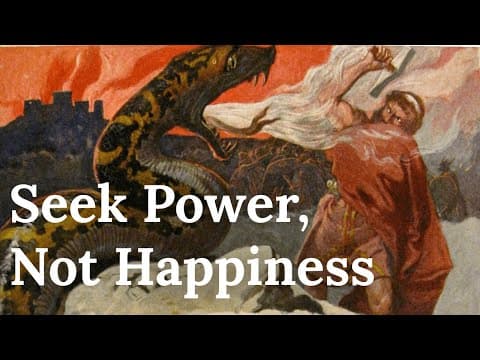
Friedrich Nietzsche argues that the ultimate value in life should be the pursuit of power, not happiness. This power is about personal growth and overcoming challenges, leading to fulfillment and health. By setting meaningful goals and embracing resistance, individuals can enhance their capacities and achieve greatness, ultimately finding joy as a byproduct of their power.
In the quest to live a good life, each of us, consciously or implicitly, chooses an ultimate value around which to orient our life. For many, this value is wealth; for others, it may be status, social acceptance, happiness, pleasure, love, knowledge, or comfort. Drawing from the insights of the 19th-century philosopher Friedrich Nietzsche, we will argue that if we want to maximize our health and fulfillment, the value we should esteem the highest is power.
Nietzsche famously stated, "What is good? All that heightens the feeling of power, the will to power, power itself in man. What is bad? All that proceeds from weakness…Not contentment, but more power." This perspective challenges the common association of power with the ability to control others. Nietzsche believed that the desire to control others often stems from an underlying weakness or inferiority complex. He wrote, "…the will of the weak to represent some form of superiority, their instinct for devious paths to tyranny over the healthy – where can this not be discovered, this will to power of the weakest!"
Instead of seeking power through domination, Nietzsche advocated for a form of power that is embodied and expressed within ourselves. This power is akin to what he called "growth and expansion," or what contemporary philosopher John Richardson described as "the enhancement of a capacity or an activity already given."
Consider the following examples:
John Richardson elaborates on Nietzsche's view of power, stating, "Power is 'more life' not by its mere continuation, nor by its multiplication, but by life’s being raised to a higher level of capacity and control;…Power is transition to a higher level…a 'self-overcoming.'"
Embedded in Nietzsche’s writings is a guide for attaining this power. The first step is to formulate a goal that fulfills four conditions:
Nietzsche emphasized the importance of self-reflection, stating, "For what purpose humanity is there should not even concern us: why you are here, that you should ask yourself: and if you have no ready answer, then set for yourself goals, high and noble goals."
Once we have a goal that meets these criteria, the next step is to dedicate consistent time each day to its accomplishment. As we pursue our goals, we will inevitably encounter obstacles and resistances, such as self-doubt, fear, anxiety, and laziness. These challenges can include a lack of time or resources, doubts and criticisms from others, or personal health and relationship issues.
In the context of pursuing power, these obstacles present opportunities. Nietzsche posited that when we confront resistance and stretch the limits of our mind and body to overcome it, we increase our power. He stated, "The will to power can only express itself against resistances; it seeks what resists it…all expansion, incorporation, growth, is striving against something that resists."
Engaging in what Nietzsche called "the game of resistance and victory" involves overcoming hindrances, which leads to increased power. Once we achieve our goal, Nietzsche advises us to set our sights on the next, greater goal. He wrote, "Whatever I create and however much I love it, soon I must oppose it and my love; thus my will wills it."
Bernard Reginster explains that the pursuit of power is not about destroying what we have created but rather about overcoming it. The agent in pursuit of power seeks fresh challenges, leading to continual growth and self-overcoming.
Nietzsche described the pursuit of power as "without final goal, unless the joy of circle is itself a goal." This cycle involves choosing a goal, confronting and overcoming resistances, increasing our power, attaining the goal, and then starting anew. Thus, a life structured around the pursuit of power is one without a final goal, except for the joy that comes from the process itself.
Nietzsche's perspective on happiness is closely tied to the feeling of power. He stated, "What is happiness? The feeling that power increases – that a resistance is overcome." He further elaborated, "…joy is only a symptom of the feeling of attained power…one does not strive for joy…joy accompanies."
This view has profound implications for modern individuals, offering a solution to the perennial problem of suffering. Nietzsche argued that humans do not repudiate suffering; rather, they seek meaning in it. He wrote, "Man, the bravest of animals, and the one most accustomed to suffering, does not repudiate suffering as such; he desires it, he even seeks it out, provided he is shown a meaning for it."
Many philosophical and religious systems attempt to solve the problem of suffering by positing a better reality beyond this one. However, Nietzsche criticized these views for devaluing our earthly existence. He stated, "The concept 'beyond', 'true world' invented in order to devalue the only world there is—in order to retain no goal, no reason, no task for our earthly reality!"
In contrast, Nietzsche's ethics of power values the resistances that grant us the opportunity to increase our power. Suffering, defined by resistance, becomes an essential ingredient of power. He explained, "…human beings do not seek pleasure and avoid displeasure. What human beings want…is an increase of power; driven by that will they seek resistance."
Nietzsche's worldview does not require faith in external salvation. Instead, it promotes a life of meaningful action, functioning as an antidote to the passivity that has infected modern civilization. By participating in the circle of power, we can actualize our potential and cultivate the happiness that arises from the pursuit of power.
Nietzsche encapsulated this idea beautifully: "Pleasure appears where there is the feeling of power. Happiness: in the triumphant consciousness of power and victory." Ultimately, life itself confides the secret: "behold, it said, I am that which must always overcome itself."