Editorial Team
9 min read
Reported server price demands reach 45% above earlier agreements. HPE explicitly permits repricing before shipment, while XTX's disputed Dell order raises a sharper question: what happens when a buyer says it paid extra for a fixed price?
Rising memory costs are reaching server orders agreed months before delivery. The financial exposure depends on the contract: an explicitly adjustable quote offers different protection from the fixed price the Finnish subsidiary of British algorithmic trading firm XTX Markets says it secured on a roughly $549 million Dell purchase.

Reported server price demands reached 45% above earlier agreements; individual contracts’ adjustment provisions were not established. Source: Financial Times.
Suppliers of Nvidia-powered AI servers are seeking substantially higher prices months after signing contracts, with increases reaching 45%, according to a report citing people familiar with the matter. The increases are hitting financial trading firms including Jane Street, Optiver and Hudson River Trading as they expand computing capacity for research supporting their trading strategies.
Dell, Hewlett Packard Enterprise, Lenovo and Supermicro supply servers combining graphics processing units—the main AI processors, made by companies including Nvidia and AMD—with memory and networking equipment. Deals are typically agreed well before delivery, leaving an interval in which component costs can change.
One person described GPU server prices rising at least 20%–30%, while CPU nodes, where memory accounts for a larger fraction of cost, had tripled or more. These observations lack standardized configurations and a specified comparison period; they are not a market-wide price index.
Buyers approached for the report did not confirm whether their contracts permitted increases before delivery. The reporting establishes demands above earlier agreed figures, but does not establish that every demand violates a fixed-price commitment. Some trading firms are accepting increases because they value obtaining the equipment.
HPE and Supermicro declined to comment for that report; Dell and Lenovo did not respond to repeated requests. Hudson River Trading and Optiver declined to comment, and Jane Street did not respond.
Hewlett Packard Enterprise, the server, storage and networking supplier separated from HP in 2015, disclosed its policy on its March 9 fiscal first-quarter earnings call. President and chief executive Antonio Neri, who previously ran HP's server and networking businesses and HPE's Enterprise Group before becoming CEO in February 2018, said HPE had amended quoting terms to allow repricing existing orders for commodity-cost increases between quotation and shipment.
Neri said customers retained the right to cancel before shipment, and described HPE as transparent about the difference between the originally quoted component cost and the subsequent surcharge. Those are HPE's descriptions of its policy, rather than independent verification of individual invoices.
HPE began DRAM-related price increases in November 2025. A report describing its February 5 partner letter said it shortened quote validity from 30 days to 14, excluding public-sector, B2B and OEM business, and changed server and GreenLake contract terms to permit adjustments until shipment. Shorter quote validity and repricing accepted orders address different stages of procurement.
On the March call, Neri said DRAM memory and NAND flash storage together represented more than half the materials cost of a traditional server. That is not the memory share of every GPU-heavy AI system. Networking equipment was less exposed because memory accounted for a smaller share of its materials cost.
HPE said it had expanded multiyear agreements with silicon and memory suppliers, recommended alternative configurations and prioritized higher-margin orders. Neri nevertheless said it lacked enough supply to meet all demand. HPE's finance chief said its Cloud & AI segment's adjusted operating profit rose 18% year over year despite a 3% revenue decline in the quarter ended January 31. Pricing and cost discipline helped protect profitability, alongside the mix of business. HPE also lowered that segment's full-year revenue-growth outlook as it prioritized more profitable orders amid supply constraints.
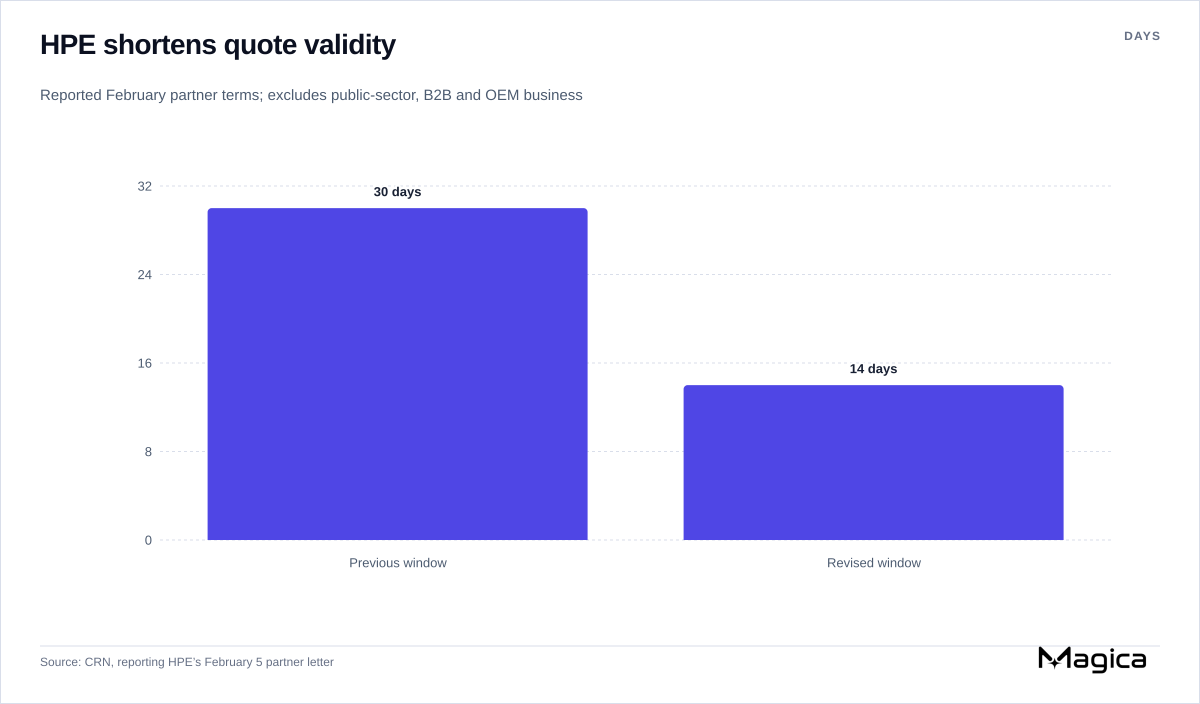
HPE’s company-reported quote window fell from 30 days to 14, with stated exclusions. Quote expiry and repricing accepted orders are separate provisions. Source: CRN.
The exposure predates this AI spending cycle. Dell's 2021 annual report warned that vendor dependence reduced its control over delivery schedules and increased the risk of shortages and component-cost increases. Qualifying alternative suppliers could also delay shipments. Those disclosures explain an established supply-chain vulnerability, without establishing Dell's rights under the disputed XTX agreement.
Market researcher TrendForce's September DRAM survey estimated that Samsung, SK hynix and Micron held second-quarter 2026 revenue shares of 39.4%, 24.9% and 23.3% respectively—87.6% combined, calculated by adding the shares. Revenue concentration is not a measure of available capacity, but shows how much of the upstream market sits with three suppliers even when buyers have several server brands to approach.
TrendForce reported historically low supplier inventories and only modest growth in second-quarter DRAM bit shipments. It projected conventional DRAM contract-price growth would moderate to 13%–18% quarter over quarter in the third quarter, partly because demand was shifting toward lower-capacity memory modules and PC and smartphone customers could not absorb further increases. That forecast covered memory contracts, rather than finished servers.
Neri's March expectation of elevated DRAM and NAND prices well into 2027 also needs qualification. In a November 19 outlook, TrendForce forecast that overall NAND flash contract prices would fall 0%–5% quarter over quarter in the first quarter of 2027, with all NAND product categories entering a downward cycle from the second quarter. It expected supply growth and cuts to Chinese cloud providers' enterprise SSD orders to outweigh additional North American demand. This is a forecast about flash storage, not evidence that DRAM shortages or existing server surcharges have ended.
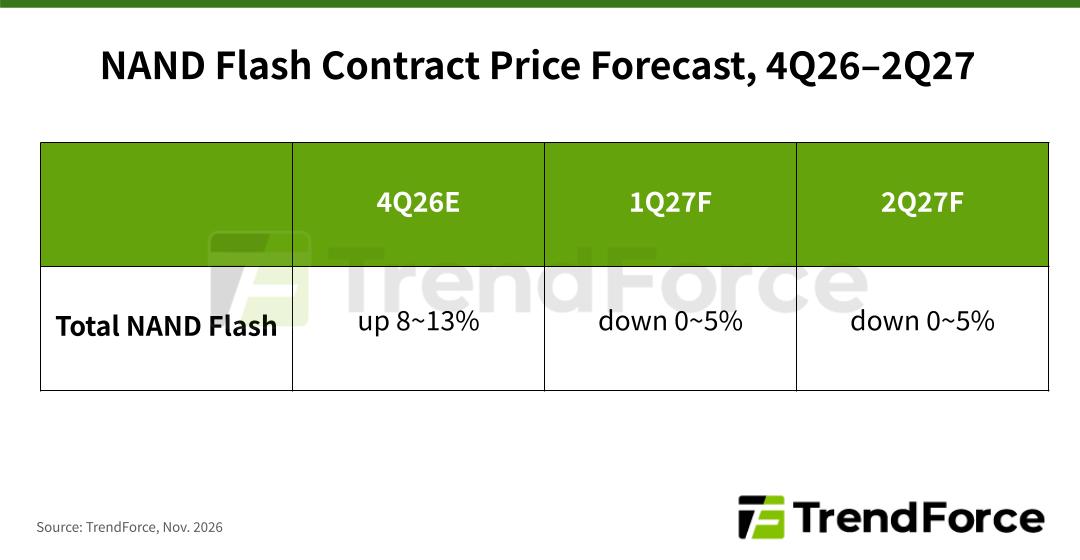
TrendForce’s November 2026 NAND forecast concerns flash-storage contract prices, rather than finished-server prices. Source: TrendForce NAND outlook.
XTX Finland OY, the Finnish subsidiary of British algorithmic trading firm XTX Markets, has sued Irish-registered Dell Products Unlimited Company over servers for its data-centre project. XTX uses machine learning to forecast prices for more than 50,000 financial instruments, according to Finnish construction company YIT's August 2025 project announcement. Computing capacity underpins its trading research.
The stakes extend beyond one order. Reporting on the Finnish development describes a planned five-data-centre complex in Kajaani worth more than €1 billion. YIT announced an agreement for the first centre in December 2024 and a contract for the second centre's shell and core in August 2025; the latter contract's value was undisclosed.
According to the June court report, XTX claims it agreed a price of about $549 million for 1,680 servers and an additional $5 million payment to avoid future price increases. It says delivery slipped by two months before Dell demanded another $62 million–$70 million because component costs had risen, with possible further increases to follow. The agreement was signed in November 2025.
The demanded increase amounts to roughly 11%–13% of the reported $549 million price, calculated by dividing the additional amounts by that base. It is a distinct example from the reported increases reaching 45% elsewhere.
Dell disputes XTX's claims. Responses attributed to Dell in the court reporting said it was unwilling to lose tens of millions of dollars and could not deliver at the terms it had considered valid when the agreement was signed. The broader pricing report, citing XTX's court filings, also relays XTX's account that Dell said other customers had tried alternative suppliers before returning and accepting adjustments. That account is not independently established evidence about competitors' offers.
At the June hearing, XTX's counsel said the servers were going to be delivered and about $70 million had been placed in escrow. The dispute concerns entitlement to the additional money, with delivery expected to proceed at that stage. It is not a court finding that Dell breached the agreement.
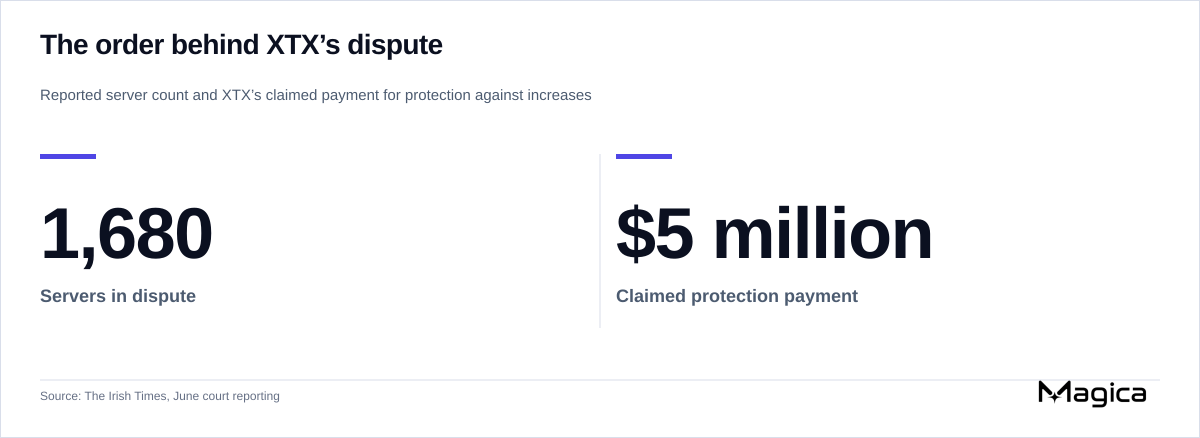
XTX says it agreed to pay extra for protection against increases. Dell disputes XTX’s claims; these figures are not a court finding of breach. Source: The Irish Times.
HPE's March account of strong demand had limits. Neri reported no slowdown at that point, but its finance chief expected higher prices to affect unit sales in the second half of the fiscal year. HPE also acknowledged some purchases had been brought forward to avoid increases, without quantifying them.
The partner report described a different response among some established enterprise customers. An executive at HPE reseller Advizex said a large manufacturing client postponed a compute purchase and planned to keep existing infrastructure for another 18–24 months. He distinguished those buyers from cloud providers willing to absorb higher prices.
HPE offered lower-memory configurations, GreenLake's consumption-based infrastructure model, financing and certified pre-owned equipment as alternatives. GreenLake orders were also covered by the reported February repricing terms. Changing payment models therefore does not itself demonstrate protection from adjustments before shipment.
For enterprises with fixed capital budgets, the problem is the gap between an approved quote and the final shipment cost, as a procurement analysis explains. Canceling, accepting a smaller configuration and extending existing equipment's life each change what the buyer receives or when it receives it.
Hardware is only part of project economics. In the Finnish project reporting, Antti Poikola, executive director of data-centre industry group Datakeskusteollisuus, emphasized operating costs, particularly electricity and cooling. XTX itself said in YIT's August 2025 announcement that proposed electricity-tax changes had left its longer-term investment roadmap under review. That was an earlier, separate uncertainty affecting future phases, before the November server agreement.
The June proceedings were adjourned to December, and the Finnish project report also places consideration of the dispute in Ireland's Commercial Court that month. The broader pricing report says the case remains ongoing. XTX declined to comment on the litigation.
The evidence needed to resolve the dispute is the particular contract: what protection the additional $5 million was intended to secure, what adjustments the agreement permits, and who is entitled to the escrow money. A December hearing need not settle all those questions. HPE has disclosed an express repricing policy; XTX claims it negotiated protection against increases. Suppliers' higher input costs and their forecasts alone do not resolve that contractual difference.
OpenRouter disclosed provider removals after investigations into inference data handling. Separate notices describe forwarded requests, a compromised deployment and stolen prompt samples, exposing different weaknesses behind privacy assurances.
Employee equity at Anthropic’s IPO price is reportedly worth $232 billion, while book rightsholders await a first settlement installment estimated at $2,203.56 per work. Vesting, shared copyrights and founder voting rights complicate the comparison.
Moore Threads is preparing a December 29 reveal for Lushan, a desktop GPU pitched at gaming and local AI inference. Its claimed memory record remains unquantified, and capacity alone will not establish performance or value.

Amazon is in advanced talks to buy Decart, whose software helps AI models run efficiently across chips. The reported deal could strengthen AWS’s Trainium business, with conditional payments and five-year founder commitments making execution central to its value.
The University of California is expanding ChatGPT and Codex access across 10 campuses, with extra charges for advanced models and an unresolved dispute over faculty authority.
Ray-Ban’s US store cuts the Gen 2 Wayfarer by 25% to $284.25. Buyers still face separate prescription-lens prices, a cheaper Gen 1 option and newer glasses outside Meta’s frame sale.
Ubisoft has made the team behind its Teammates experiment a dedicated subsidiary targeting AI characters with memory and outside game creators. Earlier playtests show both progress and limitations, while commercial plans remain undisclosed amid group cost cuts and refinancing.
Neuralink has shown a trial participant controlling GTA VI through intended movements. Earlier gaming use and company-reported trial results put the demonstration in context, while its reliability across users remains unmeasured in the reports.
SoftBank founder Masayoshi Son reportedly explored financing a $1 trillion acquisition of memory-chip maker SK hynix, but the company says the deal is no longer under active consideration. The target brings surging earnings, existing shareholders and customer commitments that complicate any simple equation between ownership and access to AI-memory supply.
Nvidia reported $115.8 billion in quarterly revenue, but its shares fell 14% Friday amid a wider technology selloff, a leadership transition and a reported accounting investigation. Strong cash generation offers a counterweight to concerns about the durability of AI spending.
The Nasdaq 100 fell 5.6% on November 20 and closed 19.8% below its record after an intraday bear-market breach. Nvidia’s revenue surge and Anthropic’s huge IPO did not halt the rout; infrastructure bills and resilience elsewhere in the market complicate the picture.
Reporting traces how Megaspeed gained access to Nvidia chips through an unlisted Inspur subsidiary and alleges links to a Cambodian smuggling intermediary. Company denials, differing customs totals and an unresolved criminal investigation complicate the account.
Together AI says an intruder downloaded stored samples of June and July API prompts and searched them for credentials. Zero data retention is now the default for new accounts, but the number of affected customers remains undisclosed.
Users describe grief and physical distress when AI relationships end, whether they choose to leave or the service changes. Research on attachment and farewell tactics raises questions about how providers measure engagement, manage updates and protect intimate data.
UN-backed talks agreed on two more years of work toward an autonomous-weapons instrument, without committing to a treaty. Consensus kept major military powers involved while allowing opponents to weaken the mandate.
Tesla is sending FSD v15 to its first customers, adding a visualization of planned driving and changes to navigation and hazard detection. The software remains supervised, and its claimed 25-fold intervention improvement lacks a disclosed baseline.
OpenAI reports sharply lower reasoning-extraction rates in internal GPT-6.2 tests and backs sanctions against illicit foreign distillation. Its own research and rival Anthropic’s experience show why protecting hidden reasoning leaves capability transfer and customer costs unresolved.
Alberta proposes 600-metre setbacks for large data centres and expanded utility oversight, but exemptions and rules still to be written will determine how much protection communities receive.
President Donald Trump backed Commerce Secretary Howard Lutnick as lawmakers scrutinize alleged delays in restricting a suspected route for AI chips to China. A new congressional inquiry also questions Nvidia’s influence on an existing investigation.

Amazon’s month-old Echo Time is $50 off for Black Friday. Its touchscreen, home hub and optional sleep-aware alarm cost $90 more than the reported Echo Spot price, while Alexa+ access and evidence of better waking remain key buying questions.