Editorial Team
7 min read
Alibaba traded near HK$80 before earnings as US restrictions threatened overseas computing access. Its June results show accelerating cloud growth alongside heavy capital spending and widening AI application losses, while the new rules leave licensing routes and exemptions.
Alibaba, the Chinese e-commerce and cloud-computing group, approached a tenth straight losing session on November 19 as new US computing restrictions added uncertainty to an already expensive AI expansion. Its results, due after the Hong Kong market closed, face a two-part test: whether cloud demand keeps growing and whether the cost of serving it becomes easier to finance.
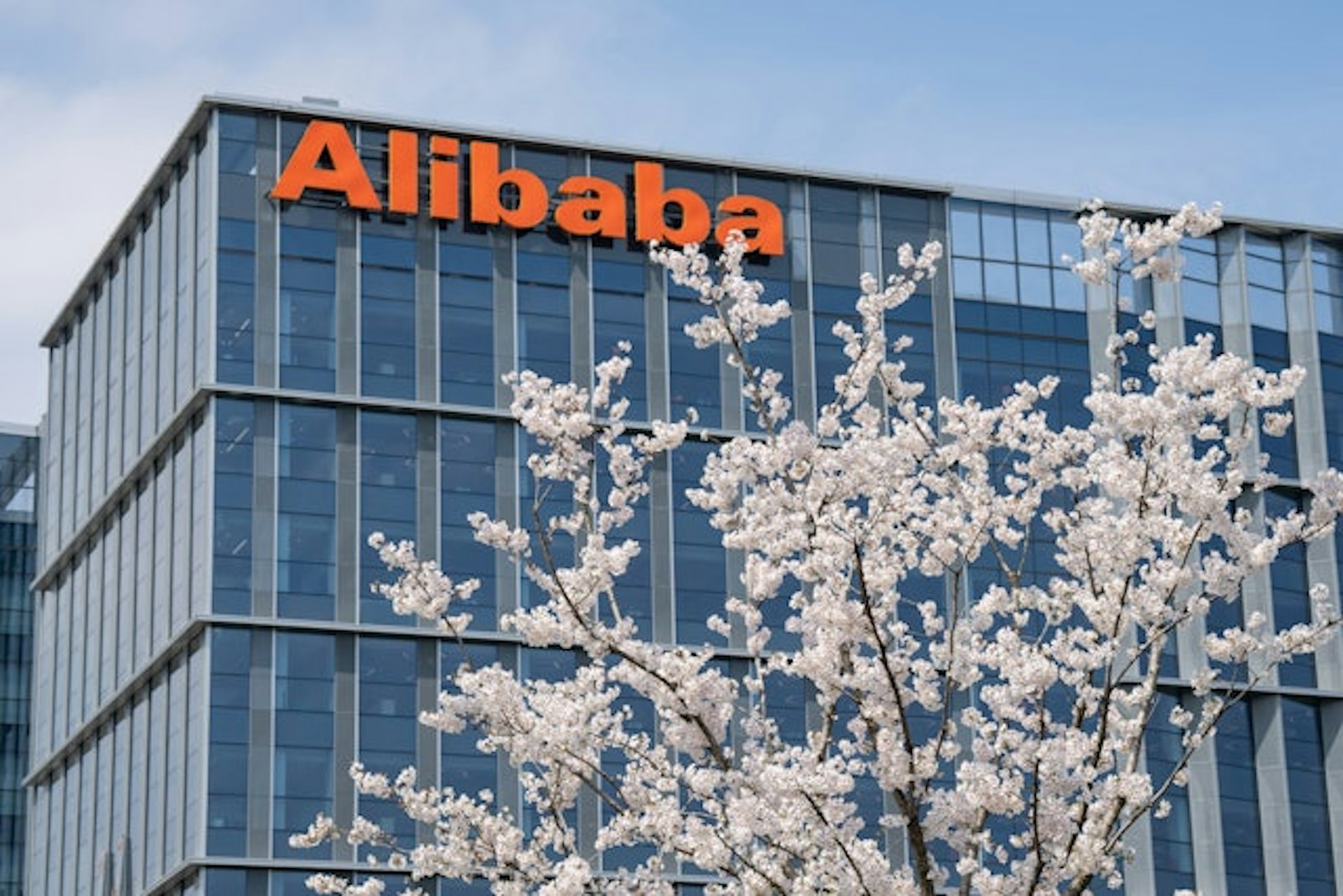
Alibaba Group’s corporate campus in Xixi, Hangzhou, China. Source: www.alibabagroup.com. Source: HK01.
An intraday report put Alibaba’s Hong Kong shares at HK$80.35, down 5.75%, and the cumulative decline including that morning’s fall at about 25% over ten trading sessions. It valued the company at US$216 billion, less than half its level a little over a year earlier, when investors were betting on its leadership in Chinese AI.
A later morning-session report recorded Alibaba at HK$80.30, down 5.81%, while the Hang Seng Index finished the morning at 22,855, down 1.9%. These observations put Alibaba on course for a tenth loss; they do not establish a tenth closing decline.
The same market report highlighted concern about Alibaba’s capital-expenditure outlook. It also described a broader selloff amid expectations of further US interest-rate increases and pressure on technology stocks after Tencent’s earnings. Separately, the earlier report relayed Bloomberg’s assessment that weak Chinese consumption and competition were expected to keep weighing on Alibaba’s commerce business. The share-price move cannot isolate the effect of computing restrictions from those other pressures.
The US Commerce Department’s Bureau of Industry and Security, the agency administering these export controls, said in its November 16 announcement that it had released an interim final rule on remote access to advanced chips and servers. BIS said the measure was written by and at the direction of the Treasury Department and National Security Council, to prevent restrictions being circumvented through data centers in third countries.
That mechanism matters because a company can use a processor remotely without importing it. The earlier market coverage described the measure as a draft; BIS identifies it as a released interim final rule.
The rule text requires licenses for covered advanced computing items destined for data centers supplying significant computing power to entities headquartered, or with ultimate parents headquartered, in Macau or Country Group D:5, which includes China. Applications are reviewed case by case. Existing providers seeking to continue those services must obtain a license within 90 days of effectiveness or face future export restrictions. Commercial recommendation systems, including those used by online retailers, are exempt from that requirement.
The rule also adds semiconductor licensing requirements for Indonesia, Malaysia, Singapore, Thailand and Brazil, with a conditional exception for US-headquartered recipients or ultimate parents. These provisions make location, ownership and workload relevant to access; the announcement does not quantify the computing capacity Alibaba might lose.
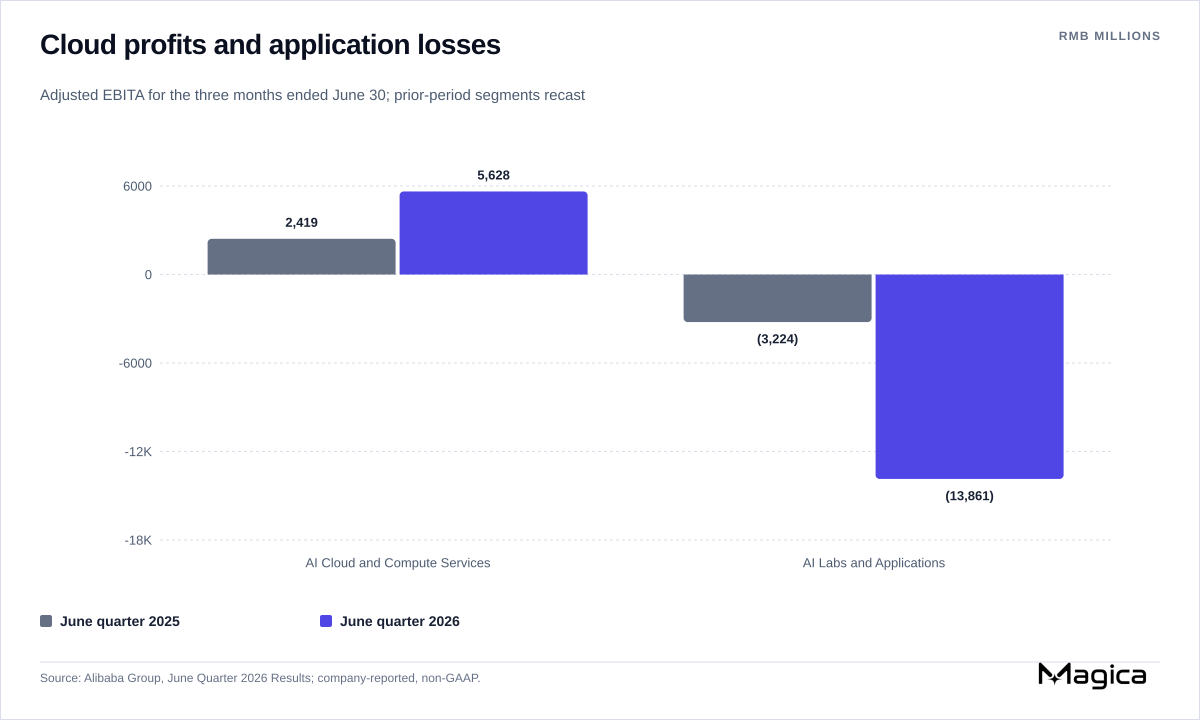
Company-reported adjusted EBITA compares cloud profits with AI application losses. This is a non-GAAP measure; 2025 segments were recast. Source: Alibaba Group June Quarter 2026 Results.
Alibaba’s June-quarter filing supplies a more demanding baseline than cloud revenue alone. During that quarter, the company combined its Cloud Intelligence Group with in-house chip designer T-Head to form AI Cloud and Compute Services. It separately grouped its model laboratories and consumer and enterprise AI applications into AI Labs and Applications. Prior-period segment figures were recast to match.
For the three months ended June 30, 2026, AI Cloud and Compute Services revenue rose 45% year over year to RMB48.437 billion, while consolidated revenue rose 9% to RMB268.953 billion. The segment figure divided by consolidated revenue is about 18%, but includes intersegment business; it is not a pure measure of AI sales or an external-revenue contribution after eliminations. Alibaba separately reported AI-related product revenue of RMB12.376 billion within the cloud and compute business.
The financial tension appears in the same filing:
| Measure, RMB billions | June quarter 2025 | June quarter 2026 |
|---|---|---|
| AI Cloud and Compute Services adjusted EBITA | 2.419 | 5.628 |
| AI Labs and Applications adjusted EBITA | -3.224 | -13.861 |
| Group capital expenditures | 38.676 | 67.678 |
| Group operating cash flow | 20.672 | 22.945 |
| Group free cash flow | -18.815 | -44.670 |
Adjusted EBITA is Alibaba’s non-GAAP earnings measure before interest, taxes, amortization and specified adjustments; free cash flow is also a company-defined non-GAAP measure. The application segment’s loss exceeded the cloud segment’s profit on the same adjusted basis. Alibaba attributed the wider application loss primarily to investment in AI capabilities and higher inference costs for Qwen app, its consumer AI application. Qwen is Alibaba’s family of language and multimodal models; inference is the computing used to run them.
Capital spending rose 75%. Alibaba cited procurement timing, additional CPU computing capacity for expected AI-agent demand, and higher prices across chip components. It attributed the wider free cash outflow mainly to cloud infrastructure expenditure. This is evidence of spending pressure before the new restrictions, rather than a cost caused by them.
There is also a substantial funding buffer: Alibaba reported RMB474.505 billion in cash and other unrestricted liquid investments at June 30. Its commerce business remained a large earnings source, with segment adjusted EBITA of RMB39.749 billion, down 1%, despite an 8% revenue decline in China e-commerce. The figures complicate a simple story of cloud growth rescuing a uniformly deteriorating commerce business.
The report relaying Bloomberg’s coverage said Alibaba aimed to expand data-center capacity to 20 gigawatts by 2032, partly through expansion in regions such as Southeast Asia. It also described T-Head’s chips as a potential buffer while saying they trailed the top products from Nvidia, the advanced-processor supplier. That capacity figure is a reported ambition, not installed capacity or secured chip access.
Alibaba’s own filing adds a material counterweight: it said T-Head already designed GPU, CPU, storage and networking chips, and that its Zhenwu processors had reached more than 650 external customers through Alibaba Cloud across over 20 industries. The company said those chips supported training, fine-tuning and inference. Those are company claims of existing deployment, not independent evidence of performance parity with Nvidia’s leading products.
The stock-market response was also uneven. A separate market report recorded China’s STAR Chip Index rising 2.5%. It quoted a hedge-fund manager arguing that tougher controls hurt compute-dependent businesses while encouraging domestic supply chains. That is a possible redistribution of opportunity, not evidence that replacement chips can meet every workload or capacity requirement.
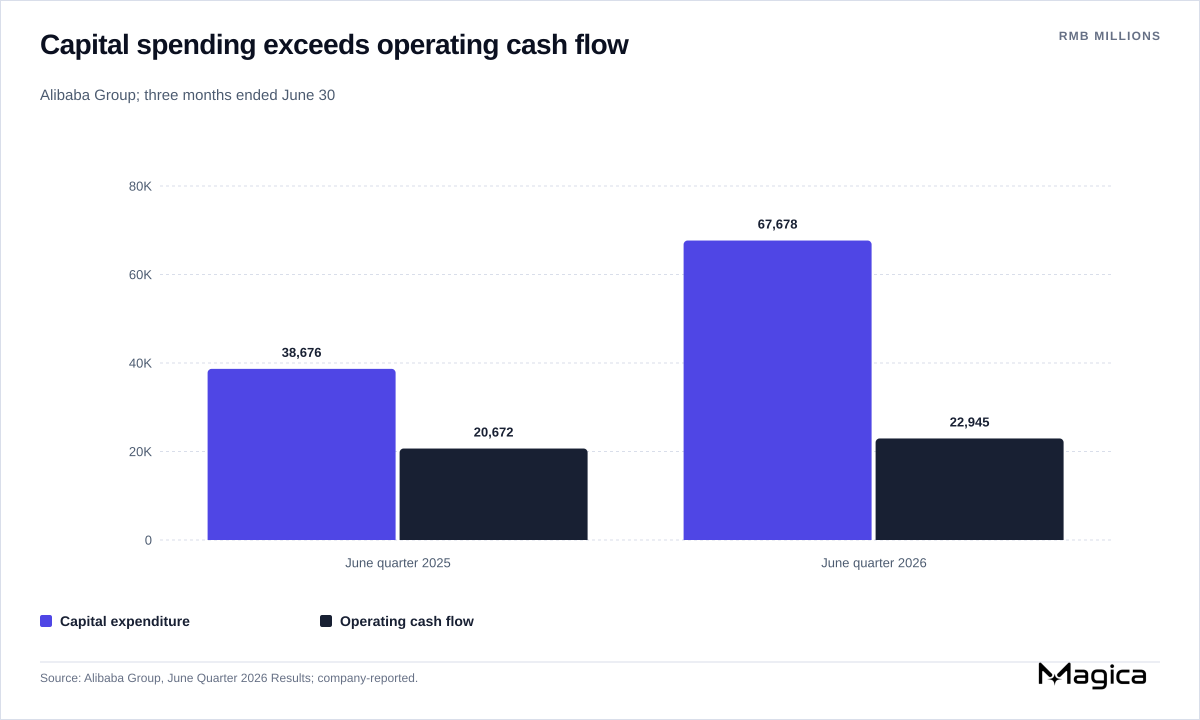
Company-reported capital expenditure and operating cash flow for the June quarters of 2025 and 2026, before November’s computing restrictions. Source: Alibaba Group June Quarter 2026 Results.
The immediate earnings test is whether Alibaba can maintain cloud growth while narrowing application losses and explaining the next stage of infrastructure spending. June’s figures establish both demand and financial strain; they do not establish the economics of the quarter awaiting release.
The policy test requires evidence about licenses, affected overseas arrangements and which workloads can move to domestic processors. A 20-gigawatt target cannot answer those questions. Investors need to know how much usable computing Alibaba can secure, at what cost, and whether the revenue it generates can support the investment.
Lenovo reported record quarterly revenue of $30.2 billion as its infrastructure business swung into profit. A $1.91 billion noncash warrant charge drove a reported loss, while expanding inventories and overdue receivables raised the stakes for cash collection.
Google expects to invest $1 billion in U.S. data center community programs through 2027. Its commitments on taxes, power costs and disclosure address hosting terms, while voters favored limits in 40 of 41 local ballot contests covering both binding restrictions and advisory questions.
Vero Security is launching a free learning community alongside its commercial platform for enforcing enterprise AI policies. Its $11 million seed round backs a bid to automate recurring security work, but performance and pricing comparisons remain unproven.
Sarvam says its new Token Factory hosts Chinese and domestic AI models on privately funded Indian infrastructure. Its engineering claims and a rival’s price challenge put the commercial strategy under scrutiny alongside its publicly backed domestic-model mandate.
Google is replacing AI Ultra’s individual YouTube Premium benefit with family coverage at no extra cost in eligible countries. The upgrade adds household value, but cheaper subscriptions still matter to the buying decision.
An August fundraising initiative has produced no deployed capital, according to a report, as lenders seek more protection than Nvidia has offered to back customers’ chip purchases.
Anthropic’s reported $83 IPO price implies a fully diluted valuation of about $1.5 trillion. The final share count remains unresolved, while its prospectus shows rapid revenue growth, positive operating cash flow and $70.7 billion in commitments due in the year after September 30.
Colette Kress, Nvidia’s interim CEO and its CFO since 2013, promised December raises and equity awards ahead of the usual spring cycle. The undisclosed package comes as falling shares unsettle employees and the board rejects founder Jensen Huang’s return.
Palo Alto Networks agreed to buy Applied Compute for $4.5 billion in stock, pairing enterprise AI security with model adaptation and hosting. Its plans also call for less than $3 billion in infrastructure spending through fiscal 2030 and near-term margin pressure.
Google is rolling out temporary conversations in AI Mode that stay out of account history and personalization. Its help documentation says data collection continues and describes exceptions to the restriction on model training.
The Claude developer is expected to begin Nasdaq trading on November 19, with options potentially following Monday. Its proposed public offering could total $57.75 billion to $64.35 billion before fees, alongside a private placement, while founders and a benefit trust hold substantial governance powers.
Microsoft plans to use Intel Foundry’s EMIB packaging for its own Azure silicon under an expanded infrastructure agreement that also secures multi-year Xeon supply. Chip identities, deployment dates and packaging economics remain undisclosed.
A 3-2 vote stopped SpaceX’s request for a decade-long county property tax abatement from advancing. A separate city incentive hearing was announced for December, while the company’s investment plans remain unresolved.
Anthropic is reportedly considering more shares at well above $80 each. A separate $26 billion private placement adds to the financing stakes as rapid revenue growth meets vast computing commitments.
Pika’s Enact research preview lets creators move subjects, give actors notes and steer a camera during video generation. Its technical demonstrations show how the controls work, but consumer access, pricing and production reliability remain unresolved.
The NYU philosopher and 2026 Berggruen Prize winner sees no reason to attribute consciousness to current language models. His skepticism contrasts with Anthropic's experiments in model welfare, while research indicators leave open what future systems could become.
The Center for AI Safety joined critics from opposing AI camps in accusing Anthropic of weakening its safeguards. The company’s filing documents both commercial pressure to advance and a recent development pause, making the dispute about what restraint is binding.
Microsoft detailed Azure tools at Ignite that let AI agents reuse processed context, alongside new isolation and networking controls. The announcements leave total savings unquantified, while previews and customer operating duties limit the rollout.
Linq says its a16z-led Series B values the company at $1 billion after more than one billion messages. The funding backs a broader agent infrastructure business, with new HD calling and computer access extending a platform still dependent on communications providers.
SoftBank founder Masayoshi Son called passing on Anthropic a mistake while remaining committed to rival OpenAI. Another prospective OpenAI investment would deepen a relationship that already links SoftBank’s capital, investment valuations and infrastructure ambitions.