Editorial Team
7 min read
Linq says its a16z-led Series B values the company at $1 billion after more than one billion messages. The funding backs a broader agent infrastructure business, with new HD calling and computer access extending a platform still dependent on communications providers.
Linq, a developer infrastructure company that evolved from digital business cards into messaging for AI assistants, announced the financing on November 18, 2026. It says customers have processed more than one billion messages through its systems. The capital backs a broader platform for agents that need to call people or operate software to finish a task.
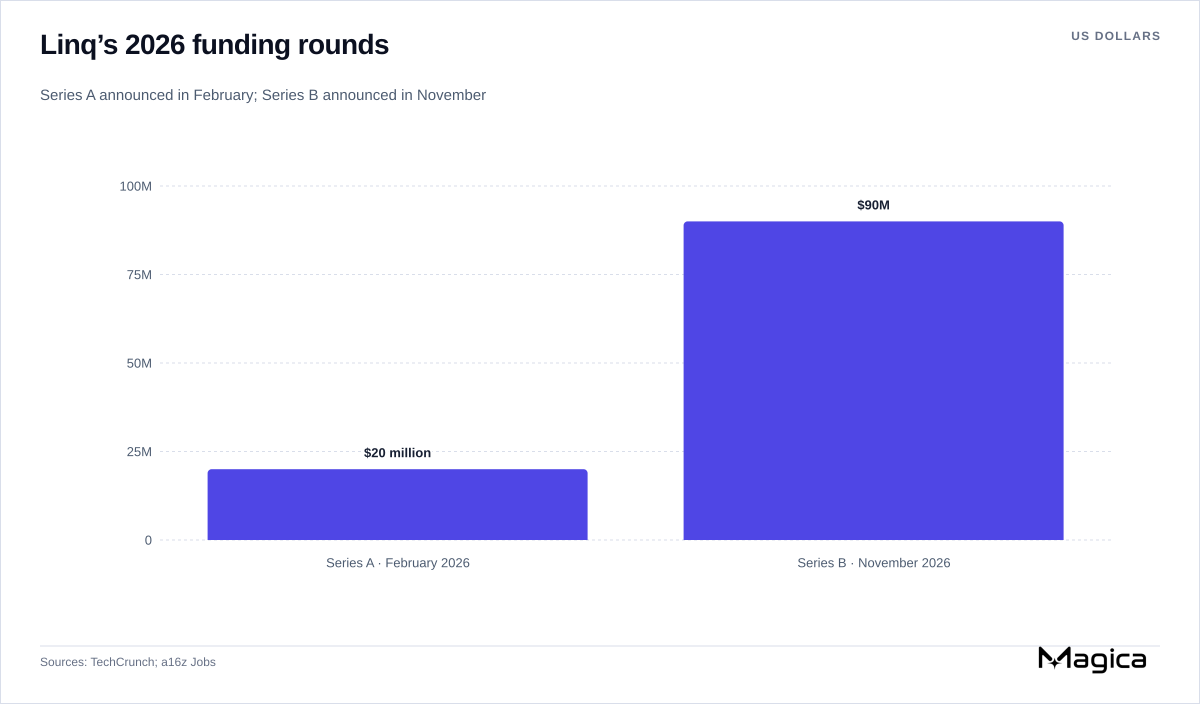
Company-reported financing: Linq raised $20 million in its February Series A and $90 million in its November Series B. Chart: Magica. Source: TechCrunch.
Venture capital firm Andreessen Horowitz, known as a16z, led the round. Linq says in its announcement that returning investors TQ Ventures, Mucker Capital and Abstract participated alongside new investors Anthos and Left Lane Capital. Total funding exceeds $120 million, and the company puts its valuation at $1 billion.
The new round is 4.5 times the $20 million Series A led by TQ Ventures announced in February. A separate account of the Series B says the valuation was undisclosed, conflicting with Linq’s explicit disclosure. The $1 billion figure is the company’s stated valuation.
Ben Horowitz, a16z’s co-founder and former CEO and co-founder of data-center automation software company Opsware, is joining Linq’s board. He led Opsware when HP agreed to acquire it in 2007 at approximately $1.6 billion in enterprise value, as documented in its acquisition filing. His appointment gives the lead investor a board role during Linq’s infrastructure expansion.
Linq co-founder and CEO Elliott Potter previously led expansion, growth engineering and marketing at grocery-delivery company Shipt. Fellow founders CTO Patrick Sullivan and president Jared Mattsson also came from Shipt: Sullivan was a founding engineer who led an engineering organization of more than 100 people, while Mattsson worked in customer and partner success, according to the investor’s recruiting newsletter.
In its investment announcement, a16z says it first met Potter in 2020, when Linq was building digital business cards in Birmingham, Alabama. Sales software and AI sales agents followed. Customers then asked to use the messaging technology beneath Linq’s application, prompting a rebuild around communications infrastructure.
The investor points to Potter’s public account of nearly running out of money multiple times and says the founders moved to San Francisco to be closer to customers. Its recruiting newsletter puts the current team at 60 people, with offices in San Francisco and New York. The financing follows repeated reinventions, rather than a straight path from business cards to agents.
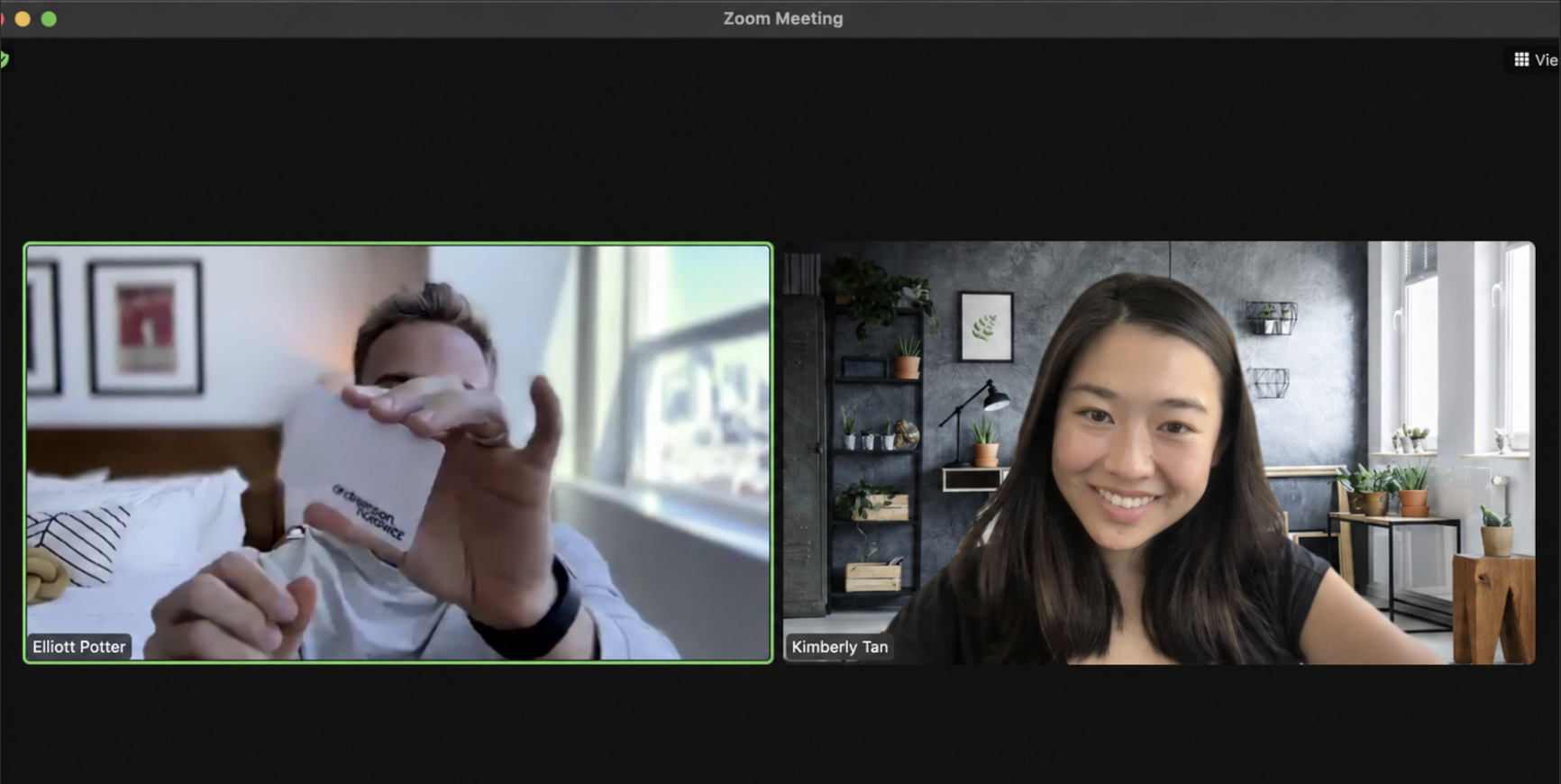
A16z’s screenshot of its first meeting with Elliott Potter in 2020, when Linq was building digital business cards. Image: Andreessen Horowitz. Source: Andreessen Horowitz.
A February report based on interviews with Potter dates Linq’s business iMessage API launch to February 2025. The developer interface offered features including group chats, threaded replies, images and voice notes. Potter said that within eight months Linq had doubled the annual recurring revenue it had built over four years; no absolute revenue was given.
Poke, a personal AI assistant from The Interaction Company of California that handles tasks and calendars within iMessage, was an important early customer. Its maker approached Linq in spring 2025. Potter told the February report that Poke’s viral September launch brought requests from other AI companies to use the messaging API.
Linq now names DoorDash, Town and Tab as customers running agents on its infrastructure. It says food-ordering company DoorDash uses the service to let customers find food, assemble a cart and check out within one Apple Messages for Business conversation. The announcement gives no transaction volume or completion rate.
Linq and a16z say it is an official messaging service provider for Apple Messages for Business, Apple’s channel for conversations between businesses and customers. That is a specific enterprise relationship, rather than evidence of unrestricted access across Apple’s consumer messaging platform.
Apple retains a role in deployment. The investor’s recruiting newsletter describes taking brands through Apple’s registration and user-experience approval process. The February report identified the risk that Apple could restrict third-party AI chatbots; it did not report that Apple had done so.
Existing alternatives narrow the novelty claim. Apple already offered business messaging, and Twilio supplied infrastructure for companies to text customers, the February report noted. Linq’s earlier pitch emphasized native iMessage features and blue-bubble conversations rather than visibly branded business messages. Its current DoorDash example uses Apple Messages for Business. Approval for that service should not be read as blanket authorization for every messaging use case.
Nor is Linq confined to iMessage. A16z says it already offers RCS and WhatsApp, alongside other platforms. That broadens its reach beyond a channel the February report described as popular mainly in the U.S., while leaving access dependent on the platforms carrying the conversations.
The company’s billion-message figure is cumulative traffic, not a count of customers, paid tasks or completed purchases. The investor’s newsletter separately says the total is growing by more than 150 million messages each month.
At the February Series A, Linq claimed more than 30 million messages a month and said its customers’ agents reached 134,000 monthly active users, according to the interview report. Those users were people reached by customers’ agents, rather than Linq’s paying developer accounts. The historical and current traffic claims lack a consistent measurement series sufficient to calculate a precise growth rate.
There was also a commercial signal: Linq claimed 295% net revenue retention and zero churn in February. The report supplied no measurement window or underlying customer-cohort detail for those figures. Along with Potter’s account of doubled recurring revenue, they indicate company-reported expansion, rather than an independently verified picture of present profitability.
The new funding announcements provide no current absolute revenue, comparable retention figure, gross margin or pricing detail. Traffic cannot establish what Linq earns per message, what a completed agent task costs to deliver, or how much revenue the newer services contribute—material gaps when assessing its stated $1 billion valuation.
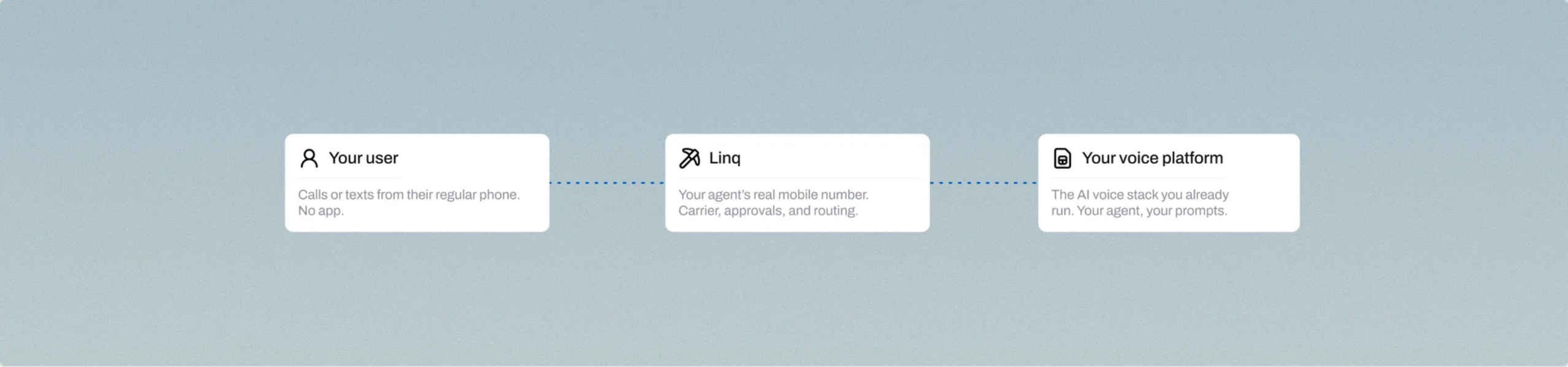
Company-reported architecture: Linq supplies the mobile number and carrier routing connecting a user’s phone to a developer’s voice platform. Diagram: Linq. Source: Linq HD Calling announcement.
Calling is an extension of an existing capability: Potter said in February that Linq already offered programmatic voice. The company’s November 12 HD Calling announcement describes incoming and outgoing calls using the same mobile number as an agent’s messages. It says HD speech requires the other phone to support HD, and developers bring a compatible AI voice platform. Linq supplies the connection for that voice software.
The company also says it is giving agents physical computing infrastructure to interact with software, naming browser-use company Kernel among its first computer-use customers. The recruiting newsletter lists payments among its capabilities. Linq says the funding will support continued messaging investment, expanded software and hardware infrastructure, and partnerships.
The practical question is whether developers adopt these services together: an appointment request may require a call, and an administrative request may require operating software. Paid adoption of calling and computing, reliable task completion, and the cost of delivering it would test the broader platform’s value. The messaging workload shows demand for communication; these newer services need their own operating and financial evidence.
Lenovo reported record quarterly revenue of $30.2 billion as its infrastructure business swung into profit. A $1.91 billion noncash warrant charge drove a reported loss, while expanding inventories and overdue receivables raised the stakes for cash collection.
Google expects to invest $1 billion in U.S. data center community programs through 2027. Its commitments on taxes, power costs and disclosure address hosting terms, while voters favored limits in 40 of 41 local ballot contests covering both binding restrictions and advisory questions.
Alibaba traded near HK$80 before earnings as US restrictions threatened overseas computing access. Its June results show accelerating cloud growth alongside heavy capital spending and widening AI application losses, while the new rules leave licensing routes and exemptions.
Vero Security is launching a free learning community alongside its commercial platform for enforcing enterprise AI policies. Its $11 million seed round backs a bid to automate recurring security work, but performance and pricing comparisons remain unproven.
Sarvam says its new Token Factory hosts Chinese and domestic AI models on privately funded Indian infrastructure. Its engineering claims and a rival’s price challenge put the commercial strategy under scrutiny alongside its publicly backed domestic-model mandate.
Google is replacing AI Ultra’s individual YouTube Premium benefit with family coverage at no extra cost in eligible countries. The upgrade adds household value, but cheaper subscriptions still matter to the buying decision.
An August fundraising initiative has produced no deployed capital, according to a report, as lenders seek more protection than Nvidia has offered to back customers’ chip purchases.
Anthropic’s reported $83 IPO price implies a fully diluted valuation of about $1.5 trillion. The final share count remains unresolved, while its prospectus shows rapid revenue growth, positive operating cash flow and $70.7 billion in commitments due in the year after September 30.
Colette Kress, Nvidia’s interim CEO and its CFO since 2013, promised December raises and equity awards ahead of the usual spring cycle. The undisclosed package comes as falling shares unsettle employees and the board rejects founder Jensen Huang’s return.
Palo Alto Networks agreed to buy Applied Compute for $4.5 billion in stock, pairing enterprise AI security with model adaptation and hosting. Its plans also call for less than $3 billion in infrastructure spending through fiscal 2030 and near-term margin pressure.
Google is rolling out temporary conversations in AI Mode that stay out of account history and personalization. Its help documentation says data collection continues and describes exceptions to the restriction on model training.
The Claude developer is expected to begin Nasdaq trading on November 19, with options potentially following Monday. Its proposed public offering could total $57.75 billion to $64.35 billion before fees, alongside a private placement, while founders and a benefit trust hold substantial governance powers.
Microsoft plans to use Intel Foundry’s EMIB packaging for its own Azure silicon under an expanded infrastructure agreement that also secures multi-year Xeon supply. Chip identities, deployment dates and packaging economics remain undisclosed.
A 3-2 vote stopped SpaceX’s request for a decade-long county property tax abatement from advancing. A separate city incentive hearing was announced for December, while the company’s investment plans remain unresolved.
Anthropic is reportedly considering more shares at well above $80 each. A separate $26 billion private placement adds to the financing stakes as rapid revenue growth meets vast computing commitments.
Pika’s Enact research preview lets creators move subjects, give actors notes and steer a camera during video generation. Its technical demonstrations show how the controls work, but consumer access, pricing and production reliability remain unresolved.
The NYU philosopher and 2026 Berggruen Prize winner sees no reason to attribute consciousness to current language models. His skepticism contrasts with Anthropic's experiments in model welfare, while research indicators leave open what future systems could become.
The Center for AI Safety joined critics from opposing AI camps in accusing Anthropic of weakening its safeguards. The company’s filing documents both commercial pressure to advance and a recent development pause, making the dispute about what restraint is binding.
Microsoft detailed Azure tools at Ignite that let AI agents reuse processed context, alongside new isolation and networking controls. The announcements leave total savings unquantified, while previews and customer operating duties limit the rollout.
SoftBank founder Masayoshi Son called passing on Anthropic a mistake while remaining committed to rival OpenAI. Another prospective OpenAI investment would deepen a relationship that already links SoftBank’s capital, investment valuations and infrastructure ambitions.