Editorial Team
8 min read
Palo Alto Networks agreed to buy Applied Compute for $4.5 billion in stock, pairing enterprise AI security with model adaptation and hosting. Its plans also call for less than $3 billion in infrastructure spending through fiscal 2030 and near-term margin pressure.
Palo Alto Networks agreed on November 18 to buy Applied Compute, a startup that adapts and runs open-weight AI models, for $4.5 billion in stock. For the enterprise cybersecurity supplier, the deal adds a model-serving business and a research team, alongside plans for infrastructure spending and near-term margin pressure.
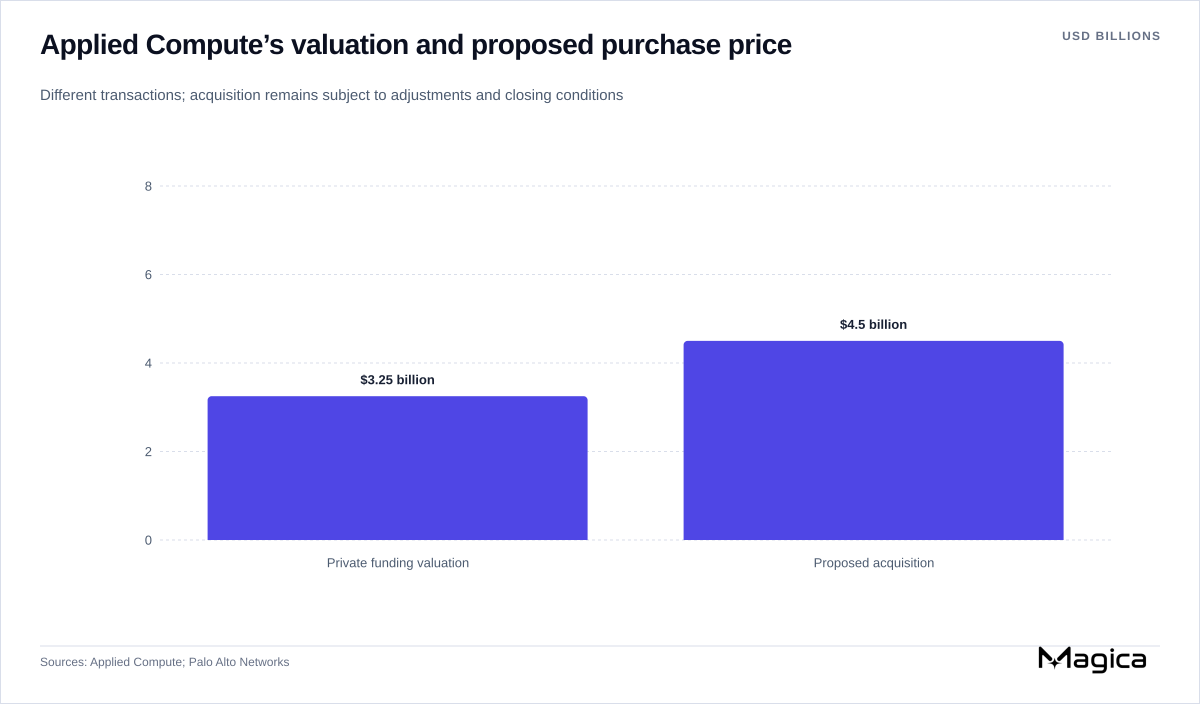
Company-reported figures compare Applied Compute’s private valuation with Palo Alto Networks’ proposed all-stock acquisition value, subject to adjustments and closing conditions. Sources: Applied Compute and Palo Alto Networks. Source: Applied Compute funding and operating update.
The acquisition announcement confirms a $4.5 billion all-stock transaction expected to close in Palo Alto Networks’ fiscal third quarter of 2027, subject to regulatory clearance and other customary conditions. Palo Alto supplies enterprise security across networks, cloud systems, security operations and identity; Applied Compute supplies software and research expertise for post-training and inference. The buyer says it serves more than 70,000 customers, giving the startup a much larger potential distribution channel.
That distinction explains the expansion. Post-training adapts an already trained model to particular tasks or data. Inference runs the resulting model to produce answers. Open-weight models make their trained parameters publicly available, allowing businesses to adapt and operate them on their own data, as described in the report on the deal.
Palo Alto says enterprises will use a mixture of open-weight and closed frontier models, with different cost and control requirements. It intends to combine Applied Compute’s platform with security for deployments in public clouds and sovereign environments. The proposed role reaches into the model’s adaptation and operation, giving Palo Alto a commercial stake in the AI workloads it also proposes to protect.
Applied Compute was founded in 2025 by former OpenAI employees, according to a report describing its origins. Yash Patil, Applied Compute’s co-founder and chief executive and a former OpenAI employee, is set to become Palo Alto’s co-chief AI officer after closing. Palo Alto says it evaluated the startup while considering becoming its customer and assessed its security foundations through Unit 42, its threat-intelligence team. That is the buyer’s assessment, rather than an independent comparison of competing platforms.
The target has about 70 employees, all based in the United States, according to the earnings presentation. Palo Alto expects 100 AI researchers by the end of fiscal 2027 and says the combined effort will help embed AI across its products, with at least 35 models in training. The research team therefore has an internal role as well as a customer-facing business.
Applied Compute said in its funding and operating update that it had raised $350 million at a $3.25 billion valuation and reached a $100 million annualized revenue run rate in less than 18 months. It named Microsoft, Shopify and DoorDash among its customers. The acquisition price is $1.25 billion, or roughly 38%, above that disclosed private valuation. Those are headline valuations from different transactions, rather than a measure of any individual investor’s return.
The funding round was led by investor Elad Gil, with participants including NVIDIA and Shopify Ventures. Applied Compute said it planned to use the financing to expand compute capacity, grow its team and accelerate enterprise deployment.
The gross $4.5 billion purchase price is about 45 times the reported $100 million annualized revenue run rate. That calculation compares the transaction value with a current pace of revenue, not a completed year’s sales or profit. Palo Alto also says the transaction includes approximately $500 million of cash and prepaid compute commitments, so the full price cannot be treated simply as payment for software revenue. Paying with new shares dilutes existing shareholders’ ownership.
The startup’s operating update points to a business already spanning adaptation and hosting. Its AC2 Agent Cloud combines training, inference and continual improvement; Applied Compute said customers had completed more than 1,700 training runs since July. Its AC Inference service handled more than 1 trillion tokens a day, and 40% of customers used Applied Compute for both training and inference. These are company-reported operating figures, not measures of profitability or retention.
Applied Compute also reported workload-specific savings: a model for customer Harvey’s Review Table product improved answer and citation quality at less than half the inference cost of an unspecified frontier alternative. A custom router for Clay reduced production inference costs by up to 47% without sacrificing quality, it said. The update supplies no common benchmark or price schedule that would make those examples a general cost advantage over rival platforms.
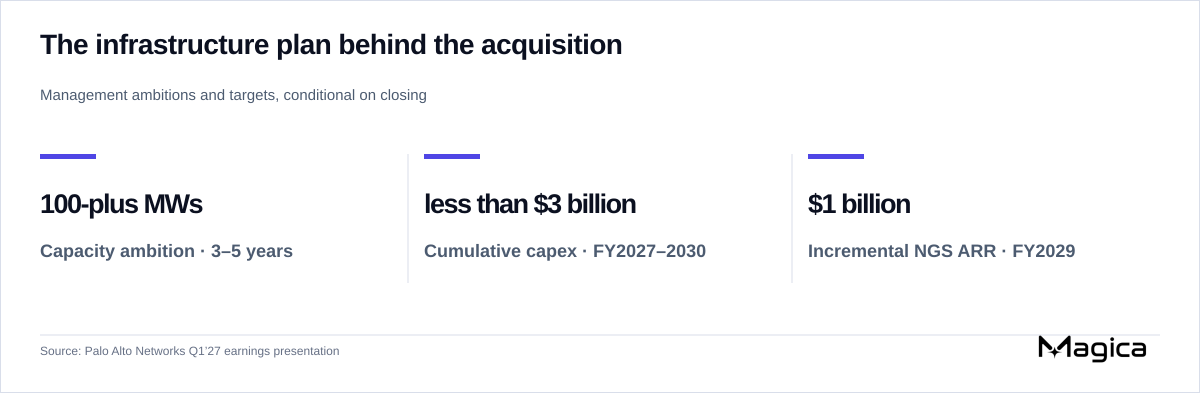
Company-reported plans call for 100-plus MW of inference capacity, cumulative capital spending below $3 billion and $1 billion in incremental NGS ARR on the timelines shown, conditional on closing. Source: Palo Alto Networks. Source: Palo Alto Networks Q1’27 earnings presentation.
Palo Alto’s presentation sets out an ambition to build diversified global inference capacity exceeding 100 MW in three to five years, with cumulative capital spending below $3 billion across fiscal 2027–2030. Its fiscal year ends on July 31. Management says it will obtain compute from multiple cloud partners as well as owned capacity, adding capacity in stages against demand it can see.
Its target is $1 billion of incremental Next-Generation Security annualized recurring revenue, or NGS ARR, by fiscal 2029, with capacity intended to support several billion dollars longer term. These are management targets conditional on the acquisition closing. NGS ARR measures annualized allocated revenue from active contracts in the covered portfolio; it is not the same as revenue recognized over a fiscal year.
Assuming a fiscal third-quarter 2027 close, management anticipates operating margins up to one percentage point lower in fiscal 2027 and two points lower in fiscal 2028, returning to its current 29%–30% range in fiscal 2029. These are adjusted profitability expectations; the company’s fiscal 2027 outlook uses a non-GAAP operating margin. Its fiscal 2028 adjusted free cash flow margin target of at least 38% explicitly excludes data-center capital spending. The exclusion matters when judging how much cash the inference buildout will consume.
Palo Alto’s reported revenue is growing, but adjusted profitability needs its own qualification. In first-quarter results for the three months ended October 31, 2026, Palo Alto reported revenue of $3.44 billion, up 39% from a year earlier. GAAP operating income fell to $96 million from $309 million, while non-GAAP operating income rose to about $1.1 billion. The adjusted measure excludes costs including stock compensation and amortization of acquired intangible assets.
Shares rose 8.5% in after-hours trading, according to the deal report. The company also forecast fiscal 2027 revenue of $14.52 billion–$14.57 billion, above the $14.16 billion analyst average compiled by LSEG. The share move therefore accompanied both the acquisition and an earnings outlook above expectations.
The acquisition also follows Palo Alto’s 2026 purchases of identity-security company CyberArk and observability firm Chronosphere. A separate report put those deals at approximately $21 billion in equity and around $3 billion, respectively. Palo Alto’s own acquisition announcement flags the risk of integrating Applied Compute while other recent acquisitions are still being integrated.
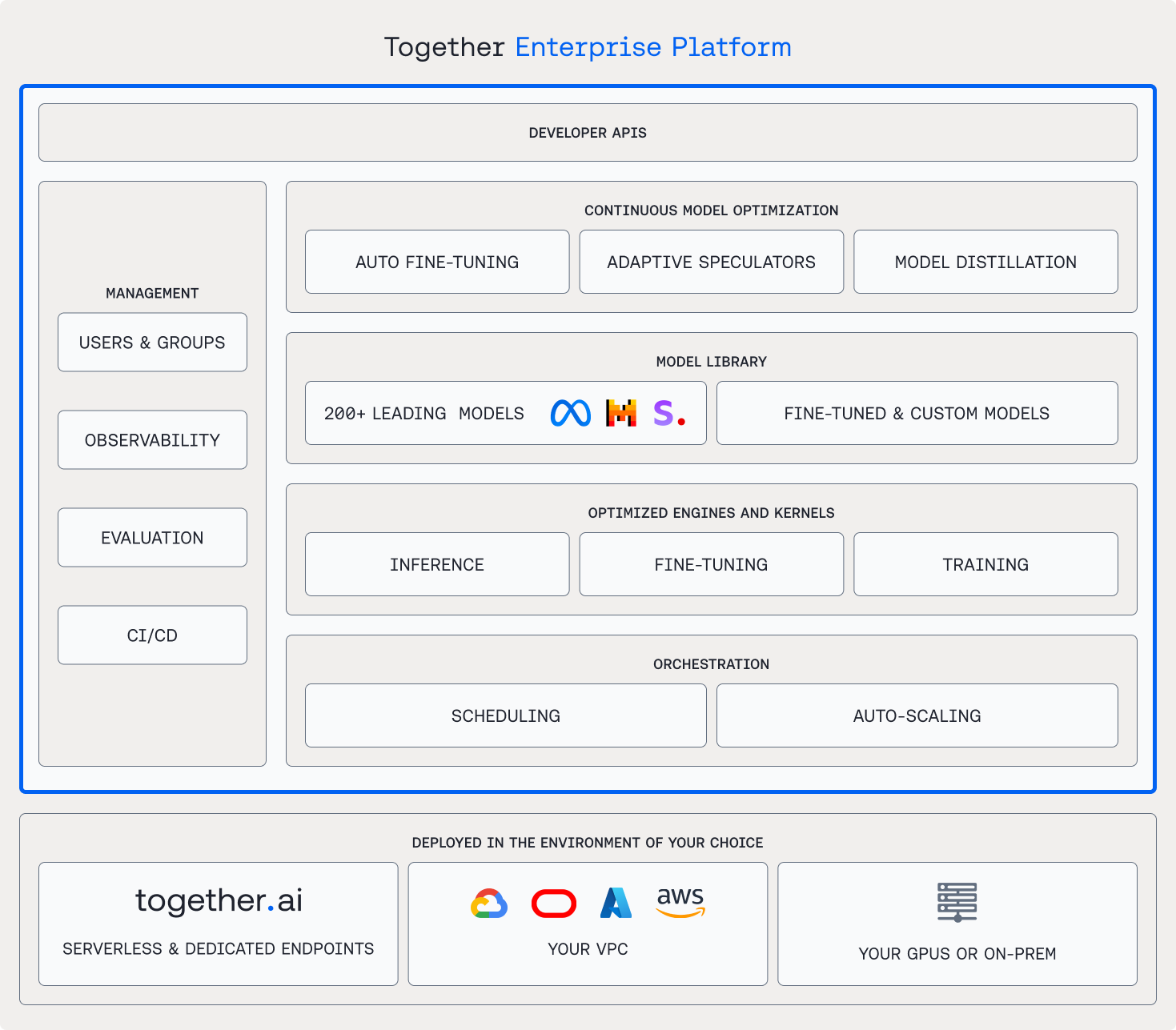
Together AI’s September 2024 diagram shows company-reported platform capabilities and deployment options across its cloud, customer VPCs and on-premises infrastructure. Source: Together AI. Source: Together AI Enterprise Platform announcement.
Palo Alto already sells Prisma AIRS, its suite for AI visibility, testing and runtime controls. Its presentation puts first-quarter fiscal 2027 ARR for that offering at about $170 million and its customer count above 1,100. Both metrics are based on booked allocations of flexible software firewall credits; customers can consume those credits across several products. They should not be read as a direct measurement of actual AI-security usage.
Applied Compute would extend that offering toward adapting and serving models, but enterprises already have alternatives. Together AI, an AI infrastructure provider, announced its Enterprise Platform in September 2024 for training, fine-tuning and inference, with deployment on its own cloud, a customer’s virtual private cloud or on-premises infrastructure. It said customer data could remain within the customer’s firewall. That overlaps with the control and deployment flexibility Palo Alto proposes to offer.
In July 2025, Together AI said it had completed a SOC 2 Type 2 examination, covering controls including access management, encryption and incident response. Such an audit does not establish the safety of model behavior or equivalence with Palo Alto’s proposed offering. It does, however, limit the acquisition announcement’s broad assertion that large providers are not delivering these models securely.
Palo Alto says Applied Compute will continue serving AI-native businesses and large enterprises while gaining access to its global customer base, according to the company’s statement. Regulatory clearance and the remaining closing conditions must come before the planned combination.
After that, the consequential evidence will be customer demand against staged infrastructure spending, the costs of serving those workloads, and progress toward the fiscal 2029 recurring-revenue target. Customers will also need evidence that the combined service’s security, model quality and total operating costs justify choosing it over existing providers. The planned capacity expansion and the research team’s work across Palo Alto’s own products are distinct tests of whether the purchase delivers its promised value.
Lenovo reported record quarterly revenue of $30.2 billion as its infrastructure business swung into profit. A $1.91 billion noncash warrant charge drove a reported loss, while expanding inventories and overdue receivables raised the stakes for cash collection.
Google expects to invest $1 billion in U.S. data center community programs through 2027. Its commitments on taxes, power costs and disclosure address hosting terms, while voters favored limits in 40 of 41 local ballot contests covering both binding restrictions and advisory questions.
Alibaba traded near HK$80 before earnings as US restrictions threatened overseas computing access. Its June results show accelerating cloud growth alongside heavy capital spending and widening AI application losses, while the new rules leave licensing routes and exemptions.
Vero Security is launching a free learning community alongside its commercial platform for enforcing enterprise AI policies. Its $11 million seed round backs a bid to automate recurring security work, but performance and pricing comparisons remain unproven.
Sarvam says its new Token Factory hosts Chinese and domestic AI models on privately funded Indian infrastructure. Its engineering claims and a rival’s price challenge put the commercial strategy under scrutiny alongside its publicly backed domestic-model mandate.
Google is replacing AI Ultra’s individual YouTube Premium benefit with family coverage at no extra cost in eligible countries. The upgrade adds household value, but cheaper subscriptions still matter to the buying decision.
An August fundraising initiative has produced no deployed capital, according to a report, as lenders seek more protection than Nvidia has offered to back customers’ chip purchases.
Anthropic’s reported $83 IPO price implies a fully diluted valuation of about $1.5 trillion. The final share count remains unresolved, while its prospectus shows rapid revenue growth, positive operating cash flow and $70.7 billion in commitments due in the year after September 30.
Colette Kress, Nvidia’s interim CEO and its CFO since 2013, promised December raises and equity awards ahead of the usual spring cycle. The undisclosed package comes as falling shares unsettle employees and the board rejects founder Jensen Huang’s return.
Google is rolling out temporary conversations in AI Mode that stay out of account history and personalization. Its help documentation says data collection continues and describes exceptions to the restriction on model training.
The Claude developer is expected to begin Nasdaq trading on November 19, with options potentially following Monday. Its proposed public offering could total $57.75 billion to $64.35 billion before fees, alongside a private placement, while founders and a benefit trust hold substantial governance powers.
Microsoft plans to use Intel Foundry’s EMIB packaging for its own Azure silicon under an expanded infrastructure agreement that also secures multi-year Xeon supply. Chip identities, deployment dates and packaging economics remain undisclosed.
A 3-2 vote stopped SpaceX’s request for a decade-long county property tax abatement from advancing. A separate city incentive hearing was announced for December, while the company’s investment plans remain unresolved.
Anthropic is reportedly considering more shares at well above $80 each. A separate $26 billion private placement adds to the financing stakes as rapid revenue growth meets vast computing commitments.
Pika’s Enact research preview lets creators move subjects, give actors notes and steer a camera during video generation. Its technical demonstrations show how the controls work, but consumer access, pricing and production reliability remain unresolved.
The NYU philosopher and 2026 Berggruen Prize winner sees no reason to attribute consciousness to current language models. His skepticism contrasts with Anthropic's experiments in model welfare, while research indicators leave open what future systems could become.
The Center for AI Safety joined critics from opposing AI camps in accusing Anthropic of weakening its safeguards. The company’s filing documents both commercial pressure to advance and a recent development pause, making the dispute about what restraint is binding.
Microsoft detailed Azure tools at Ignite that let AI agents reuse processed context, alongside new isolation and networking controls. The announcements leave total savings unquantified, while previews and customer operating duties limit the rollout.
Linq says its a16z-led Series B values the company at $1 billion after more than one billion messages. The funding backs a broader agent infrastructure business, with new HD calling and computer access extending a platform still dependent on communications providers.
SoftBank founder Masayoshi Son called passing on Anthropic a mistake while remaining committed to rival OpenAI. Another prospective OpenAI investment would deepen a relationship that already links SoftBank’s capital, investment valuations and infrastructure ambitions.