Editorial Team
8 min read
Anthropic’s reported $83 IPO price implies a fully diluted valuation of about $1.5 trillion. The final share count remains unresolved, while its prospectus shows rapid revenue growth, positive operating cash flow and $70.7 billion in commitments due in the year after September 30.
Anthropic, the AI research company behind the Claude family of models and applications, reportedly priced its initial public offering at $83 a share on November 18, above its announced range. A pricing report relaying CNBC’s account from an unnamed person familiar with the matter puts its fully diluted valuation at approximately $1.5 trillion, ahead of an expected November 19 Nasdaq debut under the ticker ANT.
The financing would add to an already substantial cash reserve as Anthropic expands its enterprise AI business. Its prospectus also reveals the financial tension behind that expansion: computing capacity must be booked well ahead of demand, while much of the revenue expected to pay for it lacks long-term contractual commitments.
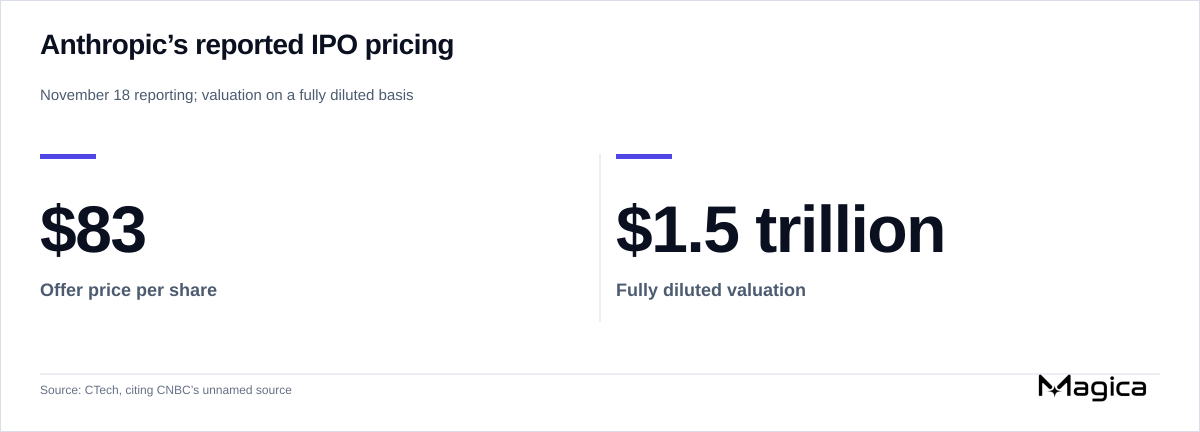
Reported IPO pricing implies an approximately $1.5 trillion fully diluted valuation. The final enlarged offering size remains unresolved. Source: CTech.
The $83 price is $5, or approximately 6.4%, above the $78 upper end of the range. A separate newswire excerpt citing an unidentified person familiar with the matter also gives the $83 price and says the offering’s size increased. It describes the deal as the first IPO by a major frontier AI model developer and one of the largest stock-market IPOs on record. The excerpt gives no revised share count.
The original offering comprised 825 million shares: about 801.4 million newly issued by Anthropic and 23.6 million sold by existing shareholders, including its seven co-founders. Applying $83 to those original quantities produces the following estimates before fees and expenses:
| Component | Gross proceeds on original terms |
|---|---|
| New public shares issued by Anthropic | $66.5 billion |
| Existing shareholders’ public share sales | $2.0 billion |
| Separate private placement to Anthropic | $26.0 billion |
| Total, including shareholder sales | $94.5 billion |
Anthropic’s portion would therefore be about $92.5 billion gross. The larger $94.5 billion transaction total includes cash going to selling shareholders. Neither estimate establishes the final enlarged deal size.
The November 11 European prospectus filed with the SEC says AMD, Broadcom, Google, Micron, Microsoft, Nvidia and TSMC agreed to purchase the $26 billion of non-voting shares at the IPO price. That placement is conditional on completion of the US offering and other conditions. The original underwriters’ option covers another 123.75 million newly issued shares, potentially adding about $10.3 billion at $83; those proceeds are excluded above.
The pricing account compares the reported $1.5 trillion valuation with Anthropic’s $965 billion valuation after its May financing and the $1.25 trillion valuation recently attributed to rival AI developer OpenAI. Those are different comparison bases: an IPO-implied fully diluted valuation and reported private-market valuations, rather than market capitalizations of publicly traded peers.
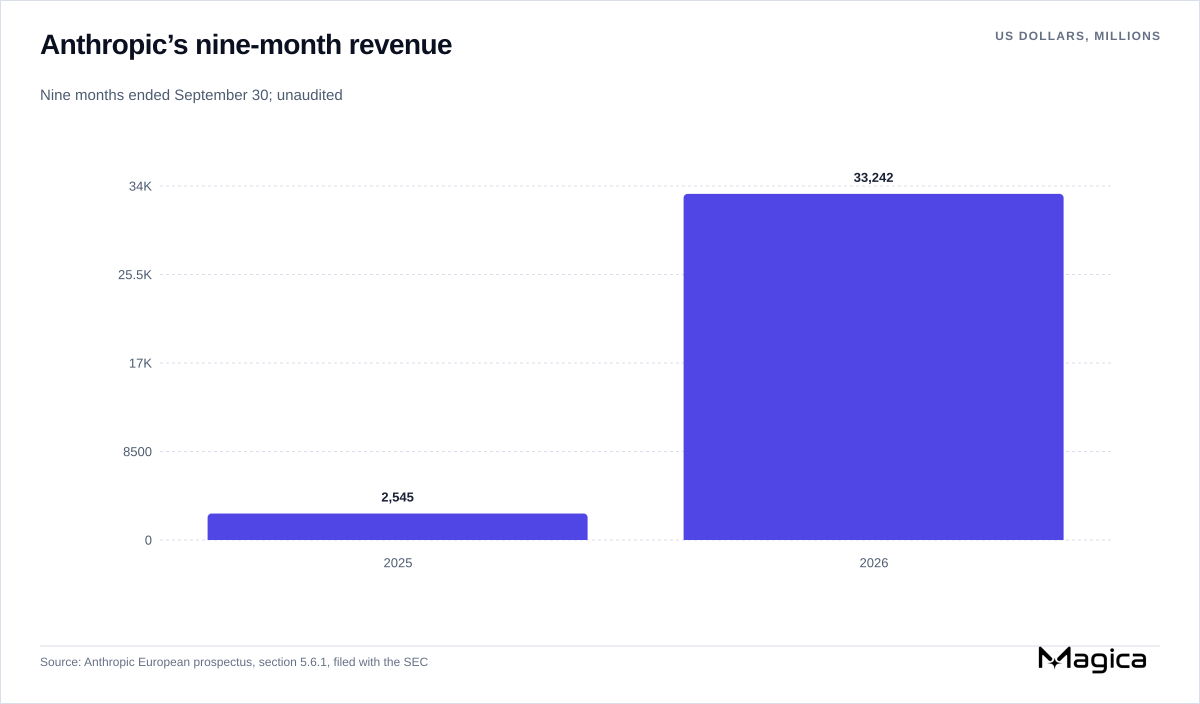
Company-reported, unaudited revenue for matching nine-month periods, distinct from an annualized run rate. Source: Anthropic European prospectus filed with the SEC.
Anthropic was founded in 2021 by former OpenAI employees and commercially launched Claude in the first quarter of 2023. It sells access to its AI models and applications for tasks including coding and enterprise workflows. Its prospectus reports revenue of $33.2 billion for the first nine months of 2026, compared with about $2.5 billion a year earlier; third-quarter revenue alone reached $17 billion. The 2026 interim figures are unaudited.
By September 30, more than 11,900 customers had generated at least $100,000 each in trailing twelve-month revenue, up from more than 950 a year earlier. Those customers supplied approximately 74% of revenue over those twelve months. Separately, the five largest customers accounted for about 25% of revenue in the first nine months of 2026, although none individually exceeded 10%.
Anthropic said its annualized revenue run rate reached approximately $81 billion on October 31, up $10 billion from September 30. That is neither annual revenue already earned nor a forecast: its measure multiplies consumption fees for the preceding 28 days by 13 and monthly subscription fees by 12.
Consumption-based sales supplied $26.3 billion, or 79% of revenue, in the first nine months of 2026. Customers pay for usage at prices that vary by model. Although a growing number of enterprise customers sign non-cancelable contracts with minimum spending commitments, Anthropic warns that much of its revenue is not subject to long-term commitments.
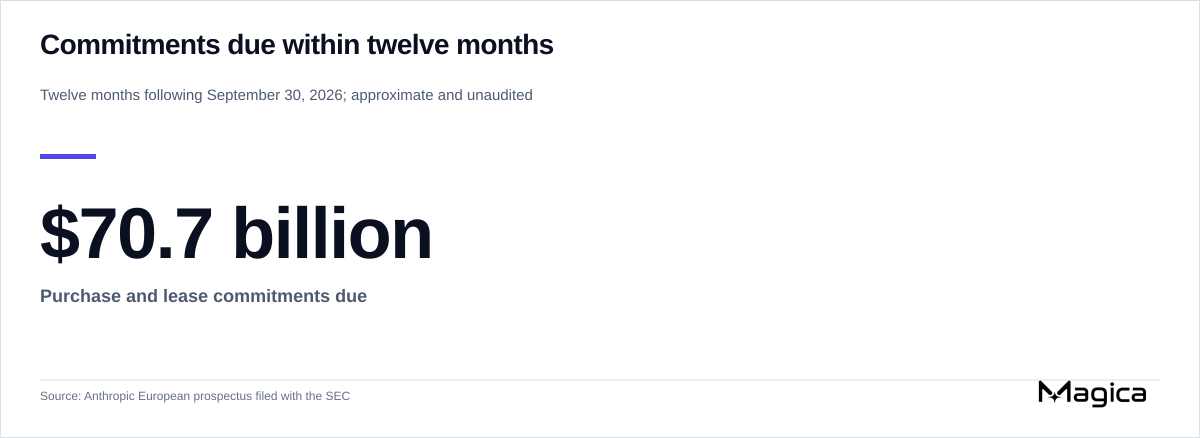
Company-reported, unaudited purchase and lease commitments due in the twelve months following September 30, 2026. Source: Anthropic European prospectus filed with the SEC.
The prospectus’s infrastructure disclosures put aggregate purchase and lease commitments entered into as of and after September 30 at approximately $900.9 billion, substantially all for compute and infrastructure. These unaudited amounts include about $70.7 billion due in the twelve months following September 30, 2026, and $451.6 billion expected to be incurred before December 31, 2030. Substantially all the remainder falls between 2031 and 2045.
That timetable matters more than comparing the entire multiyear total with a single capital raise. Anthropic held about $131.9 billion in cash, cash equivalents and short-term investments on September 30, before the offering. It also reported $14.8 billion of available credit and additional financing capacity from strategic partners; some partner commitments would be reduced when the private placement closes.
The business generated $6.6 billion in operating cash flow in the first nine months of 2026, reversing negative operating cash flow in prior years. Operating cash flow excludes investing activities, so it does not measure cash left after infrastructure investment.
The earnings figures also need separating from cash consumption. Anthropic reported a $1.3 billion operating loss for the nine months, alongside $4.1 billion of non-GAAP adjusted operating income. Its $104 billion net loss included a $94.3 billion non-cash fair-value loss on convertible notes, derivative liabilities and other instruments. The prospectus says those fair-value changes were primarily driven by its rising valuation.
Anthropic says its infrastructure contracts include minimum purchases and take-or-pay terms requiring payment regardless of usage. The company says it previously underestimated compute needs, constraining product development and deployment. Now it is moving from cloud-only arrangements toward a hybrid system that also includes directly leased chips in dedicated facilities. Facility completion, energy and water availability, and the integration of new capacity can delay usable compute even after money is committed.
Competition limits how confidently investors can assume that capacity will translate into sales. Anthropic’s competitive-risk disclosures identify Google and OpenAI as primary frontier-model rivals, alongside open-weight and open-source alternatives competing for workloads where cost matters more than maximum capability. Large competitors can bundle AI with existing products or subsidize prices. Google is also a private-placement investor and cloud distribution partner, illustrating the overlap between Anthropic’s financing, distribution and competition.
Anthropic is a Delaware public benefit corporation whose stated purpose is the responsible development and maintenance of advanced AI for humanity’s long-term benefit. Its planned voting structure separates economic ownership from significant governing authority.
Chief executive Dario Amodei, previously OpenAI’s vice president of research, and president and board chair Daniela Amodei, previously an OpenAI executive whose roles included vice president of safety and policy, co-founded Anthropic in 2021. They and the five other co-founders will initially own the entity holding a single Class F share. That share carries 50.1% of voting power on matters submitted to shareholders generally, including director elections other than Class T directors.
Separately, the Long-Term Benefit Trust generally has the right through Class T stock to elect and remove a majority of the authorized board. The trust is intended to operate through five financially disinterested trustees to help balance Anthropic’s public benefit goals; its shares carry no economic rights. Public investors therefore supply capital without proportionate authority over the company’s direction.
Final offering documents are needed to establish the enlarged share count, company proceeds, shareholder sales and any underwriters’ option exercise. The expected November 19 debut would then establish a trading price distinct from the reported $83 offer price.
Subsequent financial disclosures will need to show whether operating cash generation and available financing keep pace with infrastructure payments, and whether contracted capacity comes online when customers need it. The central unresolved question is whether Anthropic can match long-lived computing commitments with durable customer spending in a market where suppliers and investors can also be competitors.
Lenovo reported record quarterly revenue of $30.2 billion as its infrastructure business swung into profit. A $1.91 billion noncash warrant charge drove a reported loss, while expanding inventories and overdue receivables raised the stakes for cash collection.
Google expects to invest $1 billion in U.S. data center community programs through 2027. Its commitments on taxes, power costs and disclosure address hosting terms, while voters favored limits in 40 of 41 local ballot contests covering both binding restrictions and advisory questions.
Alibaba traded near HK$80 before earnings as US restrictions threatened overseas computing access. Its June results show accelerating cloud growth alongside heavy capital spending and widening AI application losses, while the new rules leave licensing routes and exemptions.
Vero Security is launching a free learning community alongside its commercial platform for enforcing enterprise AI policies. Its $11 million seed round backs a bid to automate recurring security work, but performance and pricing comparisons remain unproven.
Sarvam says its new Token Factory hosts Chinese and domestic AI models on privately funded Indian infrastructure. Its engineering claims and a rival’s price challenge put the commercial strategy under scrutiny alongside its publicly backed domestic-model mandate.
Google is replacing AI Ultra’s individual YouTube Premium benefit with family coverage at no extra cost in eligible countries. The upgrade adds household value, but cheaper subscriptions still matter to the buying decision.
An August fundraising initiative has produced no deployed capital, according to a report, as lenders seek more protection than Nvidia has offered to back customers’ chip purchases.
Colette Kress, Nvidia’s interim CEO and its CFO since 2013, promised December raises and equity awards ahead of the usual spring cycle. The undisclosed package comes as falling shares unsettle employees and the board rejects founder Jensen Huang’s return.
Palo Alto Networks agreed to buy Applied Compute for $4.5 billion in stock, pairing enterprise AI security with model adaptation and hosting. Its plans also call for less than $3 billion in infrastructure spending through fiscal 2030 and near-term margin pressure.
Google is rolling out temporary conversations in AI Mode that stay out of account history and personalization. Its help documentation says data collection continues and describes exceptions to the restriction on model training.
The Claude developer is expected to begin Nasdaq trading on November 19, with options potentially following Monday. Its proposed public offering could total $57.75 billion to $64.35 billion before fees, alongside a private placement, while founders and a benefit trust hold substantial governance powers.
Microsoft plans to use Intel Foundry’s EMIB packaging for its own Azure silicon under an expanded infrastructure agreement that also secures multi-year Xeon supply. Chip identities, deployment dates and packaging economics remain undisclosed.
A 3-2 vote stopped SpaceX’s request for a decade-long county property tax abatement from advancing. A separate city incentive hearing was announced for December, while the company’s investment plans remain unresolved.
Anthropic is reportedly considering more shares at well above $80 each. A separate $26 billion private placement adds to the financing stakes as rapid revenue growth meets vast computing commitments.
Pika’s Enact research preview lets creators move subjects, give actors notes and steer a camera during video generation. Its technical demonstrations show how the controls work, but consumer access, pricing and production reliability remain unresolved.
The NYU philosopher and 2026 Berggruen Prize winner sees no reason to attribute consciousness to current language models. His skepticism contrasts with Anthropic's experiments in model welfare, while research indicators leave open what future systems could become.
The Center for AI Safety joined critics from opposing AI camps in accusing Anthropic of weakening its safeguards. The company’s filing documents both commercial pressure to advance and a recent development pause, making the dispute about what restraint is binding.
Microsoft detailed Azure tools at Ignite that let AI agents reuse processed context, alongside new isolation and networking controls. The announcements leave total savings unquantified, while previews and customer operating duties limit the rollout.
Linq says its a16z-led Series B values the company at $1 billion after more than one billion messages. The funding backs a broader agent infrastructure business, with new HD calling and computer access extending a platform still dependent on communications providers.
SoftBank founder Masayoshi Son called passing on Anthropic a mistake while remaining committed to rival OpenAI. Another prospective OpenAI investment would deepen a relationship that already links SoftBank’s capital, investment valuations and infrastructure ambitions.