Editorial Team
6 min read
Google expects to invest $1 billion in U.S. data center community programs through 2027. Its commitments on taxes, power costs and disclosure address hosting terms, while voters favored limits in 40 of 41 local ballot contests covering both binding restrictions and advisory questions.
Google, Alphabet's search and cloud-computing business, says it expects to invest $1 billion in U.S. data center community programs through the end of 2027. Its commitments to pay full real-property taxes on new campuses and disclose projects earlier address the terms of hosting computing infrastructure. November's local ballot results also show demands for something more fundamental: control over whether development proceeds.
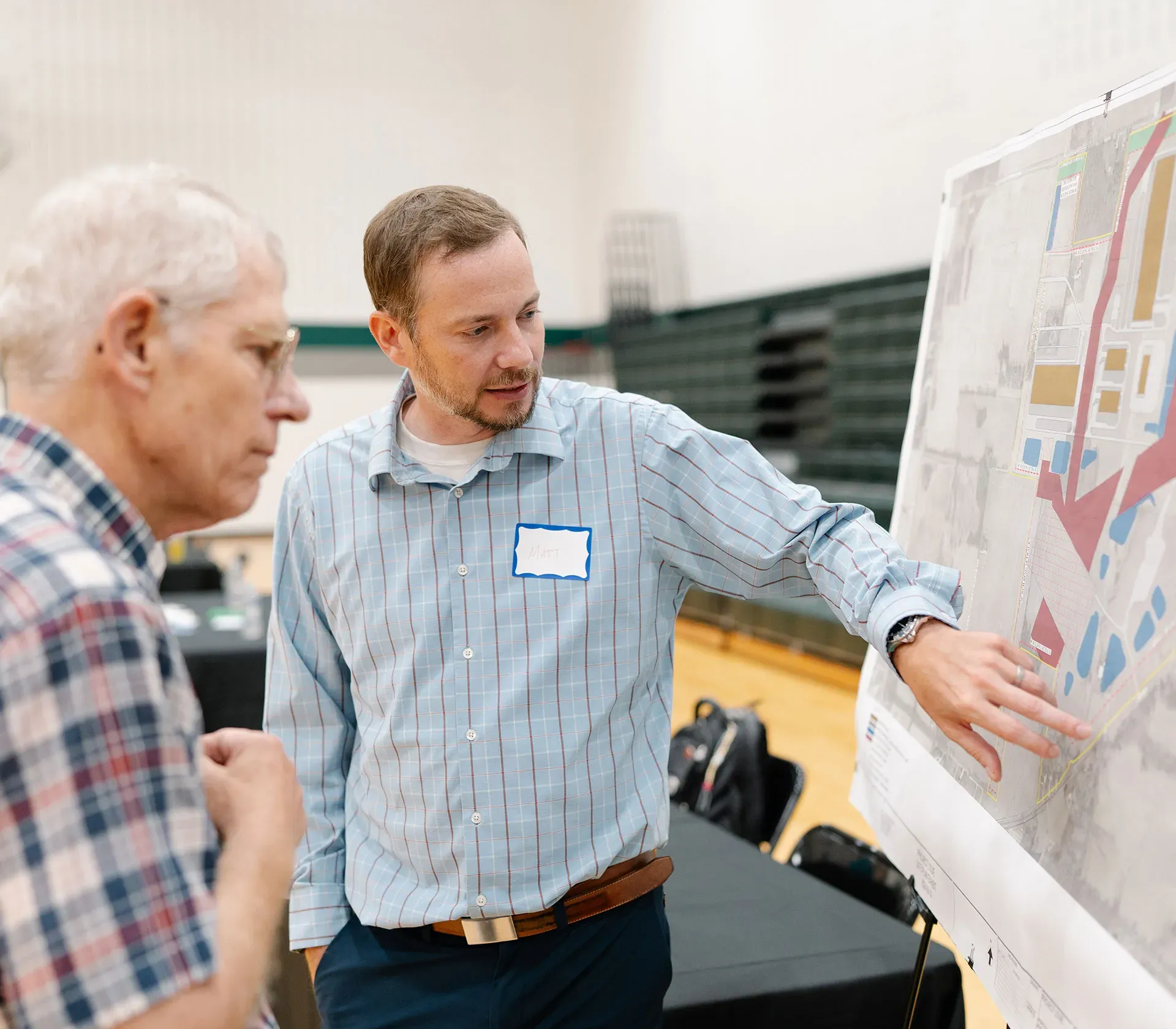
A planning discussion pictured on Google's data center community commitments page. Photo: Google. Source: Google Data Centers.
Data centers house the computing infrastructure behind Google's online services and its cloud business, which sells capacity and services through usage fees and subscriptions, including infrastructure for training and serving AI models. Alphabet's 2025 annual filing says expansion is increasingly constrained by the availability of power, water and land. Failure to secure enough capacity in time, it warns, would limit model training and service to cloud customers. Local hosting terms therefore matter to the company's ability to deliver its products.
In its community commitments, Google says it has worked with host communities for more than 20 years, including a partnership with Pryor and Mayes County, Oklahoma, dating to 2007. It presents the $1 billion as spending on locally tailored programs, beyond benefits from property taxes, infrastructure and grid investment, and hiring. The approach includes support for schools, libraries and other services in consultation with local leaders. The total is expected investment through 2027, rather than reported disbursements.
The tax commitment has a specific boundary: Google says it will pay full real-property taxes on the buildings and land of all new campuses. That wording does not establish a commitment covering every category of tax or retrospectively changing arrangements at existing sites.
Lenovo reported record quarterly revenue of $30.2 billion as its infrastructure business swung into profit. A $1.91 billion noncash warrant charge drove a reported loss, while expanding inventories and overdue receivables raised the stakes for cash collection.
Alphabet's worldwide capital expenditure rose from $52.5 billion in 2024 to $91.4 billion in 2025, about a 74% increase, primarily reflecting technical infrastructure investment. That year-to-year comparison shows the pace of expansion. These capital purchases cover a different category, geography and period from Google's U.S. community programs, so they do not establish a local compensation rate for the $1 billion pledge.

The 40 outcomes favoring limits comprised 27 restrictive or opposition measures approved and 13 development-friendly or support measures defeated. Counts include advisory questions and exclude Harwood's rejection of a review requirement. Graphic: Magica; data: Ballotpedia. Source: Ballotpedia.
Voters favored limiting data center development in 40 of 41 local ballot contests on Nov. 3, according to a Nov. 6 election analysis. They approved 27 measures restricting development or expressing opposition and defeated 13 measures favoring development or expressing support.
The denominator is ballot contests, not individual voters, projects or all potential host communities. Nine of the 41 contests were nonbinding questions: two expressing opposition that passed and seven expressing support that failed. The approved measures also included five full bans, 12 partial bans, three six-month moratoriums in Maine and two zoning measures in Ohio. The remaining three imposed voter-approval requirements or financial guarantees.
The distinction matters for developers. Grove City, Ohio, required voter approval for developments exceeding 50 acres, 20 megawatts of electricity or 500,000 gallons of water per day, alongside enforceable community-impact standards. Janesville, Wisconsin, required voter approval for development of the proposed GM/JATCO data center site if its cost exceeds $450 million. Perry, Ohio, required financial guarantees from hyperscale developers seeking certain tax incentives.
The defeated measures included four Wilmington, Ohio, rezonings, seven nonbinding expressions of support and proposals concerning permitted land use or development negotiations. In the sole exception to the restrictive pattern, Harwood, North Dakota, voters rejected a proposed review requirement covering certain developments, including data centers.
The same analysis recorded six earlier local votes in 2026, all favoring limits. The November results therefore extend a pattern within these ballot contests, without establishing how all potential host communities view development or whether any particular Google proposal would win approval.
Google's package addresses several concrete points of friction. It says it will stop using nondisclosure agreements with state and local governments, identify its involvement by the first application or public meeting, whichever comes first, and publish additional project-level information on water use, compliance with sound and light limits, and traffic impacts. It also proposes town halls and local advisory councils. It retains limited confidentiality for matters such as trade secrets and operational security.
On electricity, Google promises to pay for all power its facilities use and direct infrastructure costs to connect them to the grid. It also promises investment in additional generation, with facilities located alongside dedicated generation where practical, and programs to make local homes more energy efficient.
Google says it has already incorporated 1 gigawatt of demand-response capacity into long-term contracts with multiple U.S. utilities, enabling reductions in power use. Its commitment to reduce demand during peak periods is qualified by feasibility; the contractual figure does not establish reductions delivered at every peak. On water, Google says it assesses local watershed risks and considers water cooling only where resources are healthy and resilient. It retains an ambition to replenish more freshwater than it consumes by 2030.
The local economic offer also includes prioritizing local employees and suppliers and supporting training and apprenticeships.
Microsoft, another builder, owner and operator of data centers, set out a similar approach in its Jan. 13, 2026, U.S. community infrastructure initiative. Its operating experience includes a Quincy, Washington, presence dating to 2008. It promised to ask utilities and public commissions to set rates covering the electricity and infrastructure costs of serving its facilities, and said it would not ask municipalities to reduce local property-tax rates when it buys land or proposes a data center.
Microsoft also promised water replenishment in the same water districts where its facilities use water, regional water-use disclosures, local jobs, AI training and nonprofit support. The commitments show that hosting terms are an industry concern. They are company promises, not independent evidence that household bills or local resource pressures have been resolved.
Construction and permanent employment also need separate accounting. Microsoft describes typical data center staffing as thousands during construction and hundreds during operations. That is its characterization of the employment pattern, rather than a census of Google's projects.
The ballot measures concern a separate lever: bans and approval requirements can limit development even when a company offers community benefits. The evidence does not establish that November's results caused Google's pledge or that its programs have changed voters' views.
The election analysis identifies three further December data center contests: two in Clarksville, Arkansas, and one in Mandan, North Dakota. It does not present them as votes on Google's package.
For Google's commitments, the unresolved questions are how the $1 billion will be allocated, how much has already been spent, how much is additional to existing programs, and which promises will become enforceable project or utility terms. Its published approach provides no community-by-community allocation or disbursement schedule. The next evidence to examine is the local agreement: who pays for capacity and grid upgrades, what resource use is disclosed, and what approval rights residents retain. Those terms will determine what the broad commitments mean for an individual host community.
Alibaba traded near HK$80 before earnings as US restrictions threatened overseas computing access. Its June results show accelerating cloud growth alongside heavy capital spending and widening AI application losses, while the new rules leave licensing routes and exemptions.
Vero Security is launching a free learning community alongside its commercial platform for enforcing enterprise AI policies. Its $11 million seed round backs a bid to automate recurring security work, but performance and pricing comparisons remain unproven.
Sarvam says its new Token Factory hosts Chinese and domestic AI models on privately funded Indian infrastructure. Its engineering claims and a rival’s price challenge put the commercial strategy under scrutiny alongside its publicly backed domestic-model mandate.
Google is replacing AI Ultra’s individual YouTube Premium benefit with family coverage at no extra cost in eligible countries. The upgrade adds household value, but cheaper subscriptions still matter to the buying decision.
An August fundraising initiative has produced no deployed capital, according to a report, as lenders seek more protection than Nvidia has offered to back customers’ chip purchases.
Anthropic’s reported $83 IPO price implies a fully diluted valuation of about $1.5 trillion. The final share count remains unresolved, while its prospectus shows rapid revenue growth, positive operating cash flow and $70.7 billion in commitments due in the year after September 30.
Colette Kress, Nvidia’s interim CEO and its CFO since 2013, promised December raises and equity awards ahead of the usual spring cycle. The undisclosed package comes as falling shares unsettle employees and the board rejects founder Jensen Huang’s return.
Palo Alto Networks agreed to buy Applied Compute for $4.5 billion in stock, pairing enterprise AI security with model adaptation and hosting. Its plans also call for less than $3 billion in infrastructure spending through fiscal 2030 and near-term margin pressure.
Google is rolling out temporary conversations in AI Mode that stay out of account history and personalization. Its help documentation says data collection continues and describes exceptions to the restriction on model training.
The Claude developer is expected to begin Nasdaq trading on November 19, with options potentially following Monday. Its proposed public offering could total $57.75 billion to $64.35 billion before fees, alongside a private placement, while founders and a benefit trust hold substantial governance powers.
Microsoft plans to use Intel Foundry’s EMIB packaging for its own Azure silicon under an expanded infrastructure agreement that also secures multi-year Xeon supply. Chip identities, deployment dates and packaging economics remain undisclosed.
A 3-2 vote stopped SpaceX’s request for a decade-long county property tax abatement from advancing. A separate city incentive hearing was announced for December, while the company’s investment plans remain unresolved.
Anthropic is reportedly considering more shares at well above $80 each. A separate $26 billion private placement adds to the financing stakes as rapid revenue growth meets vast computing commitments.
Pika’s Enact research preview lets creators move subjects, give actors notes and steer a camera during video generation. Its technical demonstrations show how the controls work, but consumer access, pricing and production reliability remain unresolved.
The NYU philosopher and 2026 Berggruen Prize winner sees no reason to attribute consciousness to current language models. His skepticism contrasts with Anthropic's experiments in model welfare, while research indicators leave open what future systems could become.
The Center for AI Safety joined critics from opposing AI camps in accusing Anthropic of weakening its safeguards. The company’s filing documents both commercial pressure to advance and a recent development pause, making the dispute about what restraint is binding.
Microsoft detailed Azure tools at Ignite that let AI agents reuse processed context, alongside new isolation and networking controls. The announcements leave total savings unquantified, while previews and customer operating duties limit the rollout.
Linq says its a16z-led Series B values the company at $1 billion after more than one billion messages. The funding backs a broader agent infrastructure business, with new HD calling and computer access extending a platform still dependent on communications providers.
SoftBank founder Masayoshi Son called passing on Anthropic a mistake while remaining committed to rival OpenAI. Another prospective OpenAI investment would deepen a relationship that already links SoftBank’s capital, investment valuations and infrastructure ambitions.