Editorial Team
7 min read
Sarvam says its new Token Factory hosts Chinese and domestic AI models on privately funded Indian infrastructure. Its engineering claims and a rival’s price challenge put the commercial strategy under scrutiny alongside its publicly backed domestic-model mandate.
Sarvam AI, the Bengaluru startup selected under India’s government-backed programme to develop domestic foundation models, the general-purpose AI systems on which applications are built, is defending its new business selling access to Chinese-developed AI through Indian infrastructure. Token Factory expands its role from model developer to inference provider—and tests whether a commercial hosting business can support the technological independence associated with its public backing.
Launched on November 16, Token Factory lets developers and enterprises access multiple models through one application programming interface, or API. It runs on clusters of graphics processing units (GPUs) in India. Inference is the process of running an already developed model to generate responses; customers can pay for usage instead of buying hardware and managing deployments themselves.
The catalogue includes Sarvam’s own language model Sarvam 105B, Chinese-developed models from DeepSeek, Moonshot AI, Z.ai and Alibaba, and Google’s Gemma. Some are available on demand; others require dedicated capacity, according to the account of the launch. Open-weight models can be downloaded and deployed on another company’s infrastructure, giving Sarvam a way to offer capabilities it has not developed itself.
Sarvam co-founders Pratyush Kumar and Vivek Raghavan previously developed speech-recognition and translation models at AI4Bharat, an Indian government-backed AI research effort. A July 2023 report based on three people familiar with their plans described the new venture as building language models for India-specific uses and seeking $12 million from Peak XV and Lightspeed. That was a report of fundraising plans, rather than confirmation of a completed round.
The company has since attracted much larger backing. A report on the debate puts its fundraising at more than $300 million and its reported valuation at $1.5 billion. A separate account of interviews with the founders dates that valuation to April and identifies Lightspeed and Khosla Ventures as backers.
Kumar’s commercial argument in those interviews is that token sales bring revenue to a capital-intensive model-development business. He said Sarvam would continue developing models for India. The reporting provides no revenue or margin figures to show how much research the hosting service can finance.
The IndiaAI Mission is a government programme to strengthen domestic computing, research and foundation-model development, approved in March 2024 with an outlay of approximately ₹10,372 crore. Sarvam received subsidised access to 4,096 Nvidia H100 GPUs, with a reported GPU subsidy of ₹98.68 crore, according to the account of its public support. Another report citing government disclosures puts broader financial and computing support at ₹246.72 crore. The reports describe one figure as a GPU subsidy and the other as broader support; they do not reconcile the amounts.
The mandate was more specific than local hosting. A May 2025 government release says Sarvam was selected on April 26, 2025, to develop an open-source, 120-billion-parameter model for governance and public-service access. It also records earlier releases of Sarvam-1 and Sarvam-M. That establishes both a domestic-model objective and a prior development record; it does not establish how the current Sarvam 105B relates to that earlier target.
Sarvam says Token Factory uses no GPU capacity subsidised under the mission and runs entirely on privately procured GPUs, according to its reported response on November 18. Raghavan likewise told interviewers that investors financed the service’s separate infrastructure. The available evidence does not establish diversion of public computing resources or a breach of its government contract.
The criticism is instead about what that backing should produce. Sanchit Monga, chief executive of AI infrastructure company Runanywhere AI, argued in a reported social-media post that Sarvam should be delivering frontier research from India after receiving substantial capital and subsidised computing.
Raghavan’s own language helps explain the tension. At the Bengaluru Tech Summit on November 17, he warned that India was exporting data and importing intelligence. Those remarks did not directly address Token Factory. Defending the service in the founders’ interviews, he said Indian hosting keeps users’ data within the country.
Local hosting can avoid sending requests to Chinese developers’ servers. It does not by itself resolve model-behaviour, software-dependency or access-control concerns, nor make the underlying models Indian-developed technology.
Sarvam’s launch post describes work beyond offering an API: separating prompt processing from response generation, reusing cached context, fixing serving-software bugs and adjusting how requests reach GPUs. These are inference improvements, rather than development of the foreign models themselves. The company also says it offers this software stack on customers’ premises, including for critical institutions.
The work extends to its own model. Sarvam says changes to numerical precision and speculative decoding increased Sarvam 105B’s output throughput by about 2.2 times while reducing each replica from two Nvidia B200 GPUs to one, without reducing accuracy. These are company-reported results, but they qualify the suggestion that the launch represents an abandonment of domestic technology.
Caching illustrates the economics—and the limits of headline volume. Sarvam says it serves more than 450 billion tokens daily on DeepSeek V4.1 Flash. Separately, its production counters for October 30–November 6 show 95.7% of that model’s prompt tokens served from cache, up from 91.4% using the GPU cache alone. The share requiring fresh prompt processing therefore fell from 8.6% to 4.3%, halving that portion of the work. This concerns prompt processing, not all response generation or total operating costs, and cannot be applied to the entire daily token count.
The post offers two DeepSeek V4.1 Flash endpoints at different prices:
| Endpoint | Input price per million tokens | Output price per million tokens |
|---|---|---|
| Standard, introductory pricing | ₹14 | ₹55 |
| Interactive, for coding agents | ₹25 | ₹105 |
Those are advertised customer prices, not Sarvam’s costs or margins. Nor does its own benchmarking show a universal speed lead. In tests issuing one request at a time from AWS Mumbai and reporting medians over 72 hours, its Standard endpoint returned the first DeepSeek V4.1 Flash token in 0.90 seconds on a 10,000-token prompt, against Together AI’s 0.71 seconds. The post dates those measurements to November 3–5. Other tests favour Sarvam, underlining why location, prompt length, model and endpoint matter.
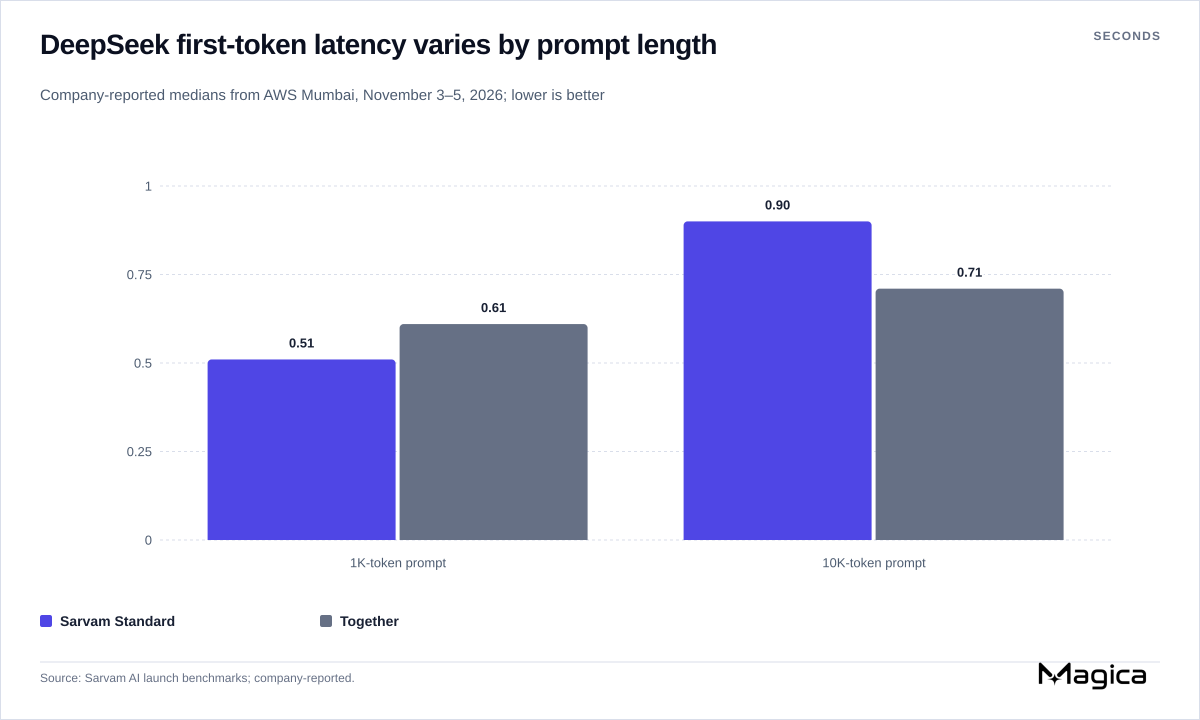
Sarvam AI’s company-reported DeepSeek V4.1 Flash benchmarks: median first-token latency over 72 hours from AWS Mumbai, November 3–5, 2026, with one request at a time. Source: Sarvam AI.
Together AI, Fireworks AI and DeepInfra already provide inference for other developers’ models. OpenRouter routes requests among providers, while Amazon’s Bedrock offers enterprise access to multiple developers’ models. Hosting open-weight systems is an established business, not a capability unique to Sarvam.
Hemant Mohapatra, a partner at venture capital firm Lightspeed India, one of Sarvam’s largest investors, defended the opportunity in a reported post. He argued that international providers already earn money hosting foreign models in India and serving global customers because GPUs are hard to secure elsewhere. He represents an investor in Sarvam; the post provides no figures establishing its margins.
There is also a domestic alternative. Jarvislabs, an Indian inference provider whose business assets were acquired by Indian cloud company E2E Networks in 2025, disputes Sarvam’s advantage. Its AI engineer Atharva Ingle said the company tested three models available on both platforms and found equal or better speed at lower prices.
According to the reported comparison, Ingle claimed GLM 5.3 Flash ran nearly twice as fast on Jarvislabs, while Gemma 4 31B and DeepSeek V4.1 Flash ran marginally faster at substantially lower token prices. He said Jarvislabs used Nvidia H200 GPUs rather than newer B200s. These are a competitor’s claims; the available account does not establish a common methodology that would reconcile them with Sarvam’s benchmarks.
For customers, the next decision is whether Token Factory offers the best combination of model capability, data location, price and performance for their workloads. Comparable tests at the same prompt lengths, concurrency and service tiers would make that choice clearer.
For Sarvam’s public backers, the unresolved question is how commercial inference supports its domestic-model mandate. The company has documented serving work on both its own and foreign models, and says it will add models and computing capacity as demand grows. Revenue and cost disclosures, alongside evidence of progress against its model-development commitments, would show whether that expansion finances greater independence in the underlying technology.
Lenovo reported record quarterly revenue of $30.2 billion as its infrastructure business swung into profit. A $1.91 billion noncash warrant charge drove a reported loss, while expanding inventories and overdue receivables raised the stakes for cash collection.
Google expects to invest $1 billion in U.S. data center community programs through 2027. Its commitments on taxes, power costs and disclosure address hosting terms, while voters favored limits in 40 of 41 local ballot contests covering both binding restrictions and advisory questions.
Alibaba traded near HK$80 before earnings as US restrictions threatened overseas computing access. Its June results show accelerating cloud growth alongside heavy capital spending and widening AI application losses, while the new rules leave licensing routes and exemptions.
Vero Security is launching a free learning community alongside its commercial platform for enforcing enterprise AI policies. Its $11 million seed round backs a bid to automate recurring security work, but performance and pricing comparisons remain unproven.
Google is replacing AI Ultra’s individual YouTube Premium benefit with family coverage at no extra cost in eligible countries. The upgrade adds household value, but cheaper subscriptions still matter to the buying decision.
An August fundraising initiative has produced no deployed capital, according to a report, as lenders seek more protection than Nvidia has offered to back customers’ chip purchases.
Anthropic’s reported $83 IPO price implies a fully diluted valuation of about $1.5 trillion. The final share count remains unresolved, while its prospectus shows rapid revenue growth, positive operating cash flow and $70.7 billion in commitments due in the year after September 30.
Colette Kress, Nvidia’s interim CEO and its CFO since 2013, promised December raises and equity awards ahead of the usual spring cycle. The undisclosed package comes as falling shares unsettle employees and the board rejects founder Jensen Huang’s return.
Palo Alto Networks agreed to buy Applied Compute for $4.5 billion in stock, pairing enterprise AI security with model adaptation and hosting. Its plans also call for less than $3 billion in infrastructure spending through fiscal 2030 and near-term margin pressure.
Google is rolling out temporary conversations in AI Mode that stay out of account history and personalization. Its help documentation says data collection continues and describes exceptions to the restriction on model training.
The Claude developer is expected to begin Nasdaq trading on November 19, with options potentially following Monday. Its proposed public offering could total $57.75 billion to $64.35 billion before fees, alongside a private placement, while founders and a benefit trust hold substantial governance powers.
Microsoft plans to use Intel Foundry’s EMIB packaging for its own Azure silicon under an expanded infrastructure agreement that also secures multi-year Xeon supply. Chip identities, deployment dates and packaging economics remain undisclosed.
A 3-2 vote stopped SpaceX’s request for a decade-long county property tax abatement from advancing. A separate city incentive hearing was announced for December, while the company’s investment plans remain unresolved.
Anthropic is reportedly considering more shares at well above $80 each. A separate $26 billion private placement adds to the financing stakes as rapid revenue growth meets vast computing commitments.
Pika’s Enact research preview lets creators move subjects, give actors notes and steer a camera during video generation. Its technical demonstrations show how the controls work, but consumer access, pricing and production reliability remain unresolved.
The NYU philosopher and 2026 Berggruen Prize winner sees no reason to attribute consciousness to current language models. His skepticism contrasts with Anthropic's experiments in model welfare, while research indicators leave open what future systems could become.
The Center for AI Safety joined critics from opposing AI camps in accusing Anthropic of weakening its safeguards. The company’s filing documents both commercial pressure to advance and a recent development pause, making the dispute about what restraint is binding.
Microsoft detailed Azure tools at Ignite that let AI agents reuse processed context, alongside new isolation and networking controls. The announcements leave total savings unquantified, while previews and customer operating duties limit the rollout.
Linq says its a16z-led Series B values the company at $1 billion after more than one billion messages. The funding backs a broader agent infrastructure business, with new HD calling and computer access extending a platform still dependent on communications providers.
SoftBank founder Masayoshi Son called passing on Anthropic a mistake while remaining committed to rival OpenAI. Another prospective OpenAI investment would deepen a relationship that already links SoftBank’s capital, investment valuations and infrastructure ambitions.