Editorial Team
6 min read
Microsoft plans to use Intel Foundry’s EMIB packaging for its own Azure silicon under an expanded infrastructure agreement that also secures multi-year Xeon supply. Chip identities, deployment dates and packaging economics remain undisclosed.
Microsoft plans to use Intel’s advanced packaging for chips it designs for Azure, its cloud platform, under an expanded agreement announced November 18. The deal gives Intel Foundry another role in Microsoft’s infrastructure alongside a multi-year commitment to Intel server processors; it does not disclose the packaging work’s value or production schedule.
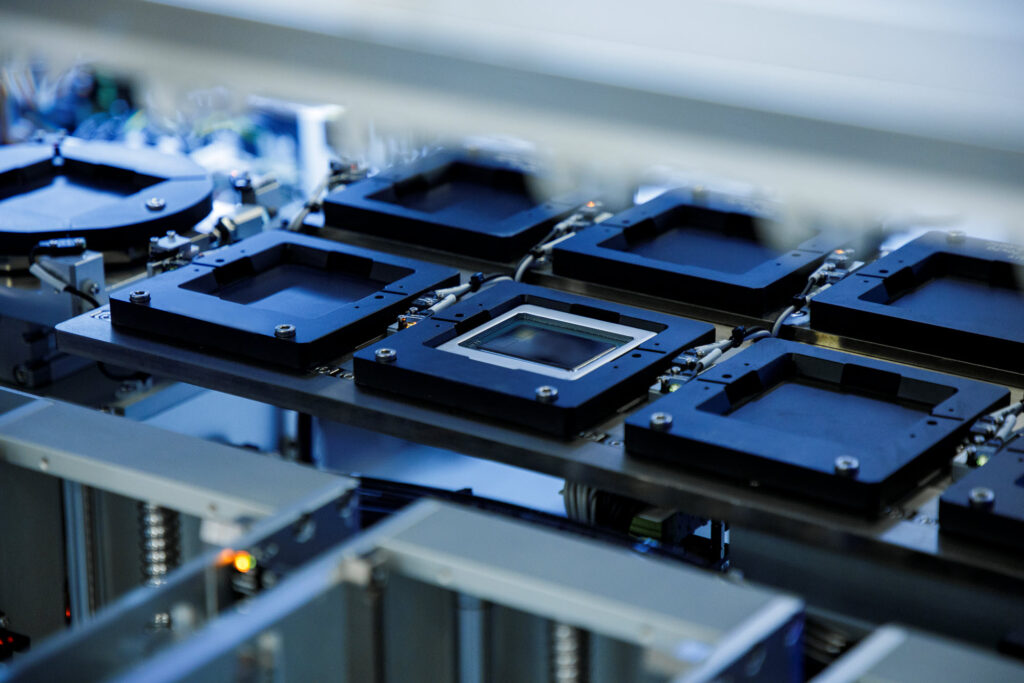
Chip testing at Microsoft’s Redmond lab, pictured in its November 2023 custom-silicon announcement. This historical photograph does not depict the newly announced EMIB designs. Photo courtesy of Microsoft. Source: Microsoft — custom silicon announcement.
Intel said in its announcement that Microsoft is the first company to announce use of Intel Foundry’s Embedded Multi-die Interconnect Bridge, or EMIB, advanced packaging technology for Azure first-party silicon. First-party silicon means chips designed by Microsoft itself.
EMIB uses embedded bridges to connect separate chips within a package. Intel designs and manufactures semiconductors; Intel Foundry offers production services to other chip designers. The packaging commitment expands that customer relationship without establishing where the individual chips will be manufactured.
The long-term agreement also confirms multi-year supply capacity for Intel Xeon server CPUs, including next-generation processors codenamed Diamond Rapids. It extends work on Azure hardware, memory efficiency and security. Intel frames the combination as a way to improve performance, efficiency, scalability and resilience for cloud and AI workloads; the announcement does not quantify the agreement’s value or the capacity reserved.
For Microsoft, the relevant precedent is its move into designing more of the infrastructure it operates. In its November 2023 introduction, it presented Maia 100 as an accelerator for AI training and inference and Cobalt 100 as an Arm-based CPU for general-purpose cloud workloads. Microsoft described those chips as part of an effort to optimize infrastructure from silicon through servers, racks and cooling for internal and customer workloads. The company said it had begun custom-building servers and racks in 2016, with silicon becoming the missing component of that approach. Selecting packaging is another decision within that system design.
Lenovo reported record quarterly revenue of $30.2 billion as its infrastructure business swung into profit. A $1.91 billion noncash warrant charge drove a reported loss, while expanding inventories and overdue receivables raised the stakes for cash collection.
Microsoft also presented its own chips as additions to a supplier ecosystem, announcing Nvidia H100-based virtual machines and plans for Nvidia H200 and AMD MI300X hardware in the same 2023 account. That history matters to the new agreement: custom silicon and purchases from established chip suppliers were already complementary parts of Azure’s strategy. The announcement does not describe an exclusive packaging relationship.
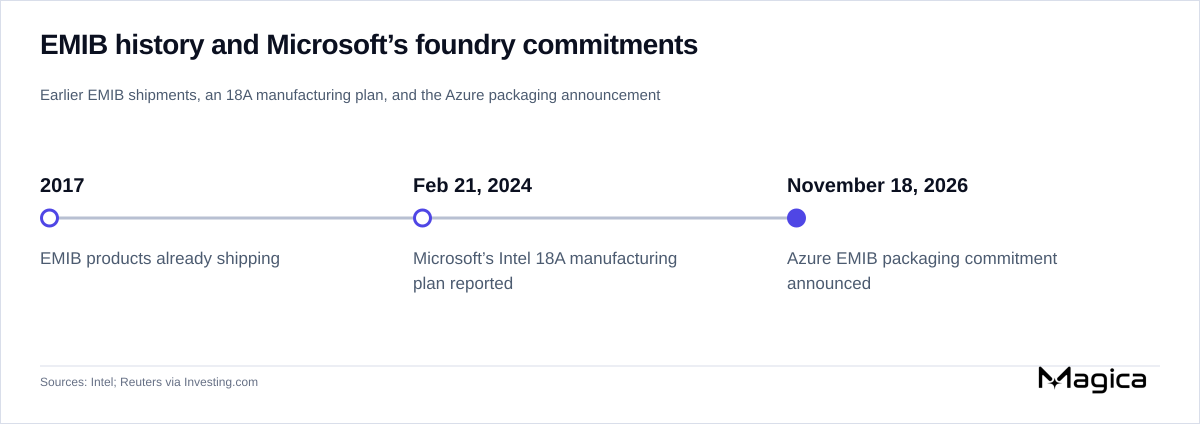
The manufacturing and packaging commitments were announced separately. Intel’s latest release does not establish whether they concern the same Microsoft chip. Source: Intel — 2021 packaging roadmap.
The EMIB commitment is distinct from Microsoft’s earlier manufacturing plan. In February 2024, Intel said Microsoft would use its Intel 18A manufacturing process for an undisclosed chip, according to the contemporary report. That report described Intel Foundry as the contract manufacturing operation established to compete with Taiwan Semiconductor Manufacturing Co. The new release does not establish whether the EMIB work concerns that same chip.
The earlier report also explained Intel’s stake in attracting outside customers: losing its manufacturing lead had weakened the premium prices and margins that helped fund factory advances. Microsoft’s packaging commitment adds business to that external-customer strategy, but its undisclosed value cannot establish the financial significance of this deal.
Nor is EMIB itself new. Intel’s July 2021 roadmap announcement said products using it had shipped since 2017. That announcement also identified Amazon Web Services, Amazon’s cloud business, as the first customer for Intel Foundry Services packaging solutions. Intel’s latest statement about Microsoft should therefore be read in its stated Azure-silicon context, rather than as the first outside use of Intel packaging.
A secondary account citing Microsoft’s announcement says Microsoft will use the EMIB-T variant and that future Maia and Cobalt generations will be packaged at Intel Foundry. Those details go beyond Intel’s release, which names neither chip family nor EMIB-T. The product assignments therefore require confirmation beyond that primary release.
The companies are also collaborating on Compute Express Link, or CXL, with Xeon processors for memory efficiency; QuickAssist Technology, or QAT, for acceleration; and confidential computing. Intel says Trust Domain Extensions can encrypt virtual-machine memory and CPU register state as confidential VMs move between hosts.
Intel cites up to 2.3 times greater performance and memory flexibility for Azure M-series v4 virtual machines using CXL memory and Intel Flat Memory Mode. Its footnote compares a 76-vCPU configuration with 1,764 GB of memory against a 64-vCPU configuration with 1,007 GB in a specified sandbox workload, tested November 10, 2026. The larger configuration has about 19% more virtual CPUs and 75% more listed memory, calculated from Intel’s specifications. That is a comparison between differently configured systems, not an isolated measurement of CXL’s contribution.
The release separately claims up to 2.5 times faster SQL backups through QAT-enabled Azure VMs, with testing completed November 2, 2026. The footnote compares a Xeon Gold 8362 system listing 128 CPUs and 1,024 GB of memory with a Xeon 6973P-C Azure VM listing 384 processors and 2.06 TB of memory. Processor generation and system resources differ, preventing the result from isolating QAT’s contribution. Neither figure measures an Azure chip packaged with EMIB, and neither demonstrates a packaging cost advantage.
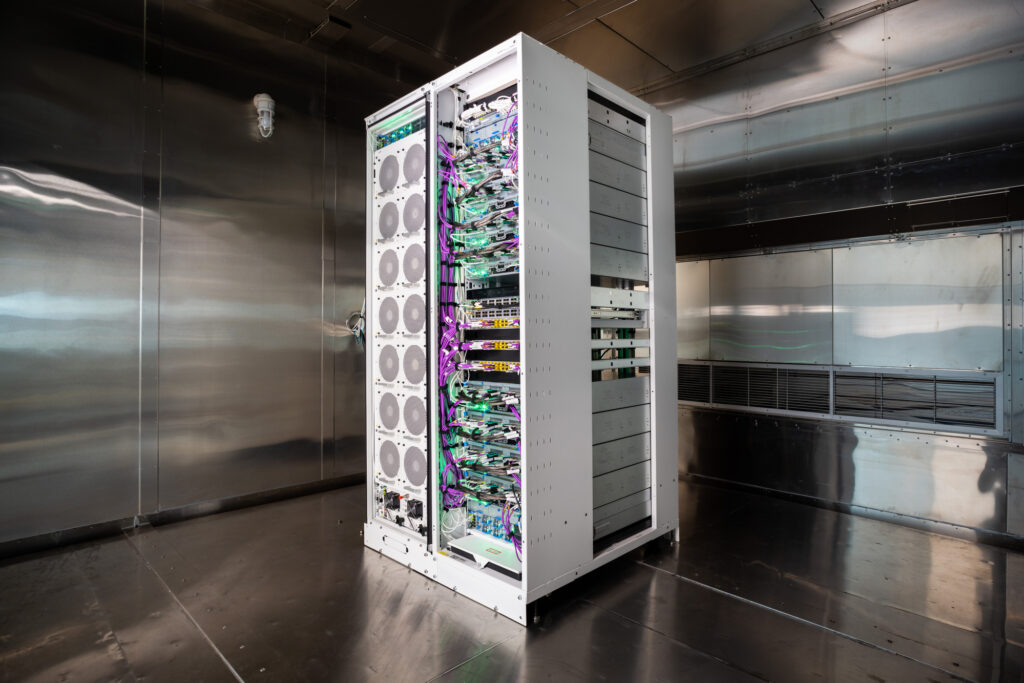
A Maia 100 rack and cooling “sidekick” in a Microsoft thermal chamber, pictured in November 2023. Cooling requirements for the new EMIB designs remain undisclosed. Photo by John Brecher for Microsoft. Source: Microsoft — custom silicon announcement.
Packaging is only one part of deployment economics. In its 2023 account, Microsoft said Maia 100 required wider custom racks and liquid cooling. Because its existing datacenters were not designed for large liquid chillers, it developed an adjacent cooling unit to circulate coolant through the chips’ cold plates. That is a historical example of the infrastructure work a custom-chip program can require, not a disclosed requirement for the new EMIB designs.
The next disclosures needed to assess this commitment are which Microsoft chips use EMIB, when they enter service, how much packaging capacity is committed and what the finished systems cost to operate. Intel’s announcement supplies none of those measures or a comparison with alternative packaging arrangements.
Production shipments and comparable measurements of finished-system performance, power use and cost would test Intel’s promise of improved Azure economics. The agreement announces a customer commitment; it supplies no EMIB-specific results on those measures.
Google expects to invest $1 billion in U.S. data center community programs through 2027. Its commitments on taxes, power costs and disclosure address hosting terms, while voters favored limits in 40 of 41 local ballot contests covering both binding restrictions and advisory questions.
Alibaba traded near HK$80 before earnings as US restrictions threatened overseas computing access. Its June results show accelerating cloud growth alongside heavy capital spending and widening AI application losses, while the new rules leave licensing routes and exemptions.
Vero Security is launching a free learning community alongside its commercial platform for enforcing enterprise AI policies. Its $11 million seed round backs a bid to automate recurring security work, but performance and pricing comparisons remain unproven.
Sarvam says its new Token Factory hosts Chinese and domestic AI models on privately funded Indian infrastructure. Its engineering claims and a rival’s price challenge put the commercial strategy under scrutiny alongside its publicly backed domestic-model mandate.
Google is replacing AI Ultra’s individual YouTube Premium benefit with family coverage at no extra cost in eligible countries. The upgrade adds household value, but cheaper subscriptions still matter to the buying decision.
An August fundraising initiative has produced no deployed capital, according to a report, as lenders seek more protection than Nvidia has offered to back customers’ chip purchases.
Anthropic’s reported $83 IPO price implies a fully diluted valuation of about $1.5 trillion. The final share count remains unresolved, while its prospectus shows rapid revenue growth, positive operating cash flow and $70.7 billion in commitments due in the year after September 30.
Colette Kress, Nvidia’s interim CEO and its CFO since 2013, promised December raises and equity awards ahead of the usual spring cycle. The undisclosed package comes as falling shares unsettle employees and the board rejects founder Jensen Huang’s return.
Palo Alto Networks agreed to buy Applied Compute for $4.5 billion in stock, pairing enterprise AI security with model adaptation and hosting. Its plans also call for less than $3 billion in infrastructure spending through fiscal 2030 and near-term margin pressure.
Google is rolling out temporary conversations in AI Mode that stay out of account history and personalization. Its help documentation says data collection continues and describes exceptions to the restriction on model training.
The Claude developer is expected to begin Nasdaq trading on November 19, with options potentially following Monday. Its proposed public offering could total $57.75 billion to $64.35 billion before fees, alongside a private placement, while founders and a benefit trust hold substantial governance powers.
A 3-2 vote stopped SpaceX’s request for a decade-long county property tax abatement from advancing. A separate city incentive hearing was announced for December, while the company’s investment plans remain unresolved.
Anthropic is reportedly considering more shares at well above $80 each. A separate $26 billion private placement adds to the financing stakes as rapid revenue growth meets vast computing commitments.
Pika’s Enact research preview lets creators move subjects, give actors notes and steer a camera during video generation. Its technical demonstrations show how the controls work, but consumer access, pricing and production reliability remain unresolved.
The NYU philosopher and 2026 Berggruen Prize winner sees no reason to attribute consciousness to current language models. His skepticism contrasts with Anthropic's experiments in model welfare, while research indicators leave open what future systems could become.
The Center for AI Safety joined critics from opposing AI camps in accusing Anthropic of weakening its safeguards. The company’s filing documents both commercial pressure to advance and a recent development pause, making the dispute about what restraint is binding.
Microsoft detailed Azure tools at Ignite that let AI agents reuse processed context, alongside new isolation and networking controls. The announcements leave total savings unquantified, while previews and customer operating duties limit the rollout.
Linq says its a16z-led Series B values the company at $1 billion after more than one billion messages. The funding backs a broader agent infrastructure business, with new HD calling and computer access extending a platform still dependent on communications providers.
SoftBank founder Masayoshi Son called passing on Anthropic a mistake while remaining committed to rival OpenAI. Another prospective OpenAI investment would deepen a relationship that already links SoftBank’s capital, investment valuations and infrastructure ambitions.