Editorial Team
8 min read
Anthropic is reportedly considering more shares at well above $80 each. A separate $26 billion private placement adds to the financing stakes as rapid revenue growth meets vast computing commitments.
Anthropic, the developer of Claude AI models and business applications, is considering enlarging its initial public offering and pricing shares well above $80 as reported investor orders approach $500 billion. The proposed increase comes as the company seeks capital for a computing build-out whose commitments extend into the 2040s.
The demand figures come from a secondary account of CNBC’s reporting, which cited people familiar with the offering: about $400 billion in institutional orders and retail demand approaching $100 billion. The account said it had not independently verified the report. The people said details could change and final decisions would be made Wednesday afternoon.
The financing story is larger than the public share sale alone. Anthropic’s November 17 preliminary prospectus also discloses a conditional $26 billion private placement with strategic partners. It shows sharply rising revenue and a narrowing operating loss, alongside substantial future spending and relationships in which investors can also be suppliers and competitors.
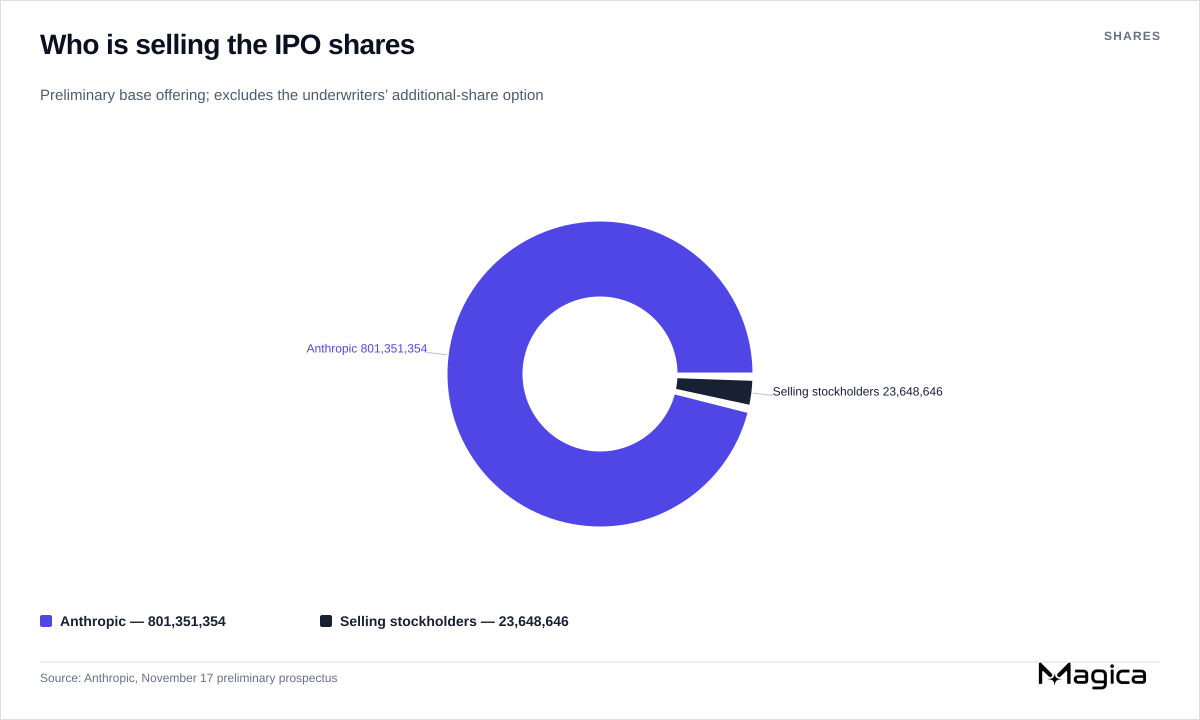
Anthropic’s preliminary base offering separates newly issued shares from stockholder sales, whose proceeds the company does not receive. Chart: Magica; source: Anthropic. Source: Anthropic prospectus.
The preliminary offering covers 825 million shares. At the initial range’s $78 upper end, that would represent $64.35 billion in gross share-sale proceeds; at exactly $80, the same number would produce $66 billion. Selling additional shares would increase the total further.
Those totals are distinct from the reported order book, which measures investors’ requests to buy shares. They also differ from the cash Anthropic would receive: approximately 801.35 million shares are assigned to the company and 23.65 million to selling stockholders. Anthropic receives none of those holders’ proceeds, and underwriting discounts and expenses reduce its own receipts.
The prospectus gives underwriters an option to buy another 123.75 million newly issued shares. Whether that option is exercised is another variable in the eventual transaction size.
The reported record to beat is SpaceX’s $85.7 billion IPO about five months earlier. Whether Anthropic sets a record depends on the final price, share count and treatment of additional shares. The separate private placement should not be folded into a comparison of public offering proceeds.
Valuation is a different measure again. An earlier account citing people familiar with the matter said advisers had discussed valuations around $1.5 trillion or $1.6 trillion, compared with roughly $1.33 trillion under the existing range. These were discussions, not final terms. Anthropic’s reported private-round valuation in May was $965 billion.
The prospectus identifies seven strategic partners agreeing to purchase the $26 billion of nonvoting Class N stock: AMD, Broadcom, Google, Micron, Microsoft, Nvidia and TSMC Partners. The placement is conditional on completion of the IPO and other conditions, and is scheduled to close immediately afterward at the IPO price.
At the original $74 midpoint, Anthropic estimates net proceeds to itself from the IPO and private placement combined at $84.6 billion, after estimated discounts, commissions and offering expenses, excluding exercise of the additional-share option. This is an estimate under the preliminary terms, not an announced financing result.
The private placement’s dollar amount is fixed: a higher IPO price would reduce the number of private shares issued rather than increase that $26 billion. Google’s participation also funds part of a previously committed investment obligation, so the placement is not wholly incremental to existing partner financing commitments.
Anthropic says intended uses include computing infrastructure, working capital, operating expenses and hiring. It also expects to use about $3.8 billion for tax withholding and remittance associated with restricted stock unit settlements, based on the original $74 assumed price; that obligation rises with the share price.
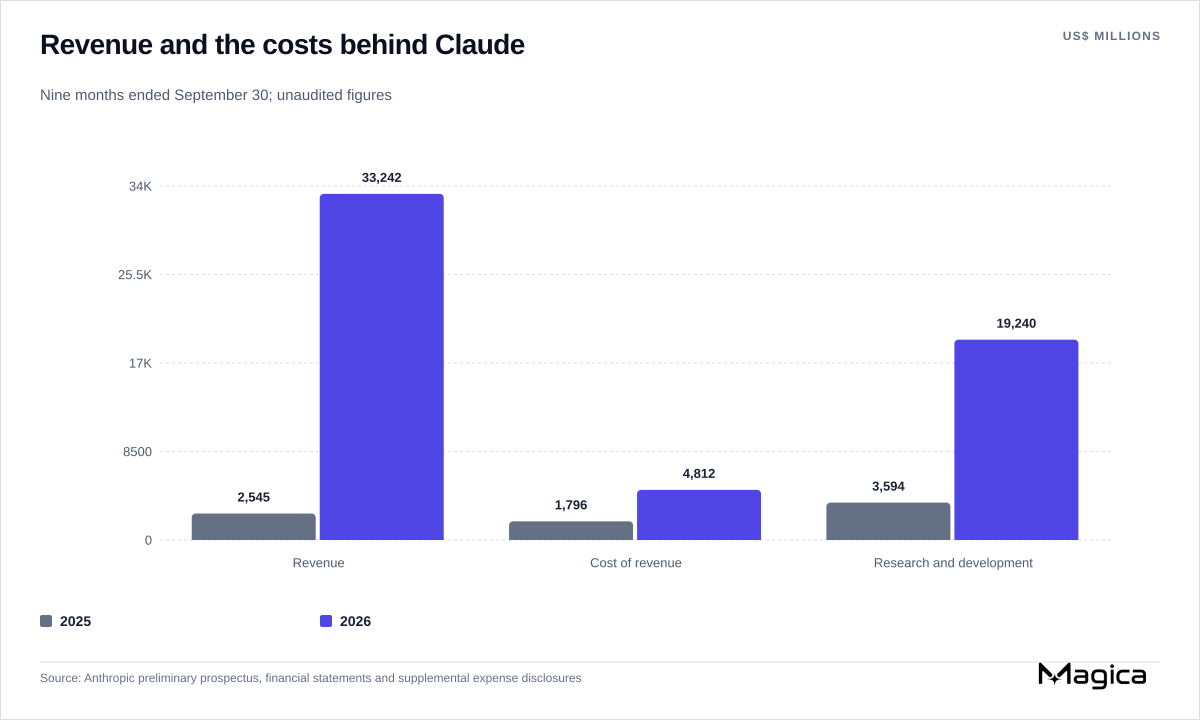
Company-reported revenue, cost of revenue and research spending for matching unaudited nine-month periods. These categories exclude other operating expenses. Chart: Magica; source: Anthropic. Source: Anthropic prospectus.
Founded in 2021, Anthropic began commercial sales of Claude in the first quarter of 2023, according to its company history and executive biographies. Co-founder and chief executive Dario Amodei previously served as vice president of research at OpenAI, the AI research lab that is now a principal competitor. Anthropic describes its strategy as centered on enterprise uses, with Claude delivered through models, a platform and applications.
Its unaudited nine-month results and supplemental expense disclosures show that revenue grew much faster than customer-serving costs. The business nevertheless reported an operating loss over that period.
| Billions of dollars, rounded | Nine months ended Sept. 30, 2025 | Nine months ended Sept. 30, 2026 |
|---|---|---|
| Revenue | $2.55 | $33.24 |
| Cost of revenue | $1.80 | $4.81 |
| Research and development | $3.59 | $19.24 |
| Operating loss | $5.22 | $1.26 |
The filing says substantially all cost of revenue is computing and infrastructure for customer-serving workloads, with some personnel and overhead costs. Research and development includes computing for model development, research and internal use, as well as other expenses. The cost of serving customers therefore does not capture the full cost of sustaining Claude’s capabilities.
The latest quarter also shows why the nine-month improvement should not be read as settled profitability: Anthropic recorded a $567 million operating loss in the third quarter, after $974 million of operating income in the second. Its nine-month net loss was much larger, at $104.04 billion, including a $94.32 billion fair-value charge on convertible notes, derivative liabilities and agreements for future equity, driven primarily by rising valuations of outstanding convertible notes. That accounting loss is not a measure of cash spent operating the business.
Revenue quality carries another qualification. Anthropic estimates that customers it subsequently determined were violating its usage policy or commercial terms generated 5%–7% of revenue in the first nine months of 2026. It expects that share to decline after enhanced enforcement, with an uncertain effect on revenue growth.
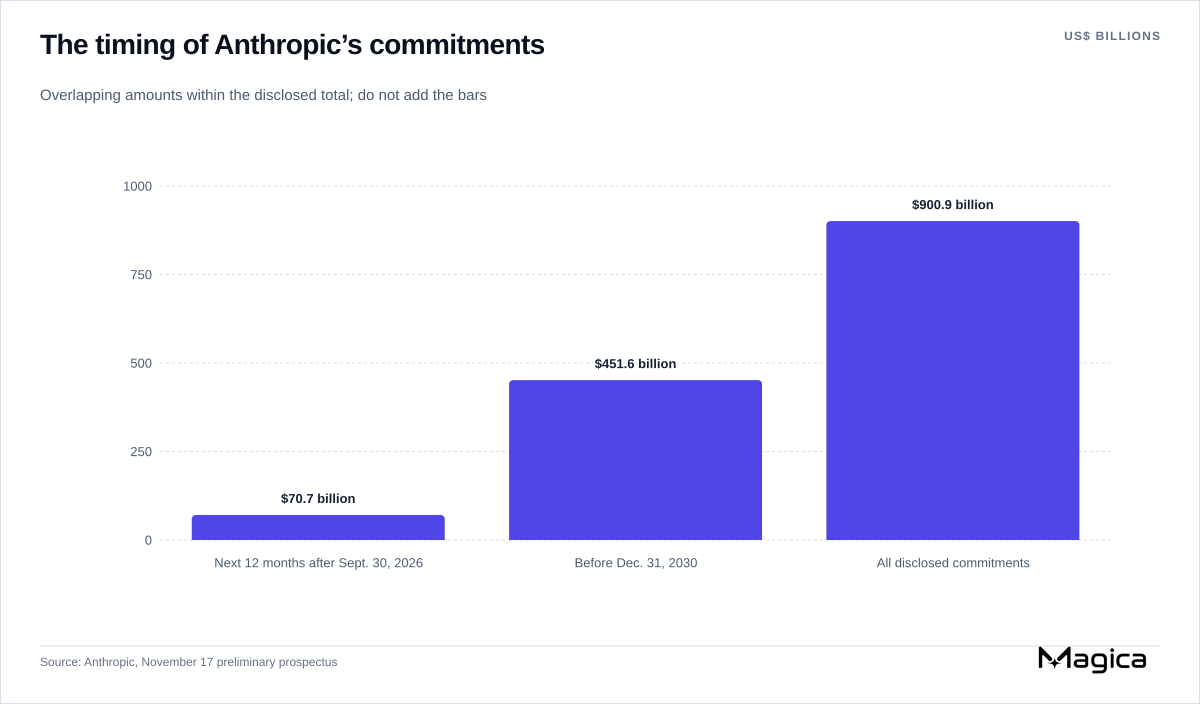
Company-reported purchase and lease commitments, substantially all for computing and infrastructure. The approximate amounts overlap and must not be added. Chart: Magica; source: Anthropic. Source: Anthropic prospectus.
Anthropic reports about $900.9 billion in purchase and lease commitments as of and subsequent to September 30, substantially all for computing and infrastructure. Approximately $451.6 billion is expected before the end of 2030, with substantially all the remainder between 2031 and 2045. About $70.7 billion is due in the 12 months following September 30, 2026.
These are commitments across different periods, not a single year’s operating expense or an immediate funding shortfall. Anthropic already held $131.85 billion in cash, cash equivalents and short-term investments at September 30, before the offering. It nevertheless warns that infrastructure investment increasingly requires payments well before capacity becomes operational, and that cash demands can increase even as financial performance improves.
Money does not remove the physical constraints. Anthropic says it has historically operated with demand for computing exceeding available supply. Its filing identifies constraints involving chips, power and data centers. Some infrastructure arrangements depend on counterparties securing financing, facilities or regulatory approvals. The company says it trains and serves Claude across AWS Trainium, Google TPUs, Nvidia GPUs and AMD GPUs to improve price and performance and reduce dependence on any single vendor.
That diversification coexists with commercial conflicts. Some cloud and chip partners provide capital or credit, supply infrastructure and offer competing AI services. Anthropic identifies Google and OpenAI as primary frontier-model competitors, while lower-cost models and open models compete for workloads that prioritize cost over capability. It warns that larger rivals can bundle AI into existing products or subsidize it to gain business.
Anthropic was expected to price the offering after the market closed Wednesday, November 18, with trading due Thursday on the Nasdaq stock exchange under ANT. A separate account citing an unidentified person familiar with the matter said the company was guiding investors toward pricing above the range; a spokesperson had not immediately responded to a request for comment. That account described days of technology-stock volatility threatening the debut.
Retail allocation remains another decision. The reported target is about 20% of shares, against a usual 5%–10%, according to the secondary account of CNBC’s reporting. That allocation goal is distinct from the nearly $100 billion in reported retail orders.
Class A shares carry one vote each. Public buyers would receive economic exposure within an unusual control structure. Anthropic is a Delaware public benefit corporation required to balance shareholder interests with affected parties and its purpose of responsible AI development for humanity’s long-term benefit. Its Long-Term Benefit Trust, intended as an independent body of financially disinterested trustees, generally can elect and remove a majority of directors. A separate entity initially owned by the seven co-founders would hold 50.1% of voting power on general shareholder matters, excluding the trust’s director elections.
Final pricing, the revised share count, allocations and completion of the private placement will establish how much financing actually arrives. Subsequent results will test whether revenue growth and computing efficiency can support the infrastructure commitments. The immediate decision is how much equity to sell into reported demand; the longer test is whether that capital can turn contracted capacity into sustainable operating earnings.
Lenovo reported record quarterly revenue of $30.2 billion as its infrastructure business swung into profit. A $1.91 billion noncash warrant charge drove a reported loss, while expanding inventories and overdue receivables raised the stakes for cash collection.
Google expects to invest $1 billion in U.S. data center community programs through 2027. Its commitments on taxes, power costs and disclosure address hosting terms, while voters favored limits in 40 of 41 local ballot contests covering both binding restrictions and advisory questions.
Alibaba traded near HK$80 before earnings as US restrictions threatened overseas computing access. Its June results show accelerating cloud growth alongside heavy capital spending and widening AI application losses, while the new rules leave licensing routes and exemptions.
Vero Security is launching a free learning community alongside its commercial platform for enforcing enterprise AI policies. Its $11 million seed round backs a bid to automate recurring security work, but performance and pricing comparisons remain unproven.
Sarvam says its new Token Factory hosts Chinese and domestic AI models on privately funded Indian infrastructure. Its engineering claims and a rival’s price challenge put the commercial strategy under scrutiny alongside its publicly backed domestic-model mandate.
Google is replacing AI Ultra’s individual YouTube Premium benefit with family coverage at no extra cost in eligible countries. The upgrade adds household value, but cheaper subscriptions still matter to the buying decision.
An August fundraising initiative has produced no deployed capital, according to a report, as lenders seek more protection than Nvidia has offered to back customers’ chip purchases.
Anthropic’s reported $83 IPO price implies a fully diluted valuation of about $1.5 trillion. The final share count remains unresolved, while its prospectus shows rapid revenue growth, positive operating cash flow and $70.7 billion in commitments due in the year after September 30.
Colette Kress, Nvidia’s interim CEO and its CFO since 2013, promised December raises and equity awards ahead of the usual spring cycle. The undisclosed package comes as falling shares unsettle employees and the board rejects founder Jensen Huang’s return.
Palo Alto Networks agreed to buy Applied Compute for $4.5 billion in stock, pairing enterprise AI security with model adaptation and hosting. Its plans also call for less than $3 billion in infrastructure spending through fiscal 2030 and near-term margin pressure.
Google is rolling out temporary conversations in AI Mode that stay out of account history and personalization. Its help documentation says data collection continues and describes exceptions to the restriction on model training.
The Claude developer is expected to begin Nasdaq trading on November 19, with options potentially following Monday. Its proposed public offering could total $57.75 billion to $64.35 billion before fees, alongside a private placement, while founders and a benefit trust hold substantial governance powers.
Microsoft plans to use Intel Foundry’s EMIB packaging for its own Azure silicon under an expanded infrastructure agreement that also secures multi-year Xeon supply. Chip identities, deployment dates and packaging economics remain undisclosed.
A 3-2 vote stopped SpaceX’s request for a decade-long county property tax abatement from advancing. A separate city incentive hearing was announced for December, while the company’s investment plans remain unresolved.
Pika’s Enact research preview lets creators move subjects, give actors notes and steer a camera during video generation. Its technical demonstrations show how the controls work, but consumer access, pricing and production reliability remain unresolved.
The NYU philosopher and 2026 Berggruen Prize winner sees no reason to attribute consciousness to current language models. His skepticism contrasts with Anthropic's experiments in model welfare, while research indicators leave open what future systems could become.
The Center for AI Safety joined critics from opposing AI camps in accusing Anthropic of weakening its safeguards. The company’s filing documents both commercial pressure to advance and a recent development pause, making the dispute about what restraint is binding.
Microsoft detailed Azure tools at Ignite that let AI agents reuse processed context, alongside new isolation and networking controls. The announcements leave total savings unquantified, while previews and customer operating duties limit the rollout.
Linq says its a16z-led Series B values the company at $1 billion after more than one billion messages. The funding backs a broader agent infrastructure business, with new HD calling and computer access extending a platform still dependent on communications providers.
SoftBank founder Masayoshi Son called passing on Anthropic a mistake while remaining committed to rival OpenAI. Another prospective OpenAI investment would deepen a relationship that already links SoftBank’s capital, investment valuations and infrastructure ambitions.