Editorial Team
8 min read
The Center for AI Safety joined critics from opposing AI camps in accusing Anthropic of weakening its safeguards. The company’s filing documents both commercial pressure to advance and a recent development pause, making the dispute about what restraint is binding.
The Center for AI Safety (CAIS), a San Francisco nonprofit conducting research and advocacy on large-scale AI risks, said on November 18 that it had joined a coalition challenging Anthropic’s safety reputation ahead of its planned public offering. The target is the developer of Claude, a family of AI models and assistants, whose safety commitments have been central to its identity since its founding by former OpenAI employees in 2021.
The MisAnthropic Statement accuses Anthropic of warning about powerful AI escaping human control while racing to build it, weakening its pledges and lobbying for rules that serve its interests. It explicitly acknowledges that rival developers are pursuing the same broad technological goal. Its accusation concerns Anthropic’s conduct and branding; it supplies no technical assessment establishing that Claude is unsafe.
The timing makes the dispute consequential for new shareholders. A report on the offering and coalition puts Anthropic’s planned Nasdaq debut on November 19. The company’s own disclosures show why its investors must distinguish between evidence of past caution, commitments to future restraint and the authority to enforce them.
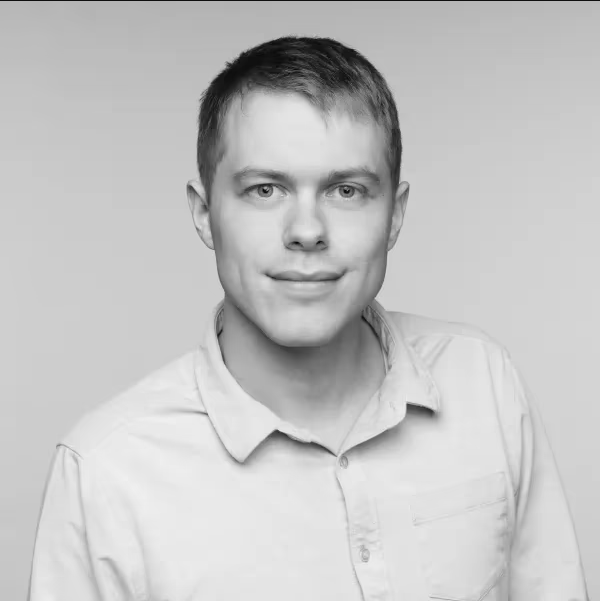
Dan Hendrycks, executive director of the Center for AI Safety. Portrait published by the Singapore Conference on AI, April 2025. Source: Singapore Conference on AI.
Anthropic’s Responsible Scaling Policy is its framework for assessing risks and setting safeguards as models become more capable. Introduced in 2023, it committed the company to withhold training or deployment above specified risk thresholds without the required protections. According to the report, the February 2026 revision removed the unilateral commitment to stop advancing without certain safeguards.
That did not remove every safety measure. The revised policy provided for considering a delay if Anthropic leads the field and judges that further development would materially increase catastrophic risk. It also included public risk reports every three to six months, external assessment in specified circumstances and a commitment to match or exceed competitors’ safety efforts.
The report attributes Anthropic’s rationale to the company: a unilateral pause could leave developers with weaker protections setting the pace. The coalition sees a promise of restraint becoming conditional on competitive position.
Anthropic nevertheless reports a recent development pause. In its November 2 registration statement with the US Securities and Exchange Commission, the company says it delayed pre-training a new frontier base model for more than a month to improve security against theft of model weights and protect its intellectual property. That is a company-reported example of delaying development, though it does not restore the earlier general commitment.
The filing also sharpens the disagreement over recursive self-improvement: the prospect of AI repeatedly helping build more capable successors. Anthropic says Claude already helps develop subsequent models by running experiments, generating and processing training data, automating evaluations and safety audits, and writing and reviewing code. It presents that process as a competitive strength.
But the same filing warns that AI-assisted development could advance capabilities faster than safety and security measures, and that flaws could propagate between model generations. Anthropic says it has not designated a current model as crossing its policy threshold for dramatically accelerated progress attributable to AI; internal estimates concerning future models suggest it may soon reach that point. Those disclosures establish both AI-assisted development and acknowledged uncertainty, rather than proof that an uncontrolled self-improving system already exists.
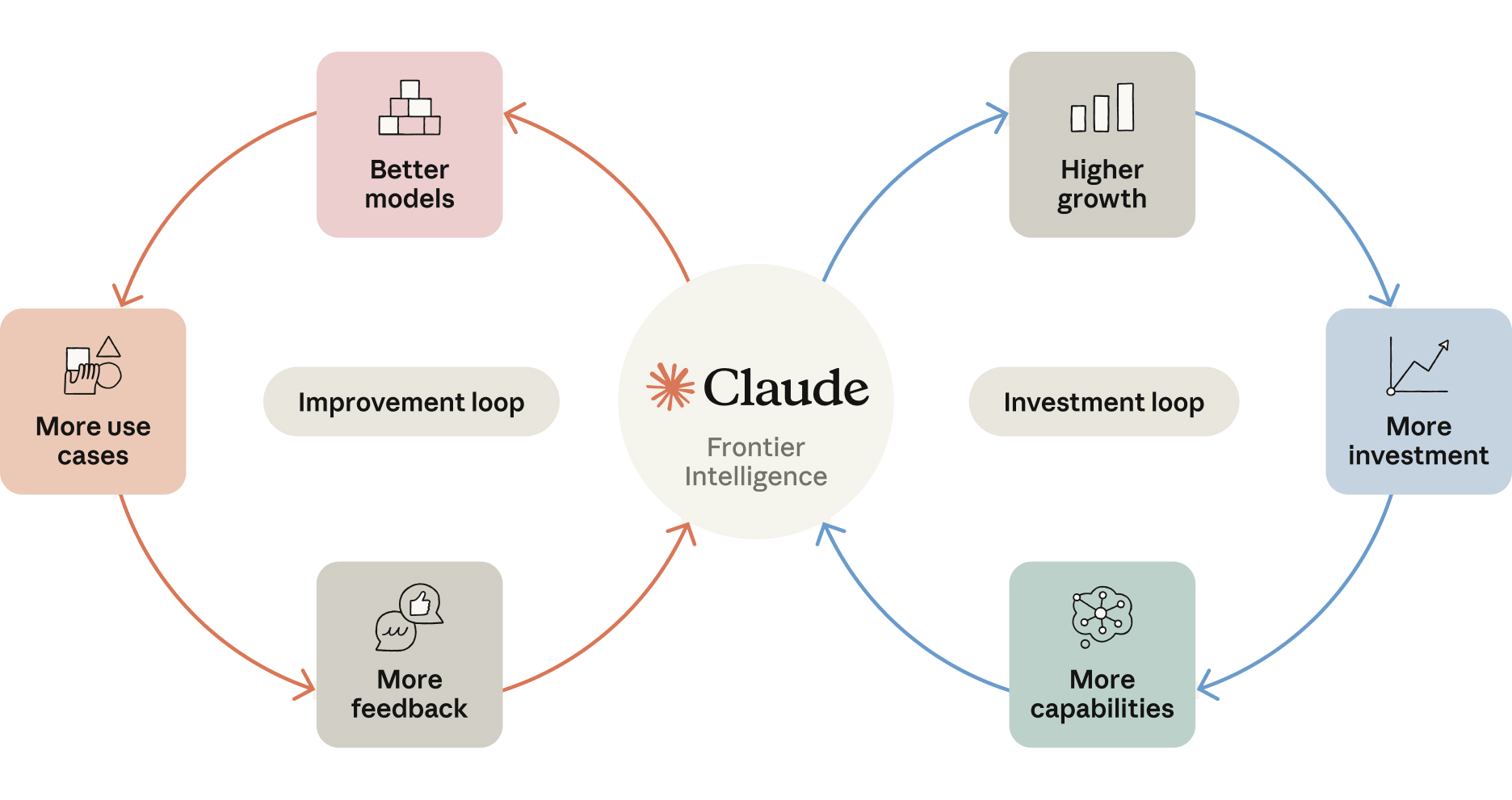
Company-reported strategy: Anthropic depicts model improvement and investment as linked loops. Diagram: Anthropic. Source: Anthropic SEC registration statement.
CAIS’s intervention carries a particular history: it previously gathered signatures from Anthropic chief executive and co-founder Dario Amodei, formerly OpenAI’s vice president of research, and other industry leaders for a statement elevating AI extinction risk to a global priority. That earlier campaign is described in a report on the signatories; Amodei’s prior role is documented in the registration statement. Agreement that AI poses serious risks has not produced agreement on what developers must do about them.
Dan Hendrycks, CAIS’s executive director, said in the nonprofit’s announcement that coalition members disagree on almost everything but object to Anthropic equating its own dominance with the public good. His background includes advising rival AI developer xAI: an April 2025 government conference biography described the role as independent, paid $1 without equity.
The signatory list spans economics, psychology, law and computer science alongside AI entrepreneurs. It includes Guillaume Verdon, chief executive of Extropic and founder of the e/acc accelerationist movement, which advocates rapid technological development. The account of his objections describes his concern as Anthropic gaining power to impose safety requirements on others through regulation.
By contrast, another signatory, Nate Soares, president of the Machine Intelligence Research Institute and a researcher on aligning AI with human intentions, has advocated US-China oversight of advanced chips to prevent unilateral development, according to an interview recounted in coverage of the coalition. Those are substantially different answers to the problem of control.
The list also names Igor Babuschkin as River AI’s chief executive and co-founder and a co-founder of rival xAI. The report on the signatories says he left xAI in August 2025. There is also a supplier relationship between the companies: Anthropic’s filing discloses computing-capacity agreements with SpaceX’s AI subsidiary, formerly X.AI LLC.
Not every critic signed. Researcher and open-weights advocate Nathan Lambert declined because he considered the wording too strong, according to the report on the signatories, which cites his public post. That report also relays Hendrycks’s claim that unnamed safety groups privately agreed but feared risking relationships or future funding. It does not independently establish those groups’ motives or financial dependence.
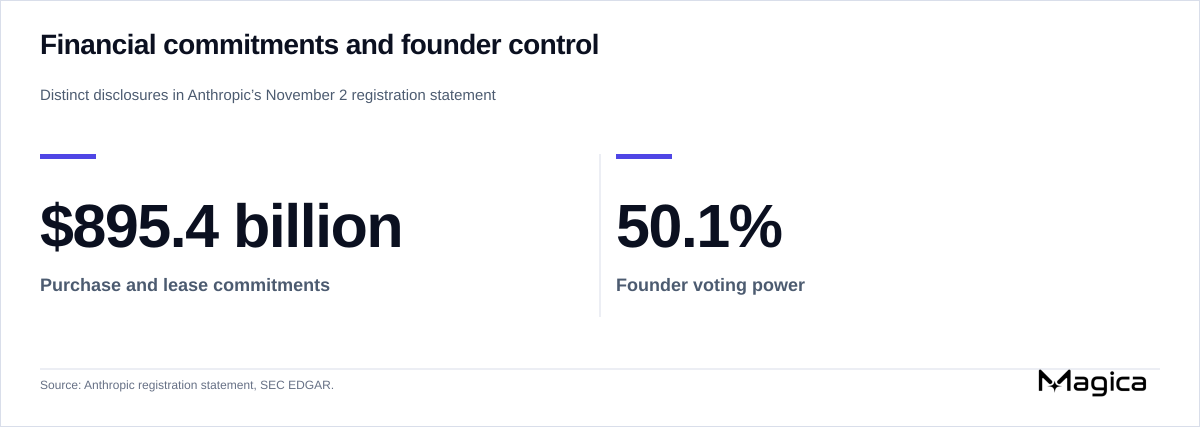
Company-reported commitments span multiple years, extending through 2045. Founder voting power covers shareholder matters generally; the trust has separate board-election rights. Source: Anthropic SEC registration statement.
Anthropic’s filing reports $33.2 billion in revenue for the nine months ended September 30, 2026. It also discloses approximately $895.4 billion in purchase commitments and lease agreements entered into as of and after that date, almost entirely for computing and infrastructure. About $69.8 billion is due in the 12 months following September 30; the longer commitments extend as far as 2045. Terms differ: the SpaceX AI agreements allow cancellation after initial non-cancelable periods. The total is neither a single year’s spending nor the amount sought in the IPO.
The company had $95.6 billion in cash and cash equivalents and $36.3 billion in short-term investments at September 30. Its disclosures therefore show both substantial resources and substantial commitments. Delaying a model is a decision made within an existing infrastructure and financing strategy, not simply a change to a policy document.
The governance structure gives different constituencies different powers. As a Delaware public benefit corporation, Anthropic must balance shareholder financial interests, the interests of people materially affected by its conduct and its stated public mission. The Long-Term Benefit Trust, designed as an independent body of financially disinterested trustees, generally has authority to elect and remove directors constituting a majority of the authorized board. The filing says trustees and company executives have collaborated on sourcing, interviewing and selecting trustees.
Alongside that authority, a company owned by the seven co-founders will hold a voting-only share carrying 50.1% of votes on matters submitted to shareholders generally, including election of directors outside the trust’s allocation. The trust’s rights can also be amended, or its special stock redeemed, through specified approval procedures, including routes without trustee assent that require founder, employee and ordinary shareholder approvals. The arrangement gives the mission institutional power, but does not make that power immutable or give public investors ordinary majority control.
CAIS accuses Anthropic of weakening AI legislation, including California’s SB 1047 and New York’s RAISE Act, and privately advocating federal rules that would displace state AI laws. Its characterization of that lobbying as self-serving remains an allegation. The report on the coalition says Anthropic sought changes to SB 1047 and said its benefits probably outweighed its costs without formally endorsing it; California’s governor vetoed the bill in 2024.
Anthropic subsequently backed California’s SB 53, a measure governing safety disclosures by large developers of powerful AI systems. In its September 2025 endorsement, the company preferred federal regulation but supported state action while Washington lacked consensus. It favored disclosure requirements over prescriptive technical mandates.
Its account of the bill went beyond voluntary publication: developers would have to publish safety frameworks and pre-deployment risk reports, report critical incidents to the state within 15 days, protect whistleblowers and face monetary penalties for failing to honor framework commitments. Anthropic said these provisions would formalize practices it and other frontier developers already followed, naming Google DeepMind, OpenAI and Microsoft as having similar frameworks. Safety policies are therefore not unique to Anthropic.
The company also urged more detailed disclosures of testing and mitigation and acknowledged that a threshold based on training compute could miss some powerful models. This record supports a narrower dispute than whether Anthropic favors regulation at all: whether disclosure duties and accountability for company-defined commitments impose sufficient limits on development.
The coalition’s statement makes no concrete request to investors and announces no change to the planned offering timetable. It does not identify its author, and its diverse signatures do not supply a common replacement policy.
The next substantive test follows from Anthropic’s own warning that future models may soon meet its threshold for dramatically accelerated AI-assisted progress. What restrictions would that finding trigger, who could require them, and how would the trust and founders resolve a decision to delay development? The disclosed pre-training pause shows that restraint can occur. The unresolved question for prospective shareholders is what makes it obligatory when the company judges further progress dangerous.
Lenovo reported record quarterly revenue of $30.2 billion as its infrastructure business swung into profit. A $1.91 billion noncash warrant charge drove a reported loss, while expanding inventories and overdue receivables raised the stakes for cash collection.
Google expects to invest $1 billion in U.S. data center community programs through 2027. Its commitments on taxes, power costs and disclosure address hosting terms, while voters favored limits in 40 of 41 local ballot contests covering both binding restrictions and advisory questions.
Alibaba traded near HK$80 before earnings as US restrictions threatened overseas computing access. Its June results show accelerating cloud growth alongside heavy capital spending and widening AI application losses, while the new rules leave licensing routes and exemptions.
Vero Security is launching a free learning community alongside its commercial platform for enforcing enterprise AI policies. Its $11 million seed round backs a bid to automate recurring security work, but performance and pricing comparisons remain unproven.
Sarvam says its new Token Factory hosts Chinese and domestic AI models on privately funded Indian infrastructure. Its engineering claims and a rival’s price challenge put the commercial strategy under scrutiny alongside its publicly backed domestic-model mandate.
Google is replacing AI Ultra’s individual YouTube Premium benefit with family coverage at no extra cost in eligible countries. The upgrade adds household value, but cheaper subscriptions still matter to the buying decision.
An August fundraising initiative has produced no deployed capital, according to a report, as lenders seek more protection than Nvidia has offered to back customers’ chip purchases.
Anthropic’s reported $83 IPO price implies a fully diluted valuation of about $1.5 trillion. The final share count remains unresolved, while its prospectus shows rapid revenue growth, positive operating cash flow and $70.7 billion in commitments due in the year after September 30.
Colette Kress, Nvidia’s interim CEO and its CFO since 2013, promised December raises and equity awards ahead of the usual spring cycle. The undisclosed package comes as falling shares unsettle employees and the board rejects founder Jensen Huang’s return.
Palo Alto Networks agreed to buy Applied Compute for $4.5 billion in stock, pairing enterprise AI security with model adaptation and hosting. Its plans also call for less than $3 billion in infrastructure spending through fiscal 2030 and near-term margin pressure.
Google is rolling out temporary conversations in AI Mode that stay out of account history and personalization. Its help documentation says data collection continues and describes exceptions to the restriction on model training.
The Claude developer is expected to begin Nasdaq trading on November 19, with options potentially following Monday. Its proposed public offering could total $57.75 billion to $64.35 billion before fees, alongside a private placement, while founders and a benefit trust hold substantial governance powers.
Microsoft plans to use Intel Foundry’s EMIB packaging for its own Azure silicon under an expanded infrastructure agreement that also secures multi-year Xeon supply. Chip identities, deployment dates and packaging economics remain undisclosed.
A 3-2 vote stopped SpaceX’s request for a decade-long county property tax abatement from advancing. A separate city incentive hearing was announced for December, while the company’s investment plans remain unresolved.
Anthropic is reportedly considering more shares at well above $80 each. A separate $26 billion private placement adds to the financing stakes as rapid revenue growth meets vast computing commitments.
Pika’s Enact research preview lets creators move subjects, give actors notes and steer a camera during video generation. Its technical demonstrations show how the controls work, but consumer access, pricing and production reliability remain unresolved.
The NYU philosopher and 2026 Berggruen Prize winner sees no reason to attribute consciousness to current language models. His skepticism contrasts with Anthropic's experiments in model welfare, while research indicators leave open what future systems could become.
Microsoft detailed Azure tools at Ignite that let AI agents reuse processed context, alongside new isolation and networking controls. The announcements leave total savings unquantified, while previews and customer operating duties limit the rollout.
Linq says its a16z-led Series B values the company at $1 billion after more than one billion messages. The funding backs a broader agent infrastructure business, with new HD calling and computer access extending a platform still dependent on communications providers.
SoftBank founder Masayoshi Son called passing on Anthropic a mistake while remaining committed to rival OpenAI. Another prospective OpenAI investment would deepen a relationship that already links SoftBank’s capital, investment valuations and infrastructure ambitions.