Editorial Team
7 min read
Pika’s Enact research preview lets creators move subjects, give actors notes and steer a camera during video generation. Its technical demonstrations show how the controls work, but consumer access, pricing and production reliability remain unresolved.
Pika, an AI-video startup, is previewing Enact, an experimental environment that accepts direction while a scene is being generated: creators can reposition subjects, speak to synthetic actors and steer a virtual camera. The company calls Enact a research preview and explicitly says it is unavailable for consumer use in its technical announcement.
The proposed benefit is a shorter feedback loop: a director can respond to a scene as it unfolds instead of waiting for a completed clip before revising instructions. That could make an almost-right performance easier to revise, but Pika has yet to establish what that interaction will cost or how reliably it will work outside its demonstrations.

Pika’s Live Staging demo shows mouse-controlled subject placement during video generation. Enact remains a research preview. Image: Pika. Source: Pika.
Pika was founded in April 2023 by CEO Demi Guo and co-founder Chenlin Meng, who left Stanford University’s AI PhD program to build it. Guo’s frustration with existing tools during an AI film competition helped prompt their ambition to build better video generation and a simpler interface, a 2024 founder profile recounts.
That profile reports Pika announced $55 million in financing in November 2023 from investors including Lightspeed Venture Partners and Factorial Capital. A subsequent $80 million round in June 2024, including Spark Capital, valued Pika at $470 million. These are historical financing figures, not an Enact budget.
Enact extends the interface ambition, but its underlying model also shows Pika building on another developer’s work. It runs on Pika H3 Flex, Pika’s post-trained version of MiniMax’s H3 model. A report on the preview distinguishes H3 Flex’s open weights from Enact’s directing layer, whose openness is not established. It also cautions that H3 Flex’s capabilities do not automatically carry into Enact.
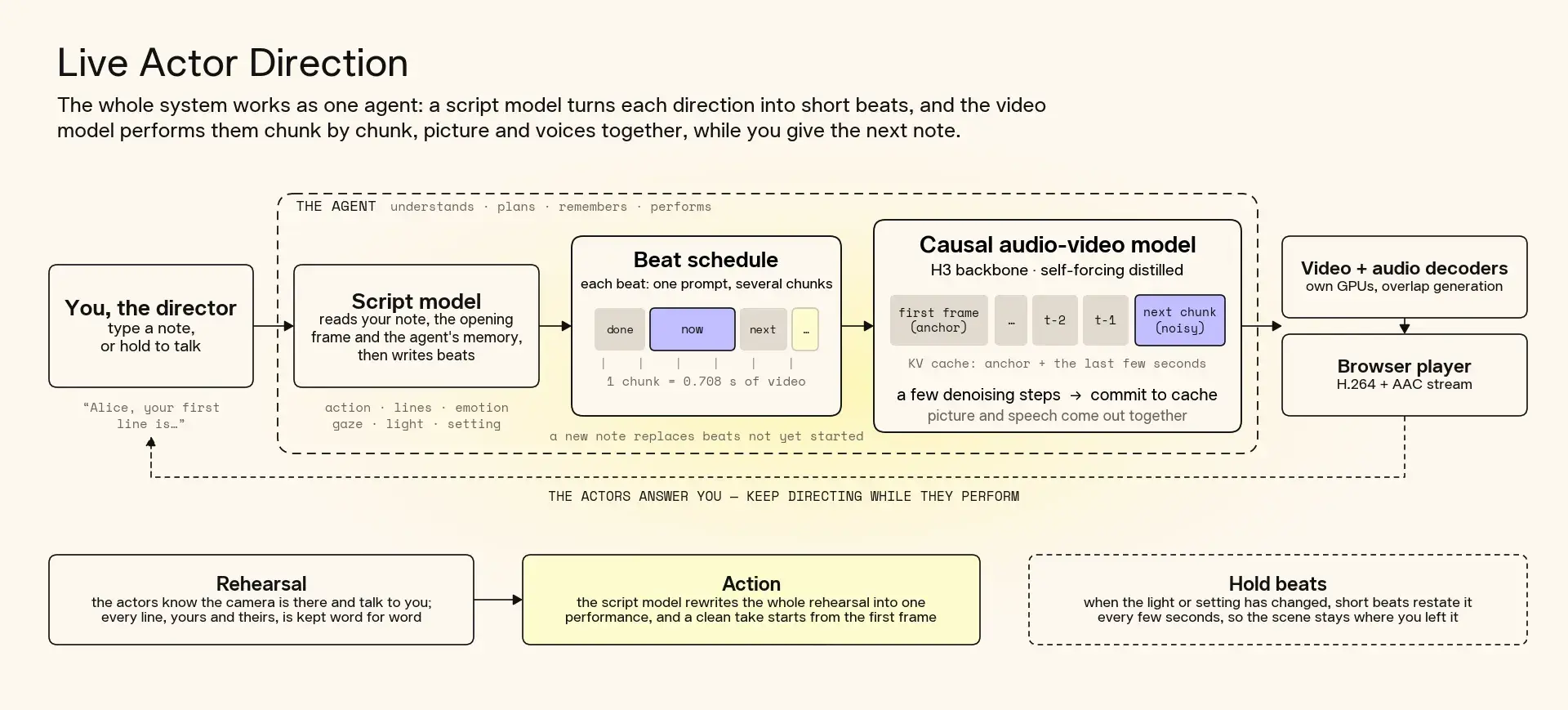
Pika’s diagram shows how notes become performance beats and how calling Action starts a fresh take. Graphic: Pika. Source: Pika.
In Live Staging, a creator drags an actor or object with a mouse while the video continues. Pika says the model generates the moved subject together with its surroundings, adjusting pose, lighting and shadows rather than simply sliding a cutout over a background.
Live Actor Direction accepts typed or spoken notes about movement, dialogue, emotion or the setting. A script language model reads those notes alongside the opening frame and session memory, then turns them into structured instructions for a streaming audio-video model. The characters’ apparent memory is software context used to sustain the performance.
Rehearsal and the final take are distinct. Pika says calling “Action” prompts the script model to rewrite the rehearsal exchange into a continuous performance generated afresh from the first frame. The result is a new generation, rather than the rehearsal footage with interruptions removed. Pika also labels its rehearsal demonstration as edited for length, with subtitles and the director’s webcam inset added afterward.
Live Camera Control uses an appearance image to anchor the cast and setting, plus a lightweight 3D motion reference, such as an untextured Blender viewport, to guide camera movement. Pika says this mode generates audio and video from scratch while the creator changes the viewpoint.
In a published interview summary, Pika creative lead Matan Cohen-Grumi describes an aim of separating an actor’s performance from camera work, so a creator can settle on a take before exploring angles. The interview describes an intended workflow, without establishing production reliability.
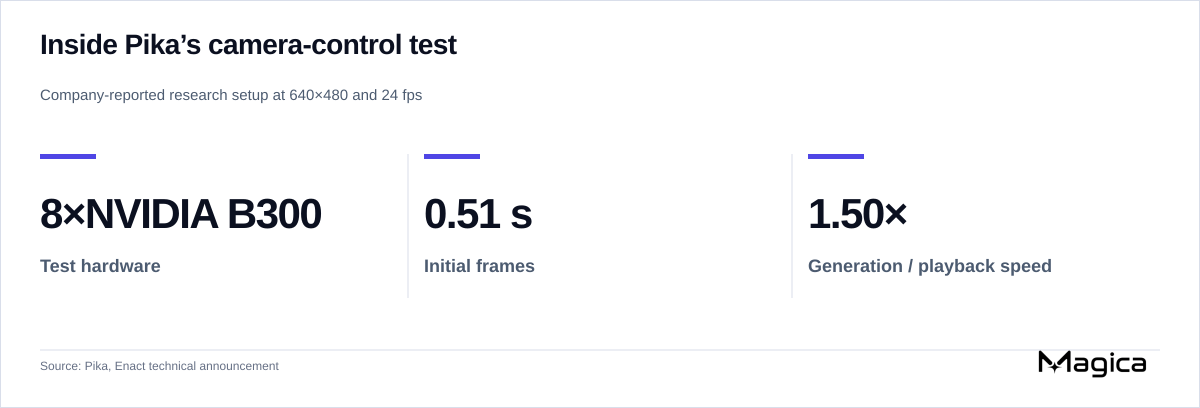
Company-reported hardware and timing for Live Camera Control at 640×480 and 24 fps. Throughput does not measure instruction-to-response delay. Source: Pika.
Pika’s measurements separate response delay from generation throughput. Generating faster than playback can keep a stream supplied with frames; that ratio alone does not measure the delay between a director’s instruction and its visible effect.
Pika supplies different measurements for the research modes. For staging, it reports picture response below 0.4 seconds on an NVIDIA H100, including decoding, in its low-latency setting. It separately reports generation at 1.8 times playback speed on a single server. For actor direction, it says synchronized picture and sound generate at 1.75 times playback speed.
The camera demonstration uses an eight-GPU NVIDIA B300 node at 640 × 480 resolution and 24 frames per second. Pika reports initial frames in 0.51 seconds and subsequent generation at 1.50 times playback speed. Those measurements describe a particular research setup, not a consumer hardware requirement, a service price or a promise of higher-resolution performance. The disclosed setups do not provide a common hardware-and-quality basis for ranking the three modes.
The report on the preview says the announcement leaves resolution and latency unstated; Pika’s technical page does provide mode-specific figures. Those figures still do not establish a complete set of product limits, including maximum supported scene length or character count.
Pika’s engineering approach combines short streaming chunks, a sliding cache of scene context and distillation into models that generate in fewer steps. For staging, the company says it built synthetic training pairs using a physics-driven 3D stand-in and video-model rendering, with cursor positions logged alongside the clips. Camera training uses synchronized 3D motion, video and spatial audio.
Speed comes with qualifications. In the interview summary, Guo says Pika’s interactive model has somewhat lower image quality than its non-real-time version. Its technical account also identifies a consistency problem: an opening reference frame can pull idle scenes back toward their initial state. Pika describes periodic instructions to preserve staging and lighting changes as a countermeasure. Keeping context available is not the same as proving every change will persist reliably.

Runway’s Act-One demonstration pairs a recorded driving performance with a generated character. Image: Runway. Source: Runway.
AI performance control predates Enact. Runway, an AI-video tools developer, introduced Act-One in October 2024, a tool inside Gen-3 Alpha that uses video and voice performances to animate generated characters. Its input is an actor’s recorded performance, providing a different route to controlling expression and delivery. Runway subsequently listed Act-Two for paid plans on July 17, 2025, describing a motion-capture model supporting head, face, body and hand tracking. These releases establish performance-control alternatives, although they do not demonstrate an equivalent to Enact’s live conversational direction.
Live video transformation also has a precedent: a July 2025 demonstration showed AI startup Decart’s Mirage video-to-video model modifying live footage in response to prompts. The report also described a website and app launching for users to create videos and modify YouTube clips. Mirage transforms existing footage; Pika’s camera mode generates scenes from an appearance image and a 3D motion reference. These are different forms of responsive video, rather than a like-for-like performance comparison.
Enact’s proposed distinction is the combination of staging, conversational rehearsal and camera direction around generated scenes.
Pika directs interested users and potential integration partners to its enterprise team. The announcement supplies no Enact price or consumer release date. H3 Flex’s open weights and other capabilities should not be treated as a specification or access policy for the experimental layer above it.
For creators, the unresolved economic question is the cost of reaching a usable take. Faster feedback could reduce repeated attempts, but lower image quality, substantial compute in the camera demonstration and unproven consistency complicate that calculation. Access, prices and repeatable tests of how well actors retain notes and scenes preserve staging and lighting changes would show whether live direction improves the economics of making a finished scene. The fresh generation after rehearsal also needs to reproduce the performance a creator intended to keep.
Lenovo reported record quarterly revenue of $30.2 billion as its infrastructure business swung into profit. A $1.91 billion noncash warrant charge drove a reported loss, while expanding inventories and overdue receivables raised the stakes for cash collection.
Google expects to invest $1 billion in U.S. data center community programs through 2027. Its commitments on taxes, power costs and disclosure address hosting terms, while voters favored limits in 40 of 41 local ballot contests covering both binding restrictions and advisory questions.
Alibaba traded near HK$80 before earnings as US restrictions threatened overseas computing access. Its June results show accelerating cloud growth alongside heavy capital spending and widening AI application losses, while the new rules leave licensing routes and exemptions.
Vero Security is launching a free learning community alongside its commercial platform for enforcing enterprise AI policies. Its $11 million seed round backs a bid to automate recurring security work, but performance and pricing comparisons remain unproven.
Sarvam says its new Token Factory hosts Chinese and domestic AI models on privately funded Indian infrastructure. Its engineering claims and a rival’s price challenge put the commercial strategy under scrutiny alongside its publicly backed domestic-model mandate.
Google is replacing AI Ultra’s individual YouTube Premium benefit with family coverage at no extra cost in eligible countries. The upgrade adds household value, but cheaper subscriptions still matter to the buying decision.
An August fundraising initiative has produced no deployed capital, according to a report, as lenders seek more protection than Nvidia has offered to back customers’ chip purchases.
Anthropic’s reported $83 IPO price implies a fully diluted valuation of about $1.5 trillion. The final share count remains unresolved, while its prospectus shows rapid revenue growth, positive operating cash flow and $70.7 billion in commitments due in the year after September 30.
Colette Kress, Nvidia’s interim CEO and its CFO since 2013, promised December raises and equity awards ahead of the usual spring cycle. The undisclosed package comes as falling shares unsettle employees and the board rejects founder Jensen Huang’s return.
Palo Alto Networks agreed to buy Applied Compute for $4.5 billion in stock, pairing enterprise AI security with model adaptation and hosting. Its plans also call for less than $3 billion in infrastructure spending through fiscal 2030 and near-term margin pressure.
Google is rolling out temporary conversations in AI Mode that stay out of account history and personalization. Its help documentation says data collection continues and describes exceptions to the restriction on model training.
The Claude developer is expected to begin Nasdaq trading on November 19, with options potentially following Monday. Its proposed public offering could total $57.75 billion to $64.35 billion before fees, alongside a private placement, while founders and a benefit trust hold substantial governance powers.
Microsoft plans to use Intel Foundry’s EMIB packaging for its own Azure silicon under an expanded infrastructure agreement that also secures multi-year Xeon supply. Chip identities, deployment dates and packaging economics remain undisclosed.
A 3-2 vote stopped SpaceX’s request for a decade-long county property tax abatement from advancing. A separate city incentive hearing was announced for December, while the company’s investment plans remain unresolved.
Anthropic is reportedly considering more shares at well above $80 each. A separate $26 billion private placement adds to the financing stakes as rapid revenue growth meets vast computing commitments.
The NYU philosopher and 2026 Berggruen Prize winner sees no reason to attribute consciousness to current language models. His skepticism contrasts with Anthropic's experiments in model welfare, while research indicators leave open what future systems could become.
The Center for AI Safety joined critics from opposing AI camps in accusing Anthropic of weakening its safeguards. The company’s filing documents both commercial pressure to advance and a recent development pause, making the dispute about what restraint is binding.
Microsoft detailed Azure tools at Ignite that let AI agents reuse processed context, alongside new isolation and networking controls. The announcements leave total savings unquantified, while previews and customer operating duties limit the rollout.
Linq says its a16z-led Series B values the company at $1 billion after more than one billion messages. The funding backs a broader agent infrastructure business, with new HD calling and computer access extending a platform still dependent on communications providers.
SoftBank founder Masayoshi Son called passing on Anthropic a mistake while remaining committed to rival OpenAI. Another prospective OpenAI investment would deepen a relationship that already links SoftBank’s capital, investment valuations and infrastructure ambitions.