Editorial Team
7 min read
Some 44% of employed euro-area consumers reported using AI at least weekly in August 2026. ECB researchers see adoption as broadly similar to the United States, but survey differences, checking costs and weaker investment leave the economic payoff unresolved.
Some 44% of employed euro-area consumers reported using artificial intelligence at least weekly at work in August 2026, including around 18% daily, according to research published on November 27 by the European Central Bank, the currency bloc’s central bank. Its researchers describe adoption as broadly similar to the United States despite Europe’s weaker investment. Their findings leave open whether comparable use will deliver comparable economic returns.

ECB Consumer Expectations Survey, August 2026: employed consumers aged 18–64 across 11 euro-area countries. Daily users are included in the weekly share; the categories should not be added. Source: European Central Bank.
The European figures come from the ECB’s Consumer Expectations Survey, which tracks households’ economic views and behaviour. Launched as an online pilot in January 2020, the survey provides a way to examine how consumers respond to economic change. The AI comparison uses population-weighted estimates for employed consumers aged 18–64 across its 11 euro-area countries, rather than a census of workplaces.
For August 2026, Gallup’s workplace tracker put daily use among US employees at 16%, with 32% using AI a few times a week or more. Its survey covers adults aged 18 and older working full time or part time for US organizations, using a probability-based panel and demographic weighting.
The ECB explicitly warns that the comparison indicates trends rather than fully harmonized estimates. “At least weekly” and “a few times a week or more” are different thresholds, and the samples differ. Even the researchers’ finding that daily use is higher in the euro area comes with that qualification; they say the gap is narrowing.
Nvidia closed at $150.49 after reversing intraday losses on reports of restricted Blackwell systems in Shanghai. Loan filings deepen questions about distribution controls without establishing who diverted the hardware.
The central bank has a direct reason to examine what follows adoption. Its mandate is price stability, and its June 2025 strategy assessment identified increasing AI use as one structural change making the inflation environment more uncertain, while retaining a symmetric 2% inflation target over the medium term. The new blog draws on its research task force’s work on AI and the real economy and forms part of a forthcoming working paper. The authors’ views do not necessarily represent the ECB or the Eurosystem.

ECB analysis using Eurostat and US Bureau of Economic Analysis data. These are broader investment proxies, not AI spending: euro-area non-construction investment excludes volatile Irish intellectual-property products; US private non-residential investment excludes structures. Source: ECB Economic Bulletin.
The investment evidence points to a wider transatlantic divide. The new blog cites an estimate, with a footnote pointing to a press report, projecting that firms’ investment will rise by around 40% in the United States between 2021 and the end of 2027, compared with about 12% in the euro area. Those projections cover firms’ investment overall, with AI-related spending contributing significantly to US growth; they do not measure AI spending alone.
The divergence predates that forecast. An earlier ECB investment analysis found cumulative growth of 15.4% in its US business-investment measure between the fourth quarters of 2021 and 2024, against 6.8% in the euro area. These are national-accounts proxies: whole-economy non-construction investment excluding volatile Irish intellectual-property products in the euro area, and private fixed non-residential investment excluding structures in the United States. Intellectual-property products contributed most to the gap.
That earlier analysis also complicates any explanation centred on AI alone. It linked weaker European investment to subdued demand, energy costs and uncertainty, and reported that EU firms faced obstacles including skills shortages and regulation. Its firm-survey comparisons cover the EU, a broader geography than the euro area. It also argued that deeper venture-capital markets would help innovative EU firms obtain risk capital and grow.
Citing the 2024 EU Industrial R&D Scoreboard, it described euro-area research and development investment as concentrated in mature industries such as cars and equipment, while US spending increasingly focused on information and communications technology, including data centres and AI-related facilities.
The new research warns that strong adoption alongside weaker domestic investment could deepen European dependence on foreign AI technologies and infrastructure. Workplace use therefore answers a different question from who supplies the systems or captures the investment behind them.
The worker-level barriers are different. Among employed respondents aged 18–64 who did not use workplace AI in June 2025, skills and knowledge gaps, along with privacy and security concerns, were among the most frequently reported obstacles. Social norms and existing regulation were cited less often as direct barriers. That does not establish that regulation has little effect on firms’ investment decisions.
The researchers point to training, clear employer policies and access to approved tools as ways to widen adoption. They suggest that trusted tools, including European alternatives, could address privacy concerns, while predictable safeguards could support investment. They also stress that productivity requires complementary spending on skills, data, computing capacity and organizational change.
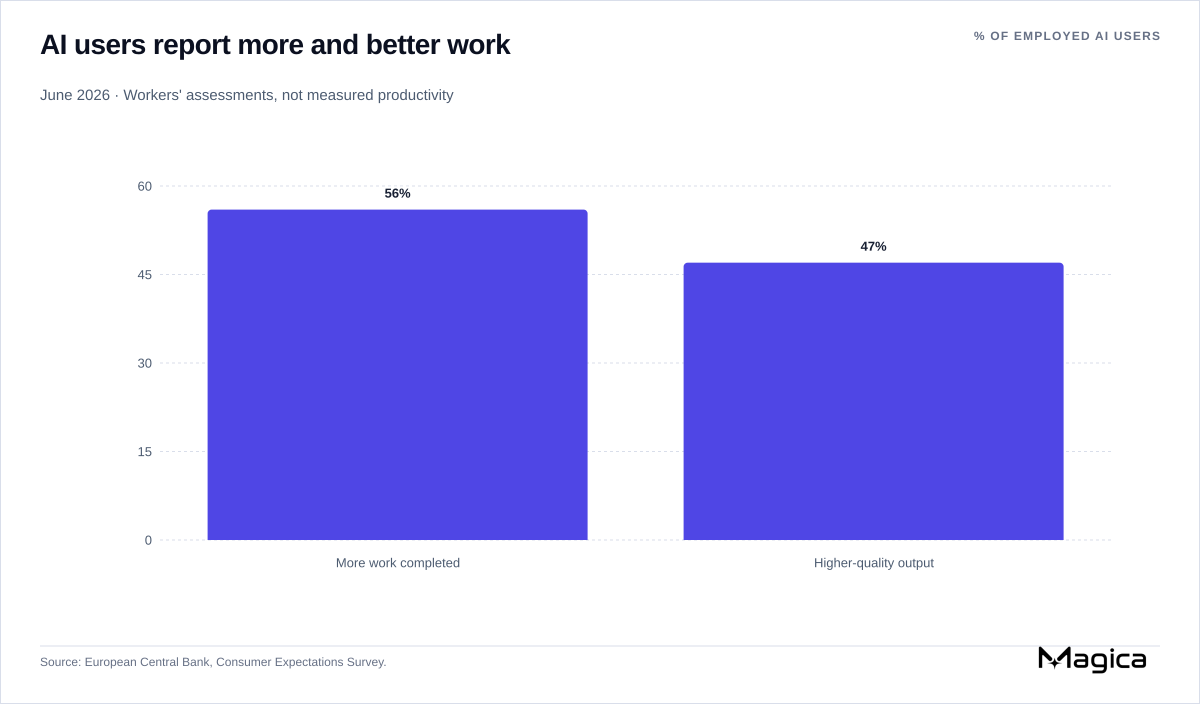
ECB Consumer Expectations Survey, June 2026: employed AI users aged 18–64, including employees and the self-employed. Quantity and quality were asked separately. Responses describe perceived benefits rather than independently measured productivity gains. Source: European Central Bank.
Among employed AI users aged 18–64 surveyed in June 2026, including employees and the self-employed, around 56% said AI increased the amount of work they completed, and 47% reported higher-quality output. These are population-weighted workers’ assessments, rather than independently measured productivity gains. Among users reporting more output, 62% cited help finding or processing information and 51% cited reduced effort; respondents could select multiple reasons.
For users who reported no increase in output, the most commonly cited reason was the time required to check or correct AI-generated results. Unsuitable tasks and concerns about retaining control were other obstacles. Faster generation of an answer can leave substantial work before that answer is usable.
The US evidence offers a related limitation. Gallup found in May 2026 that 65% of employees in organizations that had implemented AI reported a positive effect on their productivity and efficiency. Yet only 14% strongly agreed that it had transformed how work was done in their organization. These measures have different questions and denominators from the ECB findings, but both distinguish perceived individual benefits from wider changes in production.
The next question is whether use produces sustained improvements in output and quality after checking costs, investment and organizational changes are accounted for. The ECB researchers caution that adoption alone cannot establish economy-wide productivity gains.
Workers anticipate broader diffusion: in August 2026, employed respondents expected 46% of workers in their own sector to use AI within five years, up from an expectation of 34% a year earlier. That is a belief about future sector-wide use, not a measured adoption rate or an ECB forecast.
Their expectations are also mixed. In June 2026, around half of employed respondents expected AI to save time on everyday tasks or help them find the best prices over the next 12 months. But respondents were more likely to expect a greater risk of job loss than improved household income or job opportunities. Among those anticipating higher prices, the most cited explanations were greater corporate pricing power and higher energy and material costs. These are expectations, not observed price effects.
In August, support for regulation was strong among regular users as well as nonusers, even when respondents were asked to weigh regulation against slower AI development. Familiarity therefore did not remove demand for safeguards.
For employers, the practical test is whether redesigned workflows and better tools increase usable output after checking and correction. For the ECB, the evidence still needed concerns both the productive capacity AI adds and how expectations about employment, income and prices affect economic decisions. Adoption surveys illuminate the transition; measured output and investment will be needed to establish its economic return.
Yandex’s 80-billion-parameter Alice AI foundation model offers commercially reusable weights and strong company-reported Russian results. Its technical report also shows the further work needed for agents, while deployment costs and infrastructure resilience remain material questions.
Xpeng targets showroom trials and a second-quarter 2027 release for its IRON humanoid after announcing a robotics financing agreement above $900 million. Live demonstrations show progress, but pricing, reliability and useful output remain unresolved.
Q.ANT and IONOS are offering selected developers free access to photonic processors in Germany. Earlier tests show gains over Q.ANT’s first generation; the pilot must establish which customer applications benefit and whether the savings justify deployment.
The S&P 500 gained 1.6% in the shortened session and 5.6% for the week as technology shares recovered. Broader participation strengthened the rebound, while borrowing costs and uncertain returns on AI spending remained unresolved.
Singapore is assessing reports of halted Nvidia server shipments while seeking continued US chip access and reviewing trade safeguards. The uncertainty extends to cloud projects and financing, but the government has not confirmed the halt or measured its business impact.
Ren Zhengfei credits US sanctions with Huawei’s push for self-reliance. Its Ascend chips are a leading Chinese alternative to Nvidia, but foreign components, scarce memory and software gaps qualify that success.
Delaware’s unintroduced AI-company proposal would pair owner liability protections with continuing funding duties, shutdown controls and a supervised trial. Lawmakers still face questions about the need for a new legal form, recoverable capital and public access to the test results.
Germany wants generative AI providers to compensate rights holders for competing output through collecting societies. Eligibility would depend on allowing free training use, while fee levels and enforcement remain unresolved.

Iran’s semi-official Mehr News Agency circulated simulated attacks on technology company headquarters, demanding reparations over alleged military involvement. Public Pentagon agreements establish supplier ties, but do not substantiate the video’s accusations about attacks on Iran.
Elliot Callender’s hunger strike outside Anthropic reached its fifth day on November 27. His demands range from product warnings to a development halt, while the Claude developer has argued that a meaningful pause requires verifiable cooperation among competing labs.
Starting January 1, Rhode Island will require an open manual checkout for every three operating grocery self-checkouts, with separate protections for monitors’ workload. Stores’ responses elsewhere and limited research leave the effects on employment, prices and theft unsettled.
The German consumer organization wants an injunction against ChatGPT subscription cancellation hurdles and a price-change clause. The clause promises advance notice, but the claimant says it leaves the grounds for increases insufficiently defined.
Moonshot AI is accepting applications for Kimi for Science through December 8. Selected researchers can receive model-use credits and technical support, but the company has not disclosed the program’s total budget or cohort size.
Nvidia's proposed $290 million shareholder settlement would end disputed claims over cryptocurrency demand within gaming sales. The fund equals about 14% of plaintiffs' estimated maximum damages before fees and costs; court approval and individual payouts remain pending.
TrueLayer says an AI agent’s Papa John’s order was a UK first for direct bank payments to a retailer. The trial used customer-set, bank-enforced limits and human approval; merchant savings and readiness for wider use remain unproven.
Taiwan forecasts 6.51% economic growth in 2027 after a projected 13.28% surge in 2026, as AI hardware demand drives exports and capacity expansion despite risks to infrastructure investment.
Two Dutch court actions seek restrictions on Meta’s camera glasses, including a sales ban, over covert recording and disputed AI data practices. The cases test how much responsibility belongs to the companies that design and operate the glasses, rather than their wearers.
Dante Security has raised a $10 million seed round for AI agent monitoring and human accountability. Its founders bring enterprise-security experience, but existing vendor controls and limited deployment evidence complicate the pitch.
Avicena has raised over $100 million for microLED connections between AI chips, with a new CEO targeting a first product in 2027. Chipmaker backing strengthens its commercialization effort, but deployment economics remain unproven in the announcement.