Editorial Team
8 min read
Ren Zhengfei credits US sanctions with Huawei’s push for self-reliance. Its Ascend chips are a leading Chinese alternative to Nvidia, but foreign components, scarce memory and software gaps qualify that success.
Ren Zhengfei, founder and chief executive of Huawei, the Chinese telecommunications and consumer-device supplier that became a global industry leader before the 2019 US crackdown, wants US President Donald Trump thanked for pushing it toward self-reliance. In an October interview published November 26, Ren portrayed the restrictions imposed during Trump’s first presidency as a spur to rebuilding Huawei’s technology supply chain.
Huawei’s emergence as a leading Chinese supplier of AI processors gives that argument weight. Yet its strategic importance to Beijing and its ability to match Nvidia, the US AI-chip supplier, are different questions. Production forecasts show a large computing gap, and Huawei’s recent chip output has continued to depend partly on foreign components.
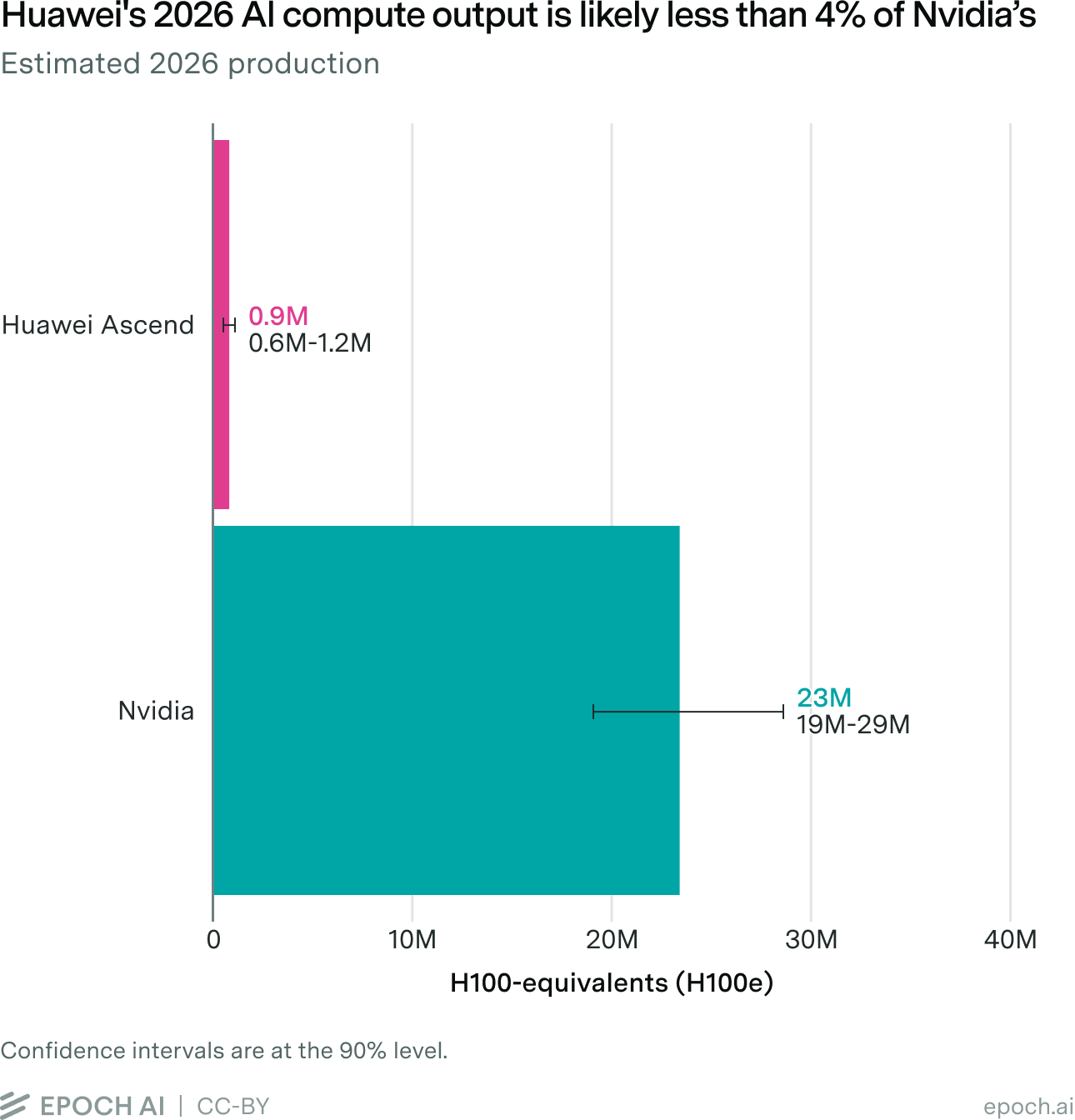
Epoch AI’s modeled 2026 computing output in H100-equivalents, with 90% confidence intervals. These estimates describe theoretical capacity in annual chip production. Credit: Epoch AI, Venkat Somala and Irene Trotta, CC BY 4.0. Source: Epoch AI.
Executives at Huawei’s Shenzhen headquarters call an ornate hallway the “Trump Corridor,” referring to the president’s campaign to exclude Huawei from global wireless networks and advanced chips. Speaking to New York Times interviewers, Ren said:
“Pass on our thanks to him, and also share the story of the Trump Corridor as well,”
The available interview preview describes a company that survived a threat to its existence and became central to China’s AI ambitions.
Before the sanctions, Huawei said it bought $2.5 billion of semiconductors annually from Intel and was a major customer of software supplier Oracle and contract chipmaker TSMC, according to an account drawing on the interview. Around 2021, Ren accelerated work with SMIC, China’s largest chip foundry, research institutions and domestic companies to build an independent semiconductor supply chain.
Huawei is now bringing together component suppliers, government-backed factories and equipment makers as it seeks to expand from chip design into manufacturing. Its annual research and development spending exceeds $27 billion, according to reporting based on the interview. That is company-wide spending; the report does not identify a separate AI-chip budget. Huawei is also building data centers and working with Chinese AI developers, including DeepSeek, to adapt models to its Ascend processors.
The original restrictions also reflected security concerns: US officials expressed concern that Huawei might support China’s military, the interview-based account says. Liza Tobin, who worked on China policy at the National Security Council during Trump’s first administration, described the sanctions as having slowed Huawei before it regrouped, according to a separate account of the interview. Survival and renewed investment do not establish that the controls failed to constrain the company.
Epoch AI, a research organization analyzing AI progress, estimates in its technical analysis that Huawei will produce about 1.5 million Ascend processors in 2026, compared with 5.9 million processors for Nvidia. Those are modeled estimates, not audited shipments.
The gap widens when chip performance is included. Epoch converts each processor’s theoretical processing power into equivalents of Nvidia’s H100 and multiplies by estimated production. Huawei’s output comes to roughly 880,000 H100-equivalents, against 23 million for Nvidia: less than 4%, despite a unit count about one-quarter as large. This compares computing capacity embodied in annual chip output, rather than installed capacity, Chinese market share or measured customer workloads.
Even that comparison leaves out memory, networking and software effects. Epoch judges Huawei’s CANN software, which helps developers run workloads on Ascend, less mature than Nvidia’s CUDA, making actual utilization another disadvantage. Its analysis cites reporting that DeepSeek reverted to Nvidia after an unsuccessful attempt to train its R2 model on Ascend, despite help from Huawei engineers. Adapting models to Ascend is therefore work in progress, rather than proof that it can replace Nvidia across workloads.
Epoch also sees a route to improvement: more Chinese AI workloads could expose problems that help Huawei refine its software and chip designs. Huawei has opened CANN components to developers and is integrating Ascend with widely used AI tools, the analysis says. Those efforts qualify the software disadvantage without demonstrating that it has disappeared.
Nor is Huawei the only domestic option. Epoch identifies Cambricon, Biren, Baidu and Alibaba as other Chinese AI-chip designers expanding production and competing for scarce domestic memory. Huawei’s position as a leading alternative should not be mistaken for an exclusive route to Chinese computing independence.
Chipmaking equipment is another constraint. Epoch says restrictions on advanced lithography limit the transistor density available from Huawei’s fabrication partner SMIC. More elaborate manufacturing steps and larger chip packages can compensate in part, but add cost and risks of defects.
High-bandwidth memory, or HBM, stores and supplies data to the processor’s computing circuitry. Epoch identifies it as the main near-term production constraint. The analysis cites a teardown that found TSMC-made logic dies and Samsung or SK Hynix memory in Huawei’s Ascend 910C, underlining the difference between a Huawei-designed processor and a fully domestic supply chain.
Epoch’s 2026 production estimate combines domestic memory, lower-bandwidth alternatives, foreign stockpiles and assumed smuggling. It models the stockpile as being exhausted during 2026 and explicitly calls its smuggling estimate highly speculative. The output forecast should be read with those supply assumptions in mind.
A separate scenario using only Chinese-made HBM puts Huawei’s computing output around 1% of Nvidia’s through 2028. Crucially, this excludes both foreign HBM and Ascend variants using non-HBM memory; it is not an estimate of all computing Huawei could supply using domestic components. Lower-bandwidth memory can support the compute-intensive prefill stage of AI inference, when a model processes an input, but is less suited to bandwidth-intensive decoding, when it generates output.
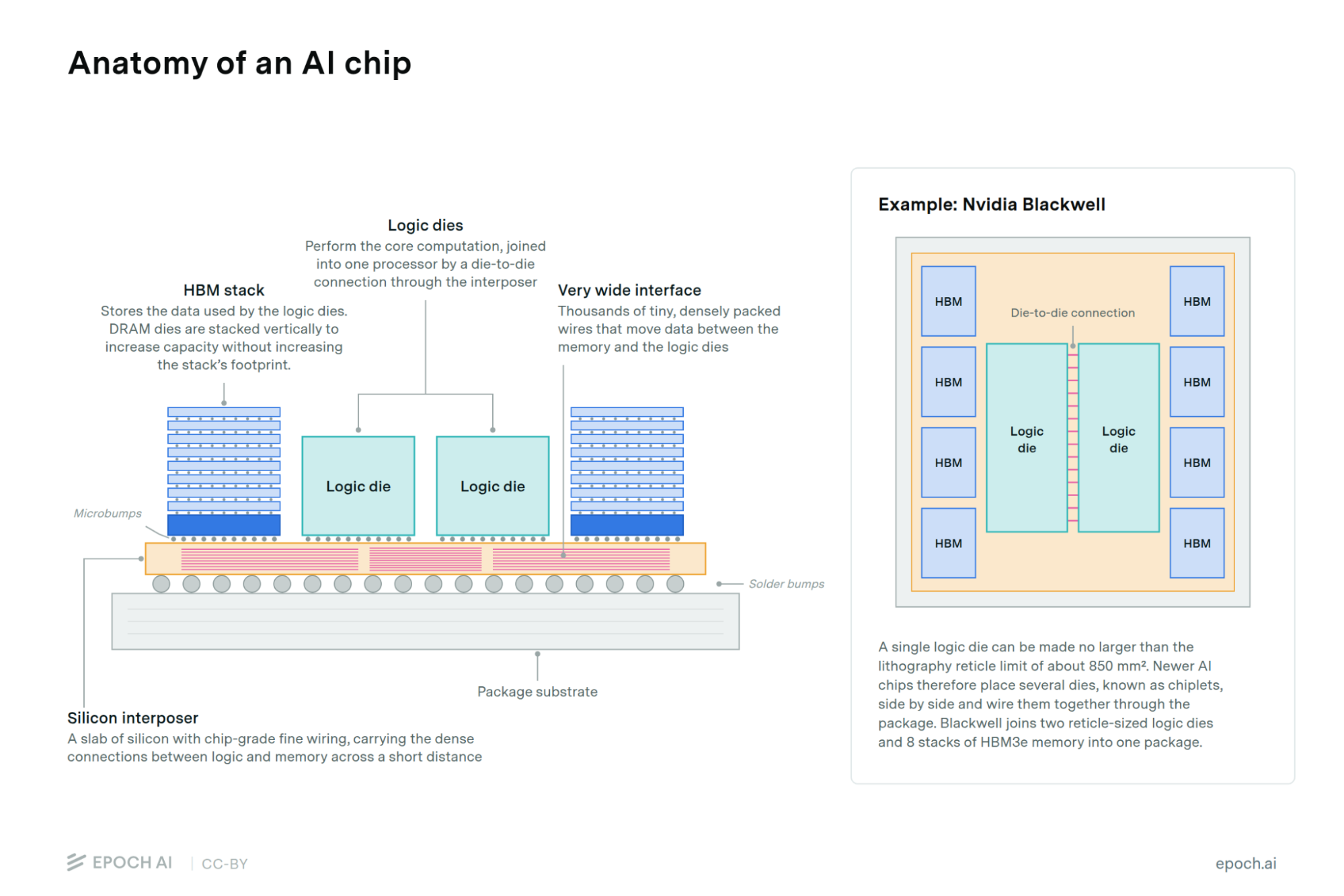
HBM stacks connect to computing dies through an interposer; the right-hand example shows Nvidia Blackwell. Diagram: Epoch AI and Irene Trotta; research by Venkat Somala, CC BY 4.0. Source: Epoch AI.
Huawei argues that linking many weaker processors can let it rival Nvidia’s systems, according to a subsequent account of the interview. Epoch regards large systems and networking as an area where Huawei is particularly competitive. The CloudMatrix 384 system connects 384 Ascend chips across 16 racks; Huawei’s roadmap calls for an Atlas 950 SuperPoD connecting as many as 8,192 chips in the fourth quarter of 2026.
But a larger connected system is not automatically a faster or cheaper one. Epoch explains that the planned SuperPoD uses a communication hierarchy: transfers between distant chips can encounter shared links and congestion. Nvidia’s smaller 72-GPU scale-up domain allows simultaneous communication at full bandwidth. The chip counts describe different network designs and cannot serve as a direct performance ranking.
Connecting more processors also requires switches, optical modules, power and floor space. Epoch says Huawei has not published key network metrics needed to assess its proposed system fully. Its economics will depend on the workload, software quality and how much of the aggregate hardware customers can use.
Individual chip prices offer limited reassurance. Epoch compares an approximately $37,000 Ascend 950DT with an approximately $40,000 Nvidia B300, while giving the B300 theoretical throughput at four-bit floating-point precision of 13.5 quadrillion operations per second, against 2 quadrillion for the 950DT. Those reported prices and peak specifications do not measure total deployment cost or application performance; bandwidth-bound workloads can produce a different comparison. They do show why a slightly cheaper processor need not deliver cheaper computing.
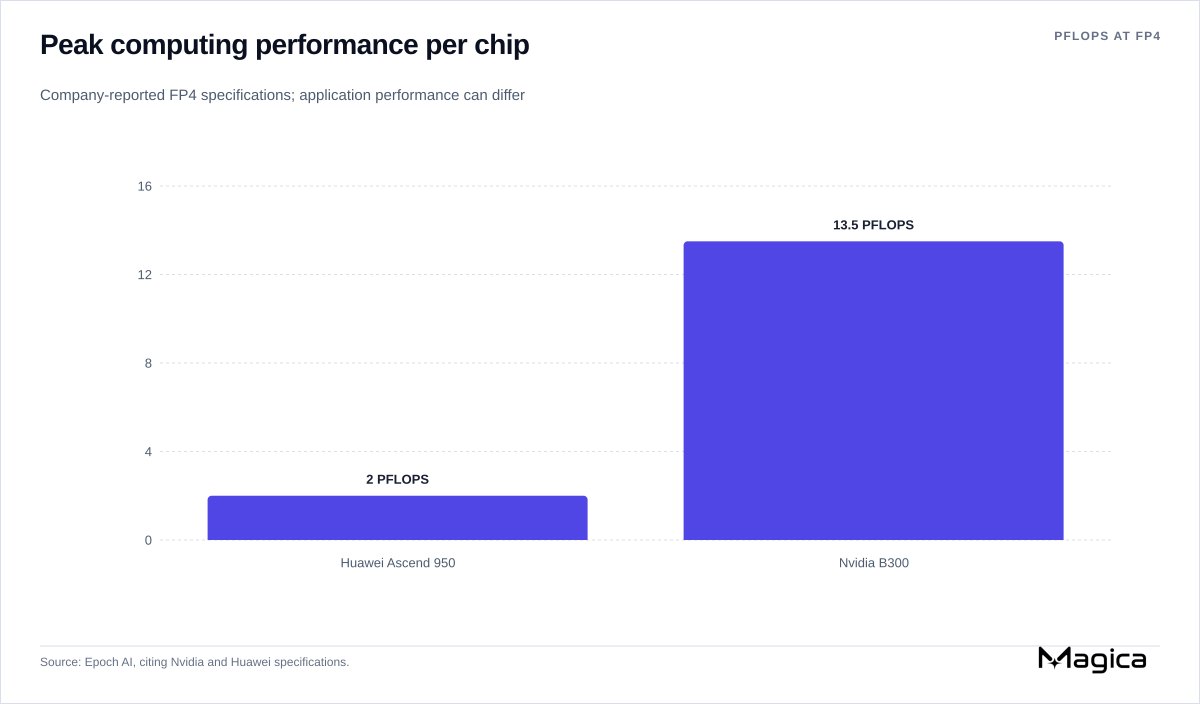
Company-reported theoretical peak FP4 specifications, as compared by Epoch AI. These figures do not measure application performance or total deployment cost. Source: Epoch AI.
The US moved on November 16 to restrict remote access to American AI chips through overseas data centers, the subsequent interview account says. Such restrictions can strengthen the case for domestic infrastructure while leaving Chinese buyers with fewer ways to obtain advanced computing.
Access has nevertheless varied by product and license. A November 19 House Foreign Affairs Committee disclosure, based on Commerce Department licensing information, records approvals covering 879,868 Nvidia H200 and AMD MI325X chips across 21 applications as of May 11, 2026. The disclosure’s definition includes companies located or headquartered in China and entities with a Chinese-headquartered ultimate parent. These are approvals for export, re-export or transfer, not a count of deliveries or evidence of present availability.
Chinese buyers still have a stake in Huawei’s progress. Martin Lau, president of Chinese internet group Tencent, told investors that loss of access to Nvidia’s advanced chips was setting back AI development across Chinese companies and made a domestic supply chain a priority, according to the interview-based account. That incentive can support Huawei without erasing the cost of restricted access.
Huawei also faces a legal setback: the subsequent account says a New York federal jury convicted it on November 24 of conspiring to steal US companies’ trade secrets and of bank fraud linked to Iran. Huawei rejected the verdicts as lacking legal or factual merit.
Ren acknowledged the difficulty of building an advanced semiconductor supply chain while predicting China would eventually overtake the US; he also expressed hope for repaired relations. Epoch reaches a more cautious conclusion: even successful execution of Huawei’s roadmap is unlikely to close the gap by 2030 because Nvidia is advancing too. Huawei’s further-out bet on vertically stacked logic, called LogicFolding, is not scheduled to reach Ascend until 2030, the analysis says.
The next evidence that matters is sustained chip production after foreign stockpiles run down, delivery of the promised systems, and measured customer performance that includes memory, networking, software and operating costs. Those results would show how far Huawei has progressed from surviving sanctions to supplying computing that Chinese AI developers can depend on.
Nvidia closed at $150.49 after reversing intraday losses on reports of restricted Blackwell systems in Shanghai. Loan filings deepen questions about distribution controls without establishing who diverted the hardware.
Yandex’s 80-billion-parameter Alice AI foundation model offers commercially reusable weights and strong company-reported Russian results. Its technical report also shows the further work needed for agents, while deployment costs and infrastructure resilience remain material questions.
Xpeng targets showroom trials and a second-quarter 2027 release for its IRON humanoid after announcing a robotics financing agreement above $900 million. Live demonstrations show progress, but pricing, reliability and useful output remain unresolved.
Q.ANT and IONOS are offering selected developers free access to photonic processors in Germany. Earlier tests show gains over Q.ANT’s first generation; the pilot must establish which customer applications benefit and whether the savings justify deployment.
The S&P 500 gained 1.6% in the shortened session and 5.6% for the week as technology shares recovered. Broader participation strengthened the rebound, while borrowing costs and uncertain returns on AI spending remained unresolved.
Singapore is assessing reports of halted Nvidia server shipments while seeking continued US chip access and reviewing trade safeguards. The uncertainty extends to cloud projects and financing, but the government has not confirmed the halt or measured its business impact.
Some 44% of employed euro-area consumers reported using AI at least weekly in August 2026. ECB researchers see adoption as broadly similar to the United States, but survey differences, checking costs and weaker investment leave the economic payoff unresolved.
Delaware’s unintroduced AI-company proposal would pair owner liability protections with continuing funding duties, shutdown controls and a supervised trial. Lawmakers still face questions about the need for a new legal form, recoverable capital and public access to the test results.
Germany wants generative AI providers to compensate rights holders for competing output through collecting societies. Eligibility would depend on allowing free training use, while fee levels and enforcement remain unresolved.

Iran’s semi-official Mehr News Agency circulated simulated attacks on technology company headquarters, demanding reparations over alleged military involvement. Public Pentagon agreements establish supplier ties, but do not substantiate the video’s accusations about attacks on Iran.
Elliot Callender’s hunger strike outside Anthropic reached its fifth day on November 27. His demands range from product warnings to a development halt, while the Claude developer has argued that a meaningful pause requires verifiable cooperation among competing labs.
Starting January 1, Rhode Island will require an open manual checkout for every three operating grocery self-checkouts, with separate protections for monitors’ workload. Stores’ responses elsewhere and limited research leave the effects on employment, prices and theft unsettled.
The German consumer organization wants an injunction against ChatGPT subscription cancellation hurdles and a price-change clause. The clause promises advance notice, but the claimant says it leaves the grounds for increases insufficiently defined.
Moonshot AI is accepting applications for Kimi for Science through December 8. Selected researchers can receive model-use credits and technical support, but the company has not disclosed the program’s total budget or cohort size.
Nvidia's proposed $290 million shareholder settlement would end disputed claims over cryptocurrency demand within gaming sales. The fund equals about 14% of plaintiffs' estimated maximum damages before fees and costs; court approval and individual payouts remain pending.
TrueLayer says an AI agent’s Papa John’s order was a UK first for direct bank payments to a retailer. The trial used customer-set, bank-enforced limits and human approval; merchant savings and readiness for wider use remain unproven.
Taiwan forecasts 6.51% economic growth in 2027 after a projected 13.28% surge in 2026, as AI hardware demand drives exports and capacity expansion despite risks to infrastructure investment.
Two Dutch court actions seek restrictions on Meta’s camera glasses, including a sales ban, over covert recording and disputed AI data practices. The cases test how much responsibility belongs to the companies that design and operate the glasses, rather than their wearers.
Dante Security has raised a $10 million seed round for AI agent monitoring and human accountability. Its founders bring enterprise-security experience, but existing vendor controls and limited deployment evidence complicate the pitch.
Avicena has raised over $100 million for microLED connections between AI chips, with a new CEO targeting a first product in 2027. Chipmaker backing strengthens its commercialization effort, but deployment economics remain unproven in the announcement.