Editorial Team
6 min read
RRE Ventures led the funding for Graphon’s enterprise memory infrastructure. The startup is pitching connected, persistent context across different agents, but benchmark gains leave deployment costs and commercial scale unresolved.
Graphon Labs, a San Francisco startup building software that lets AI agents retain and retrieve information over time, has raised a $35 million Series A led by venture investor RRE Ventures. HP, Energy Impact Partners, Hitachi Ventures and Gaia VC also participated, the company said in its announcement on November 10.
The bet is on infrastructure beneath agents: a system intended to preserve relationships, sources and timing across changing company information, rather than requiring each agent to reconstruct context. That gives Graphon a potential role across different model providers, but puts it in competition with both specialist memory systems and platforms building memory into their own products.
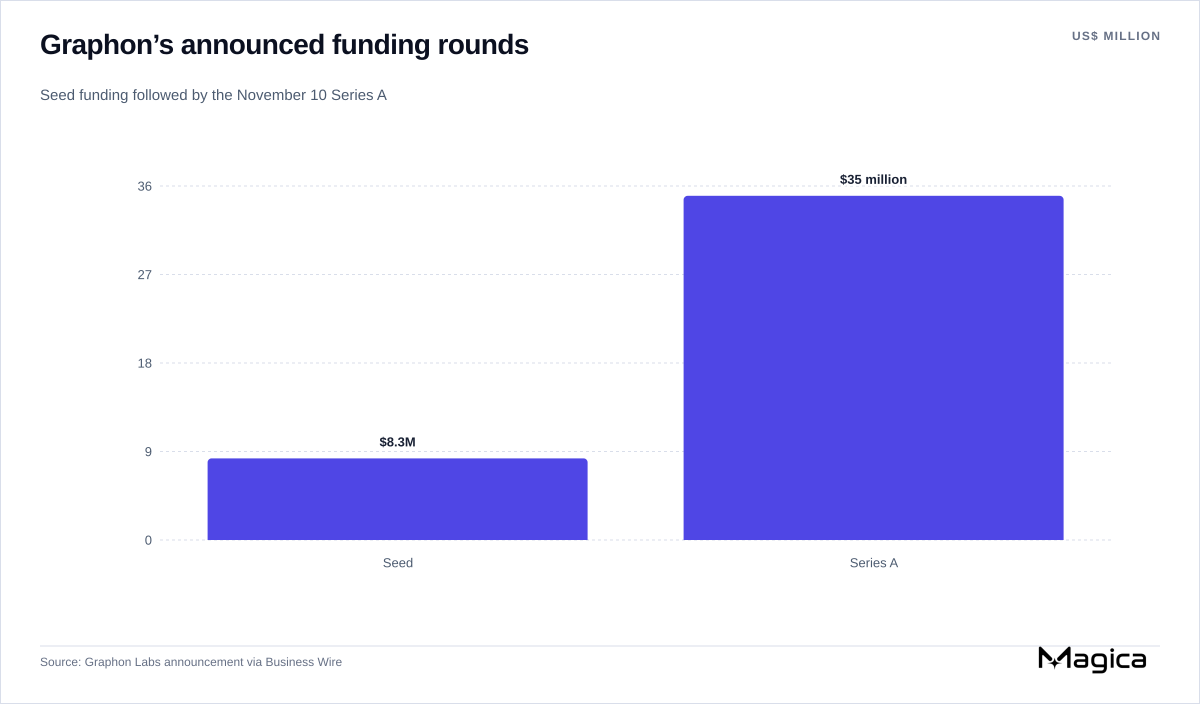
Graphon announced a $35 million Series A less than six months after emerging from stealth with $8.3 million in seed funding. Source: Business Wire.
Founder and chief executive Arbaaz Khan worked with graphons—a mathematical framework for analyzing very large graphs—during his PhD research into coordinating robot swarms, according to an interview about the financing. In a blog post described in a report on the round, Khan said he and co-founder Clark Zhang built graph-based memory for robots during their PhDs.
Graphon is applying that background to documents, video, images and other enterprise data. The company says its architecture connects information while retaining where it came from and when it changed. It calls the approach “Persistent Intelligence” and says it spans storage, search, retrieval, reasoning and memory.
That is a broader pitch than retrieving isolated passages for a model’s prompt. Retrieval-augmented generation, or RAG, supplies stored information to a model when it answers. Graphon argues that conventional retrieval, including graph-based approaches, can lose relationships and historical context as information changes. Those are the company’s claims about competing architectures, rather than proof that existing retrieval systems cannot maintain useful context.
Khan said in the financing interview that Graphon works with off-the-shelf agents, including those using Claude or GPT models. The commercial proposition is therefore a shared context layer across agents, rather than another foundation model.
The Series A follows Graphon’s emergence from stealth with $8.3 million in seed funding less than six months earlier. Together, the two announced rounds total $43.3 million. In the announcement, lead investor RRE Ventures framed the investment as a bet on shared knowledge beneath agents, with potential benefits for effectiveness and computation. That is the investor’s rationale, rather than a demonstrated commercial outcome.
Graphon has 20 employees and plans to spend the new money primarily on engineers and researchers, alongside some sales and go-to-market hiring, according to the financing interview. Its target customers include developers and companies with large technical and operational datasets, such as industrial, financial-services and healthcare businesses. Khan said enterprise customers would remain the focus before a further push into personal devices and consumer products.
The company describes three products: Graphon Enterprise, Graphon Developer and Graphon On-Device Memory. Enterprise deployment options include hosted infrastructure, a Graphon-managed or customer-managed virtual private cloud, and on-premises infrastructure. Those choices matter because the proposed memory layer would sit across company information; the customer’s ability to control where it runs is part of the offering.
Developer access and memory on phones, laptops, cameras and wearables expand the ambition beyond enterprise search. The announcement, however, does not establish adoption at that broader scale.
HP illustrates the overlap between financing and commercial interest: it participated in the round, and Graphon says in the financing report that HP also uses the software. The company identifies the San Francisco 49ers football team as a user there, too. The customer statements in the announcement are more qualified than evidence of a broad production rollout: the 49ers describe exploring applications such as sponsorship discovery, while Hitachi Rail says its evaluation shows promise in its industrial setting. They do not quantify revenue, deployment size or measured business returns.
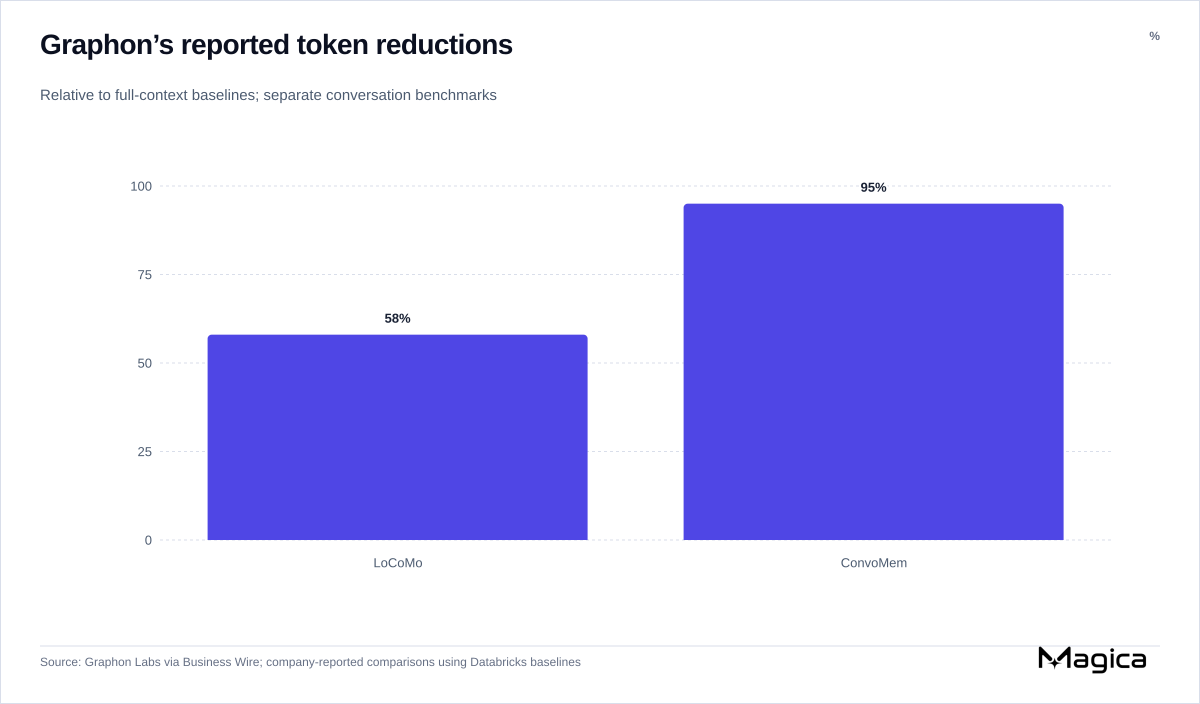
Company-reported token reductions from Graphon Labs against full-context baselines. These benchmark figures do not measure total deployment costs. Source: Business Wire.
Graphon reports the following results in its announcement:
| Benchmark | Company-reported score | Company-reported comparison |
|---|---|---|
| LoCoMo | 93.9% accuracy | 58% fewer tokens than loading the full conversation |
| ConvoMem | 90.2% accuracy | 95% fewer tokens than the full-context baseline |
| ATM-Bench | 81.7% | 5.0 percentage points ahead of the next system on the public leaderboard |
The company says the LoCoMo and ConvoMem comparisons use baseline results published by Databricks. ATM-Bench, developed by University of Cambridge researchers, tests question answering across video, audio, images and text. The release does not specify Graphon’s underlying models or a complete evaluation protocol, so its scores do not establish a like-for-like advantage across all competing systems. These are benchmark results, not measurements of customer savings. Fewer tokens supplied to an answering model do not by themselves establish total costs once preparing, storing and updating memory are included.
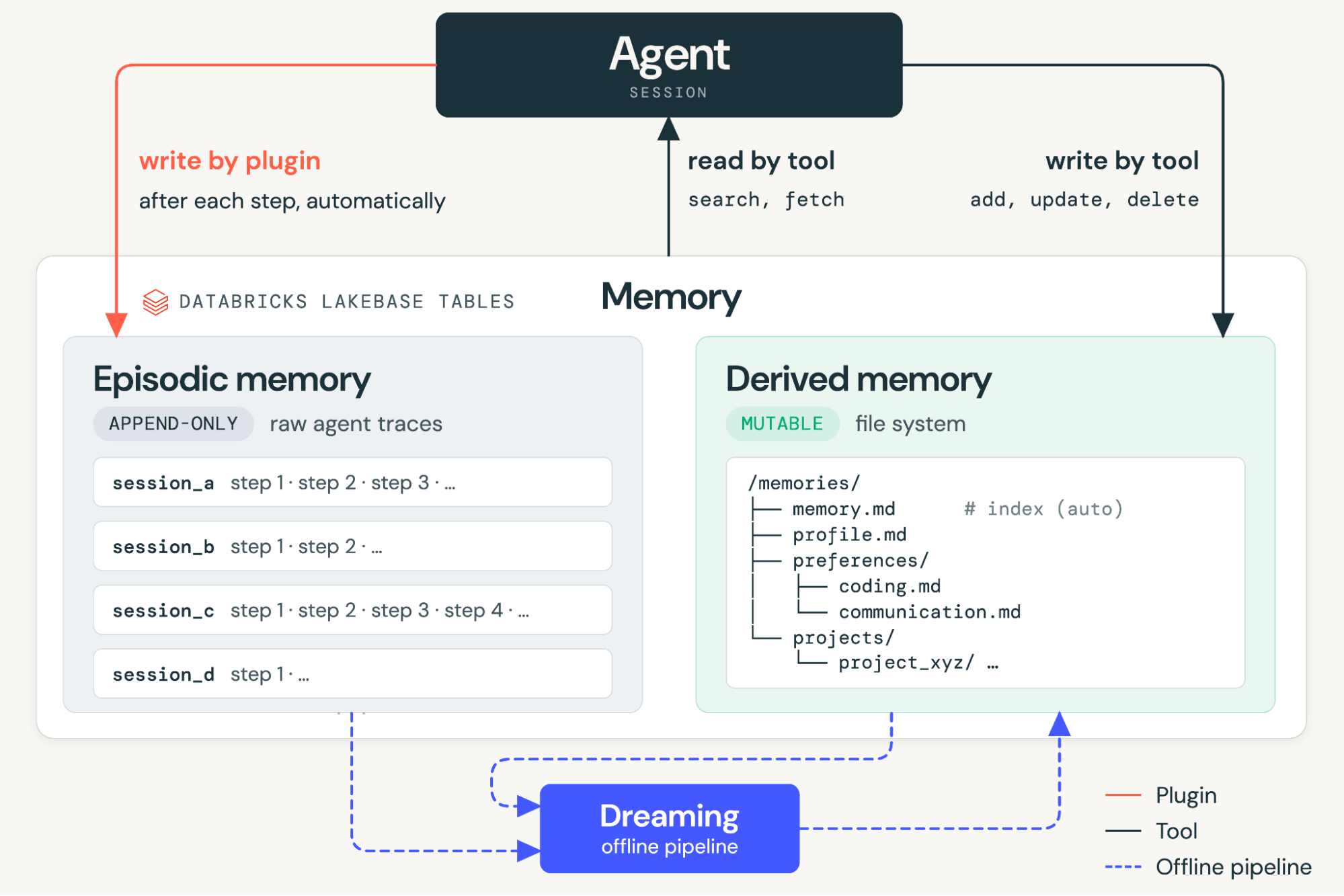
Databricks’ MemCurrent architecture combines raw session histories, derived knowledge and background consolidation. Diagram: Databricks. Source: Databricks.
In an October 20 technical account, Databricks described MemCurrent, its persistent memory architecture powering Agent Bricks Memory for custom agents and Genie, an interface for querying data in natural language. It combines raw session histories with distilled knowledge and background consolidation. Its knowledge base can move between agents or models, so portability is not solely Graphon’s pitch.
Databricks evaluated MemCurrent alongside the open-source Mem0, PropMem and OpenClaw memory systems. Across three conversation benchmarks, it reported average accuracy of 88.1%, against 87.8% with full context, using about 8,400 rather than 103,000 input tokens per question. Accuracy was averaged across two agent harnesses and three repeats, using the same model across memory backends. These results are not a controlled comparison with Graphon; prompt efficiency is a shared competitive goal.
Databricks says those benchmarks test recall from synthetic conversations. It also identifies a deployment trade-off: updating memory during a session adds runtime cost and latency, while background updates arrive later.
Built-in assistant memory creates another alternative. A report on Graphon’s financing notes that Anthropic unified memory across Claude chat and its Cowork assistant in August, and Apple added memory to Siri in iOS 27.2 in October. Those assistant features differ in scope from Graphon’s proposed enterprise infrastructure, but show why persistent memory alone is insufficient to distinguish the startup.
The funding gives Graphon resources to move from early experimentation toward larger enterprise deployments, the transition Khan describes in the announcement. Its ambition to accelerate progress toward artificial general intelligence remains a company aspiration; the reported tests measure more specific retrieval and question-answering capabilities.
The financing materials do not disclose a valuation, revenue, a paying-customer count, pricing or comprehensive deployment economics. Evidence of sustained use, accuracy as customer data changes, and costs across ingestion, storage and retrieval would make the commercial case easier to assess. For now, the round funds that next stage of proof while Graphon keeps its immediate focus on enterprises.
Alibaba’s Qwen4-Max preview gives developers a fixed model to test through November 25. API access requires Token Plan, while claimed coding gains remain unquantified in the launch materials.
Railway estimates stolen customer keys generated about $740,000 in unauthorized AI spending after an October intrusion. Secrets from up to about 100,000 workspaces could have been decrypted, and the company says it will cover losses providers decline to refund.
Anthropic expects retail investors worldwide to receive up to 20% of its IPO, potentially $12.9 billion at the proposed upper price. Access through six brokerage channels depends on demand and broker rules, while a separate technology-company investment would help finance vast infrastructure commitments and founders and a special trust retain control.
Anthropic's seven founders plan equal IPO share sales worth about $250 million each at the proposed midpoint. Their sales make up 2.9% of the public offering, while the company seeks much larger financing under a structure that limits public investors' voting influence.
Nvidia’s independent directors retained Wachtell Lipton partner Joon H. Kim for an investigation into reports of a foreign intelligence effort targeting co-founder and CEO Jensen Huang. The board previously expressed confidence in Huang; the appointment provides no findings or timetable.
Goldman Sachs, a lead bank on Anthropic’s IPO, reportedly forecasts $685 billion in annual revenue by 2030. The Claude developer has substantial cash reserves and rapidly growing sales, but rising compute costs, competitive pricing and delivery risks complicate the enterprise growth case.
Memories Upload pays contributors for accepted first-person video and sells annotated data to robotics developers. Its million-hour collection claim leaves open how much footage improves robot performance, while contributors surrender ownership without royalties.
OpenAI has acquired AI travel concierge Odessia and is bringing its founder, former Sonder chief Francis Davidson, into its travel effort. The standalone service has closed, leaving its future role alongside ChatGPT’s existing travel partners unclear.
Anthropic says expected advances from future models have triggered its research-acceleration threshold. An outside assessment finds faster progress but does not certify compliance with that threshold, while the voluntary policy leaves consequential decisions about safeguards and continued development with the company.
OpenAI’s free business-profile beta adds branded agents for eligible U.S. ecommerce and online service firms. The agents can also serve as paid-ad destinations, while OpenAI controls distribution and businesses bear responsibility for outputs.
Teleport has made Beams generally available with task-specific infrastructure permissions and a kill switch. Its access-security platform supplies an enterprise foothold, but established competitors and custom pricing for key controls complicate the buying decision.
New York will connect more than 80 researchers with Empire AI computing resources to evaluate advanced AI systems and advise state oversight, expanding a center first announced in January.
Anthropic’s amended IPO filing raises its Microsoft spending commitment while disclosing an exit right from a $34.9 billion Lambda agreement. Google’s larger commitment was already disclosed earlier, and expensive short-term computing continues to squeeze margins.
The cash deal would bring Oura’s existing AI and physician care partner under its ownership. The $159 annual integration already connects members to doctors, but geographic limits, extra service costs and unproven clinical benefits qualify the expansion.
Reddit is testing AI-organized review pages for roughly 10,000 products. The pages link back to users’ conversations, but lack purchase verification—a safeguard Amazon says it uses for its own AI review highlights.
The renamed MegaETH Foundation is funding its own products after an earlier shift away from its accelerator. Its December inference market must show how it improves on existing services that already route requests by price and reliability.
Cambridge startup Tendrils Compute has raised a Benchmark-led seed round to build processors based on interaction nets. Its backers see an opening in branching workloads, including AI agents, but theoretical parallelism has yet to establish a commercial hardware advantage.
Google and Artificial Analysis launched a 200-task test of AI agents working with visually dense professional files. Google's study finds close leading scores and sharply different API bills, as its new Carbon model reaches customers alongside the Argon alternative.
Google is widening paid access to Gemini 4 Carbon for complex coding, business and scientific work. Gemini API token rates double after November 30, while benchmark results show that its cost advantage depends on the task and reasoning setting.
MiniMax has released downloadable weights for H3-Image, a model combining image generation and editing at native 16-megapixel resolution. Local deployment offers an alternative to its paid API, but hardware demands and a restrictive community license qualify the promise of open access.