Editorial Team
8 min read
Railway estimates stolen customer keys generated about $740,000 in unauthorized AI spending after an October intrusion. Secrets from up to about 100,000 workspaces could have been decrypted, and the company says it will cover losses providers decline to refund.
Railway, a cloud hosting platform developers use to build and deploy applications, says an October intrusion turned customer credentials into access to paid AI services. Its November 10 incident report estimates unauthorized spending at roughly $740,000 and describes an attacker crossing several internal security boundaries before reaching encrypted customer secrets and the means to decrypt them.
In a January 23 update, Railway said more than two million developers had shipped on its platform and tens of thousands of companies ran production workloads there. It also announced a $100 million Series B funding round. Those adoption figures describe its earlier reach, rather than the number affected by this breach.
The financial damage extended beyond Railway itself: stolen keys were used against external services, while customers trying to replace credentials faced a pause in new deployments. The company's promise to absorb losses that providers decline to refund makes the allocation of those bills part of the recovery, alongside repairs to its infrastructure.
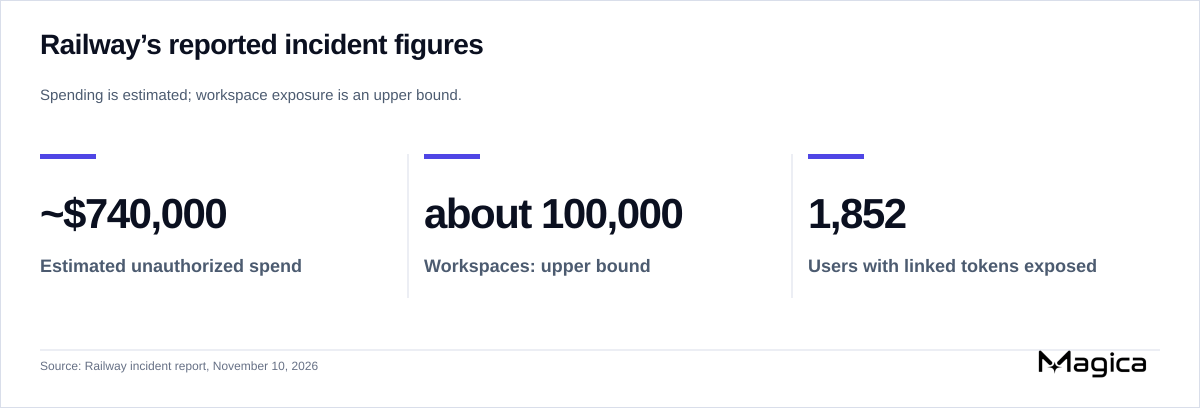
Company-reported figures from Railway’s incident report. Workspace exposure is an upper bound, not a confirmed count of workspaces whose secrets were stolen. Source: Railway Blog.
Railway says the attacker began creating dummy accounts and probing on October 18; those early attempts to exploit its systems failed. The first successful exploit came at 07:28 UTC on October 20, when a previously unknown vulnerability let the attacker partially escape filesystem isolation in its build infrastructure. At the time, multiple isolated builds could run on the same virtual machine.
The escape exposed an internal build credential. It was intended for work such as uploading completed build images, but Railway's self-hosted Temporal task system also accepted it as a trusted client. That allowed the attacker to read stored build histories containing variables, secrets and repository-access information.
One history belonged to Railway's own support platform. Access to a repository snapshot let the attacker retrieve Railway's internal source code, which the company says enabled rapid searches for further routes into its systems. Railway says it found no indication that customer repositories or snapshots were downloaded. It describes the intruder using AI agents to search for and exploit further weaknesses while engineers worked to close routes of access; that account of the attacker's tooling comes from Railway.
An alert about unusual registry API calls reached an on-call engineer at 13:58 UTC on October 20. Railway patched the isolation flaw, paused builds, and revoked the compromised build credential that evening. But the source-code access gave the attacker another path.
At 03:26 UTC on October 21, an incorrectly configured OpenID Connect trust relationship let the attacker obtain a short-lived cloud credential. From there, the attacker retrieved other internal credentials and connected to an orchestration machine that could reach the database holding encrypted environment variables. That machine also held a credential permitting decryption through Railway's key-management service.
Railway says variables were protected by separate encryption keys for each environment, themselves encrypted under a root key that could not leave the upstream cloud provider's key-management service. The attacker did not need to extract that root key: access to the decryption service was enough. The failure therefore spanned both secret storage and the authority to unlock it.
Environment variables supply application configuration, including secrets that authorize access to other services. Their theft can therefore expose accounts beyond the hosting platform.
Railway's forensic assessment puts the maximum number of workspaces whose variables could have been decrypted at 1.85%, or about 100,000. Its logs identify environments rather than individual variables, so the figure is an upper bound, not a confirmed count of workspaces whose secrets were stolen. The company’s assessment, also described in coverage of the disclosure, does not establish how many people or companies were affected.
The company says decryption began at 04:42 UTC on October 21, earlier than it initially understood. Its detailed timeline records two periods of decryption activity that morning and says it disabled the credential at 07:14 UTC. Railway says the attacker was fully evicted that morning and had no further customer-data access by 09:25 UTC.
There were additional, separately measured exposures. The attacker read histories from 353 builds, including sealed variables, on October 20. Decrypted data also included linked-account tokens for 1,852 users, covering GitHub OAuth tokens and customer-supplied AI agent keys. Railway says it reset all those tokens, notified the users and found no Railway account logins using credentials taken in the incident.
The attacker searched variable names for AI provider keys, prioritized customers with large numbers of variables, and also ran a query matching cloud, database and payment credentials, Railway says. The company says its forensics did not indicate access to customer databases. That finding limits the demonstrated damage; it does not negate the theft of credentials capable of authorizing activity elsewhere.
Railway believes AI credentials were the main target and may have been passed to services that relay or resell access for model distillation. It says customer-supplied logs showed unauthorized workloads ranging from coding agents to AI training pipelines, including reviews of agent behavior for training data and checks of training tasks.
Those observations do not establish a single operator or purpose. Railway explicitly says it has not determined whether the original intruder operated the relay services or supplied credentials to others. Railway also points to similar theft disclosures by OpenCode, Warp and Fireworks AI between October 6 and 23. Its reference to cloud-security company Wiz's broader research supplies context, rather than independent attribution of this attack.
The underlying financial mechanism predates this incident. Cloud-security company Sysdig's October 2024 threat-report announcement described an attack using stolen access to large language models that left one victim with $30,000 in charges in three hours. That single case is a precedent for rapid billing damage, not a comparable rate for Railway's aggregate estimate, which has no disclosed spending window or per-customer breakdown.
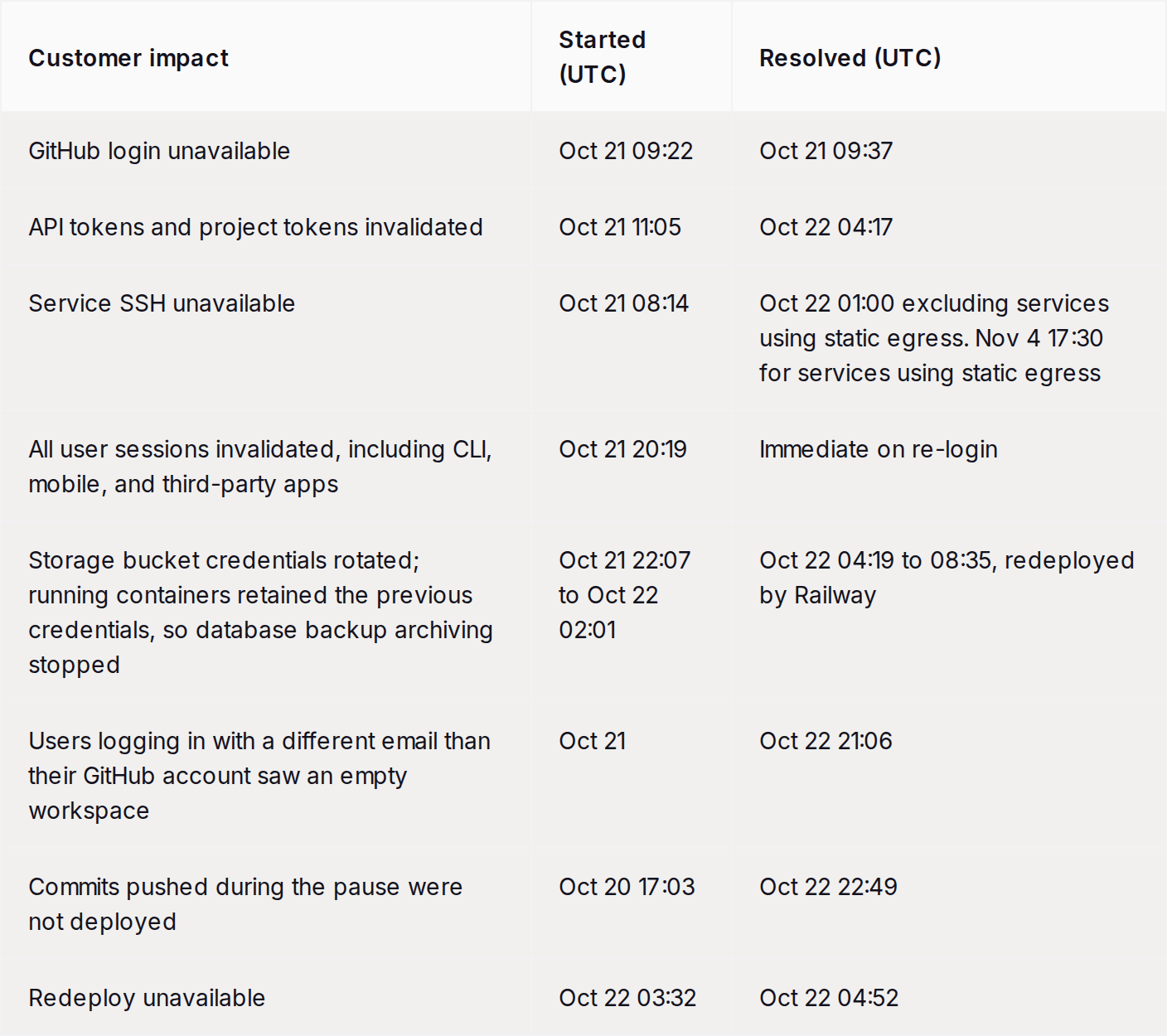
Railway’s company-reported recovery disruptions. SSH access for services using static egress was restored on November 4. Source: Railway Blog.
Railway says it contacted downstream providers before broadly notifying users because it could not yet guarantee that replacement secrets stored on the platform would remain protected. Starting on October 21, it supplied providers with hashes of potentially exposed keys for revocation. Its initial public disclosure followed on October 22.
The recovery exposed a practical conflict: customers needed to rotate secrets, but some could not redeploy applications with replacements while builds were paused. Railway says existing deployments continued running, while acknowledging that credential revocations caused some customers downtime. It also invalidated every user session on October 21, requiring users of its CLI, mobile app and third-party integrations to sign in again. Where possible, it suggested manual rotation through SSH.
Manual rotation had limits, too: Railway’s incident table records service SSH being unavailable from October 21 into October 22, with access for services using static egress restored only on November 4. Storage-credential rotation also temporarily stopped database backup archiving in running containers until Railway redeployed them.
The company had already been testing a builder that added a dedicated virtual machine for each build. It accelerated that rollout after its own engineers found another exploit derived from the original isolation flaw within an hour of patching it. The replacement used separate compute, storage and caching infrastructure, requiring Railway to provision machines rapidly while customers rushed to deploy replacement credentials. Builds returned in stages on October 22: Enterprise first, then Pro, Hobby, and finally Free and Trial by 22:49 UTC. Railway says the storage change increased bandwidth and load on its upstream storage provider by at least tenfold over baseline, causing some slow or failed builds in the following days; it says capacity has since been expanded. New signups remained paused until November 2.
Railway says each build now receives its own ephemeral virtual machine and a credential restricted to pushing one specific image. It has rebuilt internal tooling, tightened access to its deployment pipeline and restricted decryption authority to its secrets service, with calling services limited to the credentials they need. It also plans a definite deadline for broad incident notification after assessing impact.
Railway says it is coordinating refunds with AI providers and will cover token losses where providers will not. According to its report, AWS Bedrock and Google Gemini had begun refunds under existing fraud policies; OpenAI and SpaceXSI were reviewing claims individually. Railway said it would cover Anthropic costs while discussions continued and OpenRouter costs after that provider maintained its no-refund policy.
As a summary of Railway’s findings notes, the unauthorized use occurred outside Railway. Ending access to its own systems therefore did not by itself settle the downstream bills. Customers are being asked to report unauthorized charges. The roughly $740,000 remains Railway's estimate, rather than a published final accounting of validated claims, refunds or its own reimbursements.
The company says it filed a complaint with the FBI's Internet Crime Complaint Center and is engaging a specialist forensics firm whose investigation remains ongoing. The unresolved questions are how many workspaces actually lost usable secrets, who distributed and consumed the stolen access, and how the eventual financial losses will be divided among Railway and the providers.
Alibaba’s Qwen4-Max preview gives developers a fixed model to test through November 25. API access requires Token Plan, while claimed coding gains remain unquantified in the launch materials.
Anthropic expects retail investors worldwide to receive up to 20% of its IPO, potentially $12.9 billion at the proposed upper price. Access through six brokerage channels depends on demand and broker rules, while a separate technology-company investment would help finance vast infrastructure commitments and founders and a special trust retain control.
Anthropic's seven founders plan equal IPO share sales worth about $250 million each at the proposed midpoint. Their sales make up 2.9% of the public offering, while the company seeks much larger financing under a structure that limits public investors' voting influence.
Nvidia’s independent directors retained Wachtell Lipton partner Joon H. Kim for an investigation into reports of a foreign intelligence effort targeting co-founder and CEO Jensen Huang. The board previously expressed confidence in Huang; the appointment provides no findings or timetable.
RRE Ventures led the funding for Graphon’s enterprise memory infrastructure. The startup is pitching connected, persistent context across different agents, but benchmark gains leave deployment costs and commercial scale unresolved.
Goldman Sachs, a lead bank on Anthropic’s IPO, reportedly forecasts $685 billion in annual revenue by 2030. The Claude developer has substantial cash reserves and rapidly growing sales, but rising compute costs, competitive pricing and delivery risks complicate the enterprise growth case.
Memories Upload pays contributors for accepted first-person video and sells annotated data to robotics developers. Its million-hour collection claim leaves open how much footage improves robot performance, while contributors surrender ownership without royalties.
OpenAI has acquired AI travel concierge Odessia and is bringing its founder, former Sonder chief Francis Davidson, into its travel effort. The standalone service has closed, leaving its future role alongside ChatGPT’s existing travel partners unclear.
Anthropic says expected advances from future models have triggered its research-acceleration threshold. An outside assessment finds faster progress but does not certify compliance with that threshold, while the voluntary policy leaves consequential decisions about safeguards and continued development with the company.
OpenAI’s free business-profile beta adds branded agents for eligible U.S. ecommerce and online service firms. The agents can also serve as paid-ad destinations, while OpenAI controls distribution and businesses bear responsibility for outputs.
Teleport has made Beams generally available with task-specific infrastructure permissions and a kill switch. Its access-security platform supplies an enterprise foothold, but established competitors and custom pricing for key controls complicate the buying decision.
New York will connect more than 80 researchers with Empire AI computing resources to evaluate advanced AI systems and advise state oversight, expanding a center first announced in January.
Anthropic’s amended IPO filing raises its Microsoft spending commitment while disclosing an exit right from a $34.9 billion Lambda agreement. Google’s larger commitment was already disclosed earlier, and expensive short-term computing continues to squeeze margins.
The cash deal would bring Oura’s existing AI and physician care partner under its ownership. The $159 annual integration already connects members to doctors, but geographic limits, extra service costs and unproven clinical benefits qualify the expansion.
Reddit is testing AI-organized review pages for roughly 10,000 products. The pages link back to users’ conversations, but lack purchase verification—a safeguard Amazon says it uses for its own AI review highlights.
The renamed MegaETH Foundation is funding its own products after an earlier shift away from its accelerator. Its December inference market must show how it improves on existing services that already route requests by price and reliability.
Cambridge startup Tendrils Compute has raised a Benchmark-led seed round to build processors based on interaction nets. Its backers see an opening in branching workloads, including AI agents, but theoretical parallelism has yet to establish a commercial hardware advantage.
Google and Artificial Analysis launched a 200-task test of AI agents working with visually dense professional files. Google's study finds close leading scores and sharply different API bills, as its new Carbon model reaches customers alongside the Argon alternative.
Google is widening paid access to Gemini 4 Carbon for complex coding, business and scientific work. Gemini API token rates double after November 30, while benchmark results show that its cost advantage depends on the task and reasoning setting.
MiniMax has released downloadable weights for H3-Image, a model combining image generation and editing at native 16-megapixel resolution. Local deployment offers an alternative to its paid API, but hardware demands and a restrictive community license qualify the promise of open access.